What Is the Wave Theory of Light and Its Importance?
TL;DR
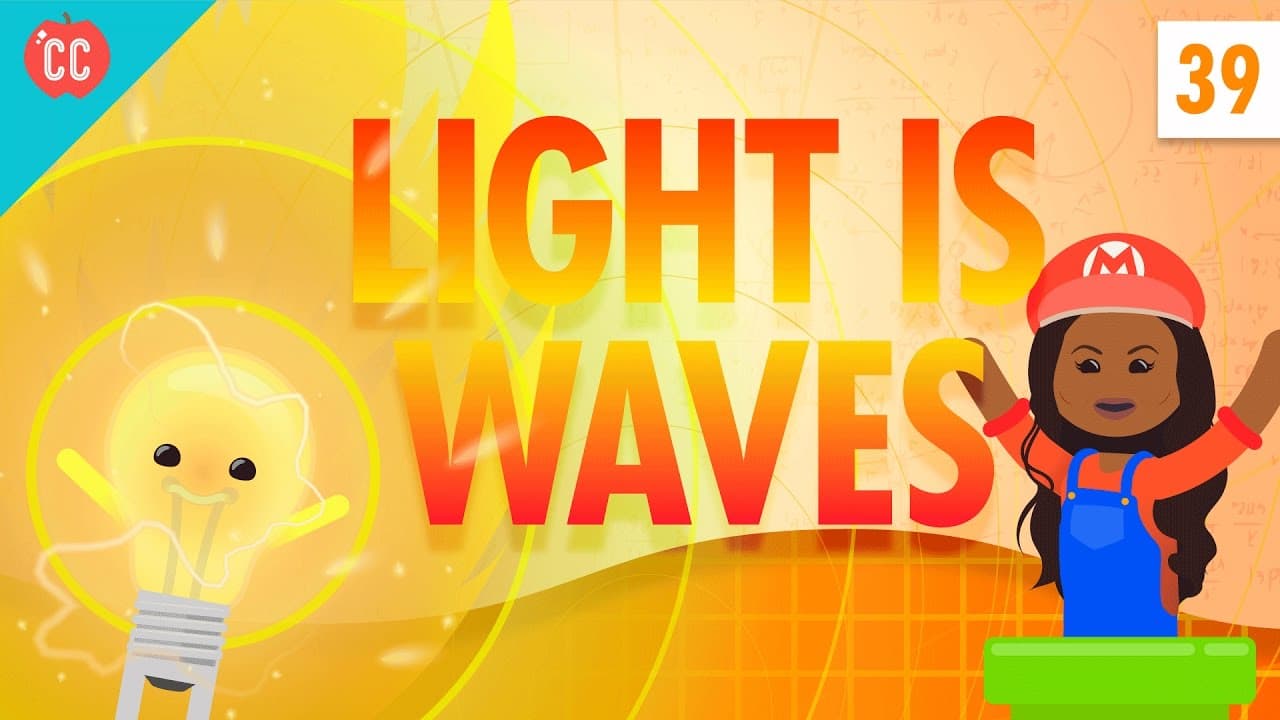
The wave theory of light posits that light exhibits both wave and particle properties. Key principles like Huygens' Principle explain phenomena such as diffraction and interference, which lead to patterns like those seen in the double-slit experiment. This theory is crucial for understanding light's behavior, including its intensity, wavelength, and the presence of bright spots in shadows.
Transcript
Here's a question for you: If you shine a light on a coin that’s hanging in mid-air, what do you think its shadow will look like? Do you think its shadow would have a bright spot of light right in the middle of it? Because it would! It might seem counterintuitive, and 19th-century physicists thought so too, when they tried this experiment. But that... Read More
Key Insights
- Light demonstrates both wave and particle properties, a concept pivotal in understanding its behavior in various experiments.
- Huygens' Principle is fundamental in predicting wave behavior by treating each point on a wave as a source of smaller wavelets.
- Diffraction occurs when waves bend around obstacles, a phenomenon not observed with particles, explaining unique light patterns.
- Interference, both constructive and destructive, plays a crucial role in the formation of light patterns, such as those seen in the double-slit experiment.
- The double-slit experiment by Thomas Young revealed light's wave nature through the creation of diffraction patterns.
- Light's intensity is related to its amplitude, with higher amplitudes resulting in increased brightness, illustrating wave properties.
- Frequency and wavelength determine light's visibility and color, with shorter wavelengths appearing blue and longer wavelengths red.
- Diffraction and interference explain the bright spot in a coin's shadow, as waves diffract around edges and interfere constructively.
Install to Summarize YouTube Videos and Get Transcripts
Explore YouTube Video Summarizer or Get YouTube Transcript Extractor
Questions & Answers
Q: What is the significance of Huygens' Principle in understanding light?
Huygens' Principle is significant because it provides a method to predict how a wave will spread out over time. By treating each point on a wave as a source of smaller wavelets, it helps explain how light behaves when encountering obstacles, leading to phenomena like diffraction and interference, which are key to understanding light's wave nature.
Q: How does diffraction demonstrate the wave nature of light?
Diffraction demonstrates the wave nature of light by showing how light waves bend around obstacles, a behavior not seen in particles. When light passes through slits or around edges, it spreads out and creates patterns that result from the interference of diffracted waves, confirming that light behaves as a wave.
Q: What does the double-slit experiment reveal about light?
The double-slit experiment reveals that light behaves as a wave. When light passes through two closely spaced slits, it creates an interference pattern of bright and dark lines on a screen, which is characteristic of wave behavior. This pattern wouldn't occur if light were only particles, thus demonstrating its wave properties.
Q: How do intensity and amplitude relate in the context of light waves?
In the context of light waves, intensity is proportional to the amplitude squared. This means that if the amplitude of a light wave is doubled, its intensity, or brightness, increases by a factor of four. This relationship highlights the wave nature of light, as amplitude affects the energy transported by the wave.
Q: Why is there a bright spot in the middle of a coin's shadow?
The bright spot in the middle of a coin's shadow is due to diffraction and constructive interference. Light waves diffract around the edges of the coin, and at the center, these waves travel the same distance, causing their crests and troughs to align. This results in constructive interference, creating a bright spot.
Q: What role does frequency play in determining light's properties?
Frequency plays a crucial role in determining light's properties, specifically its color and visibility. Light with higher frequency has shorter wavelengths and appears blue, while lower frequency light has longer wavelengths and appears red. This relationship helps categorize light within the electromagnetic spectrum.
Q: How does interference affect light patterns in experiments?
Interference affects light patterns by determining where waves will reinforce or cancel each other. Constructive interference occurs when wave crests align, creating bright spots, while destructive interference occurs when crests and troughs align, creating dark spots. This is essential in experiments like the double-slit, where interference patterns reveal light's wave nature.
Q: What does the path difference mean in the context of light waves?
In the context of light waves, the path difference refers to the difference in distance traveled by two waves meeting at a point. It determines whether the waves will interfere constructively or destructively. Constructive interference occurs when the path difference is a multiple of the wavelength, while destructive interference occurs at half-wavelength multiples.
Summary & Key Takeaways
-
The video discusses the dual nature of light, highlighting its wave properties through various experiments and principles like Huygens' Principle. It explains how light behaves differently from particles, particularly in terms of diffraction and interference, leading to unique light patterns.
-
Huygens' Principle is crucial in predicting wave behavior, treating each point on a wave as a source of smaller wavelets. This principle helps explain phenomena like diffraction, where waves bend around obstacles, and interference, which can be constructive or destructive.
-
The double-slit experiment by Thomas Young demonstrated light's wave nature, showing diffraction patterns that wouldn't occur if light were only particles. Light's intensity and color are determined by its amplitude and wavelength, further illustrating its wave properties.
Read in Other Languages (beta)
Share This Summary 📚
Summarize YouTube Videos and Get Video Transcripts with 1-Click
Try YouTube Summary with ChatGPT & Claude or YouTube Transcript Generator
Explore More Summaries from CrashCourse 📚


Summarize YouTube Videos and Get Video Transcripts with 1-Click
Try YouTube Summary with ChatGPT & Claude or YouTube Transcript Generator