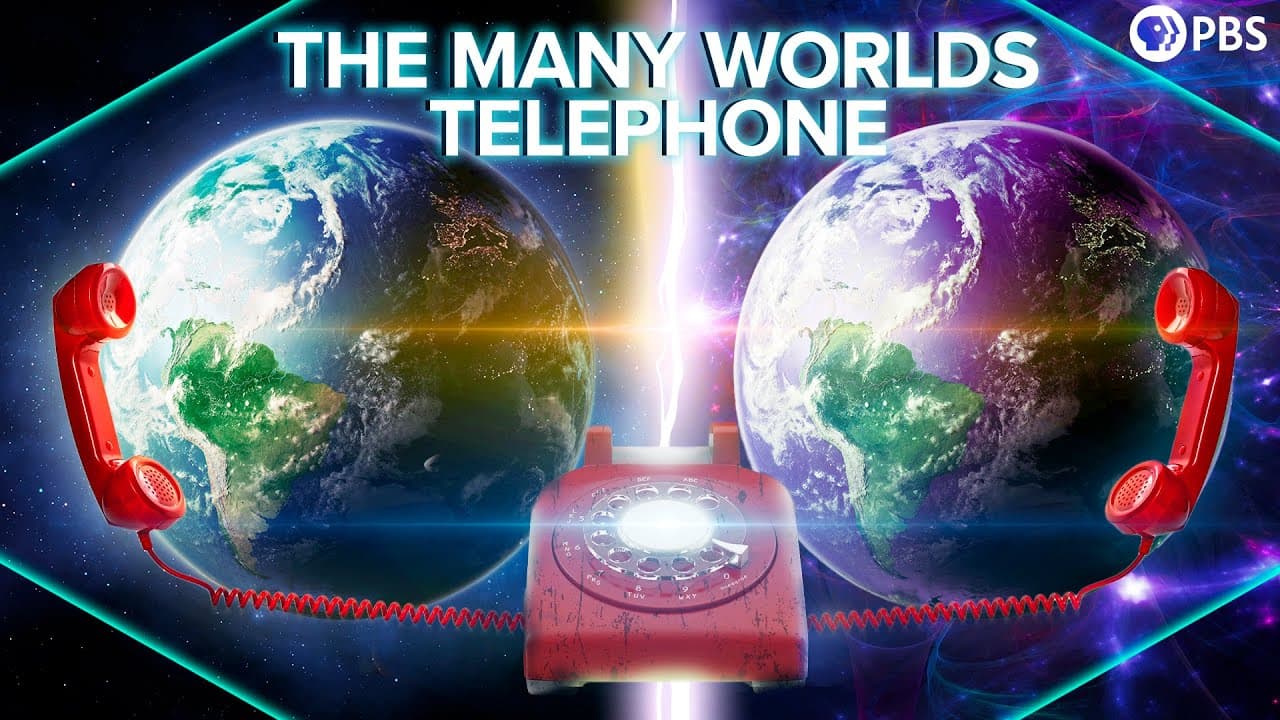
How to Communicate Across the Quantum Multiverse
TL;DR
Exploring communication possibilities between quantum worlds via non-linear mechanics.
Transcript
Oh Hello There. I’m Matt from a different quantum timeline. I figured out the secret truth behind quantum mechanics and I’m sending it to Matt in your timeline so he can tell you. Stand by. Listen to the world around you for a moment… What do you hear? My voice, obviously. No doubt a sublime subjective experience - but only subjective. Outside your... Read More
Key Insights
- The Many Worlds interpretation suggests a universal wavefunction representing all possible histories and futures, where each world is a separate 'ripple.'
- The superposition principle allows independent evolution of overlapping systems, analogous to sound waves, which helps understand quantum mechanics.
- Current interpretations of quantum mechanics, like Many Worlds, Copenhagen, and de Broglie-Bohm, are all consistent with the Schrodinger equation.
- Non-linear modifications to the Schrodinger equation could allow communication between quantum worlds, offering potential science fiction-like capabilities.
- Steven Weinberg proposed that non-linear observables could exist, leading to new ways to explore quantum wavefunctions post-measurement.
- Joseph Polchinski demonstrated that non-linear Schrodinger equations could enable faster-than-light communication and interactions across quantum timelines.
- The Everett-Wheeler telephone concept suggests a method to transmit information between quantum worlds, though it remains theoretical.
- Despite theoretical possibilities, practical communication between quantum worlds is limited to those created by the communication process itself.
Install to Summarize YouTube Videos and Get Transcripts
Explore YouTube Video Summarizer or Get YouTube Transcript Extractor
Questions & Answers
Q: What is the Many Worlds interpretation in quantum mechanics?
The Many Worlds interpretation of quantum mechanics suggests that the universal wavefunction represents all possible histories and futures, where each world is a separate 'ripple' within this wavefunction. According to this view, every quantum event results in a branching of worlds, each representing different outcomes. This interpretation maintains that all possible outcomes of quantum measurements are realized in some 'world' or universe, allowing for a reality where all possibilities exist concurrently.
Q: How does the superposition principle relate to quantum mechanics?
The superposition principle in quantum mechanics states that a quantum system can exist in multiple states or configurations simultaneously. This principle allows for the independent evolution of overlapping quantum systems, much like overlapping sound waves. In quantum mechanics, it means that the wavefunction, which describes the quantum state, can be a combination of multiple possible states. This principle is fundamental to understanding phenomena such as quantum interference and entanglement, where the properties of particles are correlated across distances.
Q: What role does the Schrodinger equation play in quantum mechanics interpretations?
The Schrodinger equation is central to quantum mechanics, describing how the wavefunction of a quantum system evolves over time. All prominent interpretations of quantum mechanics, including Many Worlds, Copenhagen, and de Broglie-Bohm, are consistent with the Schrodinger equation. This consistency makes it challenging to distinguish between interpretations based on measurements alone. The equation's linearity ensures that wavefunctions can be superposed, leading to the complex quantum behaviors observed in experiments.
Q: What are the implications of non-linear modifications to the Schrodinger equation?
Non-linear modifications to the Schrodinger equation could have profound implications for quantum mechanics, potentially allowing communication between quantum worlds and faster-than-light interactions. Such modifications would introduce non-linear observables, which could provide new ways to explore the wavefunction post-measurement. These changes challenge the assumption of perfect linearity in quantum mechanics and open up possibilities for science fiction-like capabilities, such as instant communication across distances and timelines.
Q: What did Steven Weinberg propose regarding quantum mechanics?
Steven Weinberg proposed that non-linear observables could exist within the wavefunction, suggesting that even tiny deviations from linearity in the Schrodinger equation might allow for new explorations of quantum wavefunctions post-measurement. His insights imply that these non-linearities could differentiate between quantum mechanics interpretations and potentially enable phenomena like faster-than-light communication and interactions across quantum timelines. Weinberg's work highlights the potential for undiscovered aspects of quantum mechanics.
Q: How did Joseph Polchinski contribute to the understanding of quantum mechanics?
Joseph Polchinski contributed significantly by demonstrating that non-linear modifications to the Schrodinger equation could enable faster-than-light communication and interactions across quantum timelines. He mathematically showed that any deviation from perfect linearity could allow information transfer between entangled particles, which is otherwise prevented by the universe's inherent constraints. Polchinski's work also introduced the concept of the Everett-Wheeler telephone, a theoretical method for communicating between quantum worlds.
Q: What is the Everett-Wheeler telephone concept?
The Everett-Wheeler telephone is a theoretical concept proposed by Joseph Polchinski that suggests a method to transmit information between quantum worlds. The idea involves using a Stern-Gerlach device to manipulate the spin of particles and a non-linear field to spread local information across the wavefunction. Although the concept serves as a proof of principle, it highlights the potential for actions in one quantum world to influence others. However, practical communication is limited to worlds created by the communication process itself.
Q: What are the limitations of communicating between quantum worlds?
Despite theoretical possibilities, practical communication between quantum worlds is limited to those created by the communication process itself. This means that while it may be possible to influence or send information to parallel worlds, these worlds must be generated by the same quantum event or action facilitating the communication. Thus, reaching worlds where different life decisions were made remains out of reach, as they are not directly connected to the communication process. This limitation underscores the challenges in realizing inter-world communication.
Summary & Key Takeaways
-
The Many Worlds interpretation of quantum mechanics posits a universal wavefunction encompassing all possible realities, with each world being a separate 'ripple.' The superposition principle allows these worlds to evolve independently, akin to overlapping sound waves, making it challenging to test the hypothesis.
-
Non-linear modifications to the Schrodinger equation could allow communication between quantum worlds, offering potential science fiction-like capabilities. Steven Weinberg and Joseph Polchinski proposed theories suggesting that even tiny deviations from linearity could enable faster-than-light communication and interactions across quantum timelines.
-
The Everett-Wheeler telephone concept suggests a theoretical method to transmit information between quantum worlds. However, practical communication between these worlds is limited to those created by the communication process itself, leaving many theoretical possibilities yet to be explored or realized.
Read in Other Languages (beta)
Share This Summary 📚
Summarize YouTube Videos and Get Video Transcripts with 1-Click
Try YouTube Summary with ChatGPT & Claude or YouTube Transcript Generator
Explore More Summaries from PBS Space Time 📚
Summarize YouTube Videos and Get Video Transcripts with 1-Click
Try YouTube Summary with ChatGPT & Claude or YouTube Transcript Generator