Does the Universe Create Itself?
TL;DR
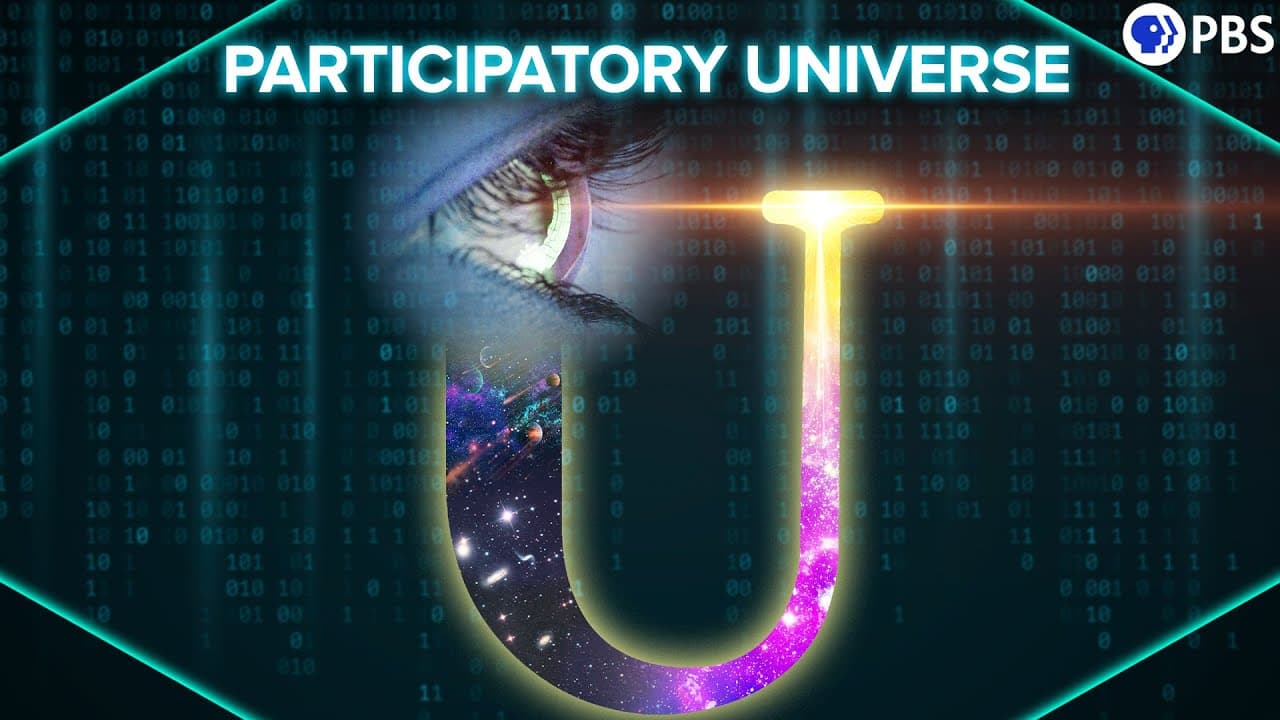
The universe may be self-generated through observer interactions.
Transcript
Imagine you’re leading a game of 20 questions but halfway through you forgot the thing you chose You have to keep answering yesses and nos and hope that you think of something that’s consistent with all your previous questions before the game is done. Well it could be that’s what the entire universe is doing as it creates our reality. I hope it thi... Read More
Key Insights
- The universe might be like a game of 20 questions, where reality forms based on interactions and observations, suggesting a participatory universe.
- Quantum mechanics challenges the realist view of the universe, suggesting reality is defined through observation, as highlighted by the Copenhagen interpretation.
- Schrodinger’s cat thought experiment illustrates the absurdity of superposition, where objects exist in multiple states until observed.
- John Wheeler proposed the 'it from bit' concept, suggesting the universe is fundamentally informational, existing through binary choices and interactions.
- Wheeler's delayed-choice experiment shows reality depends on measurements, even if choices are made after superpositions form.
- Entangled particles demonstrate that measurement choices can instantaneously influence distant particles, indicating the universe's dependence on observation.
- Wheeler’s 'participatory universe' suggests reality emerges through a self-excited circuit of observer-observed interactions.
- Participatory realism theories like quantum bayesianism propose that the universe emerges from informational interactions, maintaining some realism.
Install to Summarize YouTube Videos and Get Transcripts
Explore YouTube Video Summarizer or Get YouTube Transcript Extractor
Questions & Answers
Q: What is the participatory universe theory?
The participatory universe theory, proposed by John Wheeler, suggests that reality is not a pre-existing entity but is shaped by the interactions and observations of its observers. This concept challenges the traditional realist view, positing that the universe exists in a state of superposition until measured, and that the observer plays a fundamental role in bringing reality into existence.
Q: How does Wheeler's delayed-choice experiment work?
Wheeler's delayed-choice experiment is an extension of the double-slit experiment, demonstrating that the act of measurement determines the state of a quantum system. In this experiment, a photon passes through a beam splitter, and a second splitter is added after the photon has already traveled, affecting its path. This shows that the universe's state depends on the observer's measurements, even if choices are made after the superposition forms.
Q: What is the 'it from bit' concept?
The 'it from bit' concept, coined by John Wheeler, suggests that every element of the universe, from particles to spacetime itself, derives its existence from binary choices or bits. This view posits that the universe is fundamentally informational, with reality emerging from the answers to yes or no questions, highlighting the role of observation and interaction in defining existence.
Q: What role does observation play in quantum mechanics?
In quantum mechanics, observation plays a crucial role in defining reality. The act of measurement influences the state of a quantum system, as seen in phenomena like superposition and entanglement. The Copenhagen interpretation, led by Niels Bohr, suggests that a phenomenon only becomes real when observed, challenging the notion of an independent, objective reality.
Q: How does the participatory universe relate to the anthropic principle?
The participatory universe is related to the Strong Anthropic Principle, which posits that the universe is structured in such a way that it allows for the existence of observers. In this view, reality is shaped by the questions asked by observers, suggesting that the universe is self-generated by its interactions, and only a reality that supports observers can exist.
Q: What is the significance of Schrodinger’s cat experiment?
Schrodinger’s cat experiment is a thought experiment that illustrates the paradox of superposition in quantum mechanics. It presents a scenario where a cat in a box is simultaneously alive and dead until observed, highlighting the absurdity of the Copenhagen interpretation and the role of observation in defining reality. This experiment underscores the challenges of reconciling quantum mechanics with classical realism.
Q: How does entanglement challenge classical physics?
Entanglement challenges classical physics by demonstrating that particles can be instantaneously connected, regardless of distance. When the spin of one entangled particle is measured, it influences the state of its partner, even if separated by vast distances. This phenomenon defies classical notions of locality and causality, suggesting that reality is interconnected and observer-dependent.
Q: What are participatory realism theories?
Participatory realism theories, such as quantum bayesianism and relational quantum mechanics, propose that the universe emerges from the information exchanged between entities. These theories maintain the importance of the observer in defining the observed, while acknowledging a substrate of reality. They offer a framework where the universe is informational, balancing the observer's role with a form of realism.
Summary & Key Takeaways
-
The video explores the concept of a participatory universe, where reality is shaped by the interactions and observations of its observers. This idea challenges the traditional realist view, suggesting that the universe exists in a state of superposition until measured.
-
John Wheeler's 'it from bit' theory posits that the universe is fundamentally informational, with reality emerging from binary choices and interactions. His delayed-choice experiment supports this, showing that the universe's state depends on the observer's measurements.
-
Participatory realism theories, like quantum bayesianism, propose that the universe emerges from the information exchanged between entities, maintaining a balance between the observer's role and a substrate of reality.
Read in Other Languages (beta)
Share This Summary 📚
Summarize YouTube Videos and Get Video Transcripts with 1-Click
Try YouTube Summary with ChatGPT & Claude or YouTube Transcript Generator
Explore More Summaries from PBS Space Time 📚
Summarize YouTube Videos and Get Video Transcripts with 1-Click
Try YouTube Summary with ChatGPT & Claude or YouTube Transcript Generator