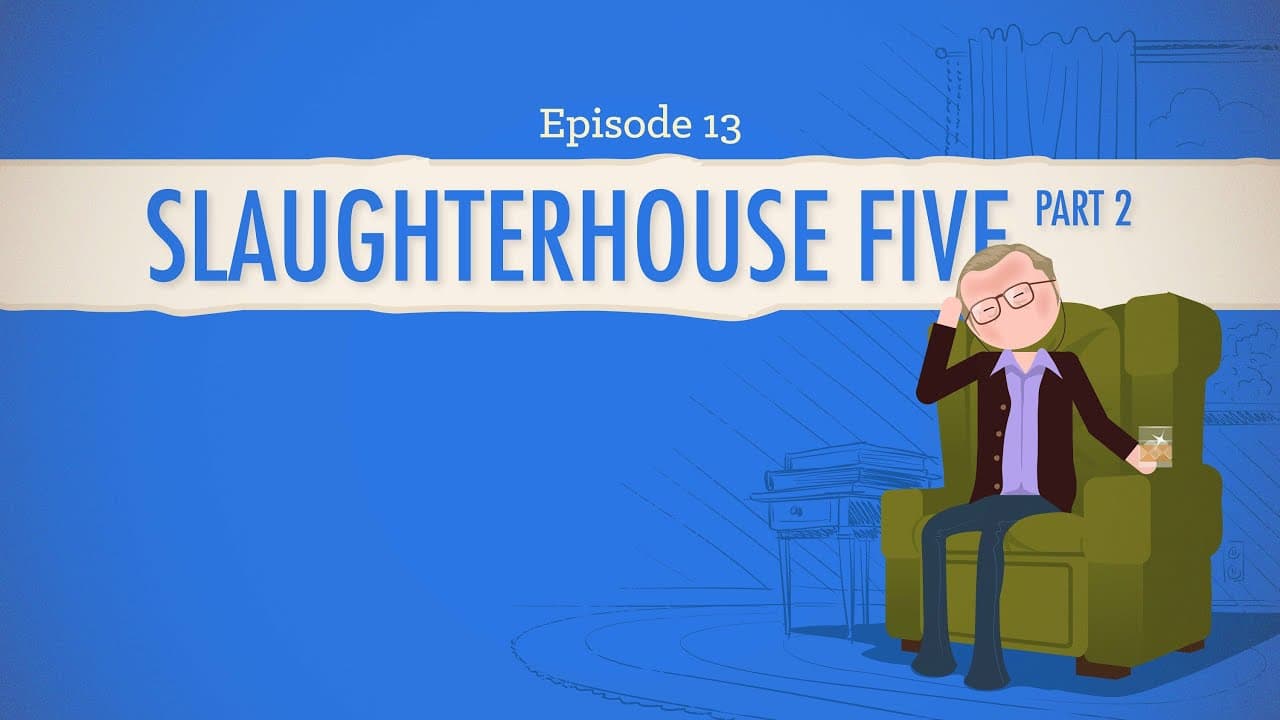
PTSD and Alien Abduction - Slaughterhouse-Five Part 2: Crash Course Literature 213
TL;DR
Explores Slaughterhouse-Five's anti-war themes and Billy Pilgrim's PTSD.
Transcript
Hi, I’m John Green, this is Crash Course Literature, and today we’re going to continue our discussion of Kurt Vonnegut’s Slaughterhouse Five. So, Slaughterhouse Five is often called an anti-war novel. But that raises a question: What does it mean for a novel to be against war? Are novels in the business of passing judgment? Can they actually change... Read More
Key Insights
- Slaughterhouse-Five is often seen as an anti-war novel, questioning the role of literature in judging and changing the world.
- Billy Pilgrim, the protagonist, struggles with PTSD from WWII, manifesting in hallucinations and flashbacks.
- Pilgrim's alien abduction fantasies parallel his wartime experiences, offering a way to cope with trauma.
- The Tralfamadorians' view of time denies free will, reflecting Pilgrim's desire to absolve himself of moral responsibility.
- Vonnegut's narrative structure mimics Tralfamadorian literature, with non-linear storytelling and brief, impactful scenes.
- The novel's use of 'so it goes' after deaths highlights a brutally unsentimental approach to mortality.
- Vonnegut aims to shock readers out of passivity regarding mass violence and its acceptance in human life.
- Slaughterhouse-Five blends humor and absurdity to make mass murder and trauma feel real and immediate.
Install to Summarize YouTube Videos and Get Transcripts
Explore YouTube Video Summarizer or Get YouTube Transcript Extractor
Questions & Answers
Q: How does Slaughterhouse-Five function as an anti-war novel?
Slaughterhouse-Five functions as an anti-war novel by highlighting the absurdity and brutality of war through its protagonist, Billy Pilgrim. Vonnegut uses Pilgrim's experiences and hallucinations to critique the acceptance of mass violence and challenge readers to confront these realities. The novel's non-linear structure and unsentimental tone further emphasize its anti-war message.
Q: What role do the Tralfamadorians play in Billy Pilgrim's coping mechanism?
The Tralfamadorians serve as a coping mechanism for Billy Pilgrim by allowing him to reinterpret his traumatic wartime experiences. Their view of time as non-linear helps Pilgrim detach from the guilt and horror he feels. By imagining himself as a 'splendid specimen' in their zoo, he rewrites his emasculating POW experiences, providing a sense of control and recovery.
Q: Why is free will a significant theme in Slaughterhouse-Five?
Free will is significant in Slaughterhouse-Five because it ties into moral responsibility and Pilgrim's guilt. The Tralfamadorian perspective denies free will, allowing Pilgrim to absolve himself of responsibility for surviving and benefiting from the war. This theme reflects the broader human struggle with guilt and accountability in the face of mass violence.
Q: How does Vonnegut's narrative style mimic Tralfamadorian literature?
Vonnegut's narrative style mimics Tralfamadorian literature by presenting events non-linearly, creating a sense of simultaneity. This approach allows readers to experience the story as a series of urgent, impactful scenes without a traditional beginning, middle, or end. The structure challenges conventional storytelling and reflects the novel's themes of time and reality.
Q: What is the significance of the phrase 'so it goes' in the novel?
The phrase 'so it goes' signifies the novel's unsentimental approach to death and tragedy. Repeated after each mention of death, it underscores the inevitability and frequency of mortality in human life. This repetition highlights the desensitization to violence and death, urging readers to confront and question the acceptance of such events as a normal part of life.
Q: How does Slaughterhouse-Five address the theme of human distraction?
Slaughterhouse-Five addresses human distraction by illustrating how individuals and society often avert their gaze from violence and trauma. Vonnegut critiques this tendency through Pilgrim's time-traveling escapism and the novel's absurd humor. By juxtaposing fantasy with harsh realities, the novel exposes the dangers of distraction and the passive acceptance of intolerable events.
Q: What is the relationship between Billy Pilgrim's PTSD and his alien abduction fantasies?
Billy Pilgrim's PTSD is intricately linked to his alien abduction fantasies, which serve as a mental escape from his traumatic war experiences. The fantasies allow Pilgrim to process and reinterpret his memories, offering a sense of control and understanding. The parallels between his real and imagined experiences highlight the coping mechanisms used to navigate trauma.
Q: In what ways does Slaughterhouse-Five challenge traditional narrative structures?
Slaughterhouse-Five challenges traditional narrative structures through its non-linear storytelling and blending of reality with fantasy. By presenting events out of chronological order and incorporating elements of science fiction, Vonnegut disrupts conventional plot development. This approach reflects the novel's themes of time, trauma, and the complexity of human experience, inviting readers to engage with the story in a new way.
Summary & Key Takeaways
-
John Green discusses Slaughterhouse-Five as an anti-war novel, exploring its themes through Billy Pilgrim's PTSD and alien abduction fantasies. The narrative questions free will and moral responsibility, reflecting on human violence and distraction.
-
Vonnegut's use of Tralfamadorian literature style presents events non-linearly, challenging traditional storytelling. The novel's repetition of 'so it goes' underscores its unsentimental view of death while urging readers to confront human violence.
-
The novel's structure and themes reveal Vonnegut's critique of war and human nature. By blending reality with fantasy, Slaughterhouse-Five exposes the absurdity of war and the human tendency to ignore its horrors.
Read in Other Languages (beta)
Share This Summary 📚
Summarize YouTube Videos and Get Video Transcripts with 1-Click
Try YouTube Summary with ChatGPT & Claude or YouTube Transcript Generator
Explore More Summaries from CrashCourse 📚



Summarize YouTube Videos and Get Video Transcripts with 1-Click
Try YouTube Summary with ChatGPT & Claude or YouTube Transcript Generator