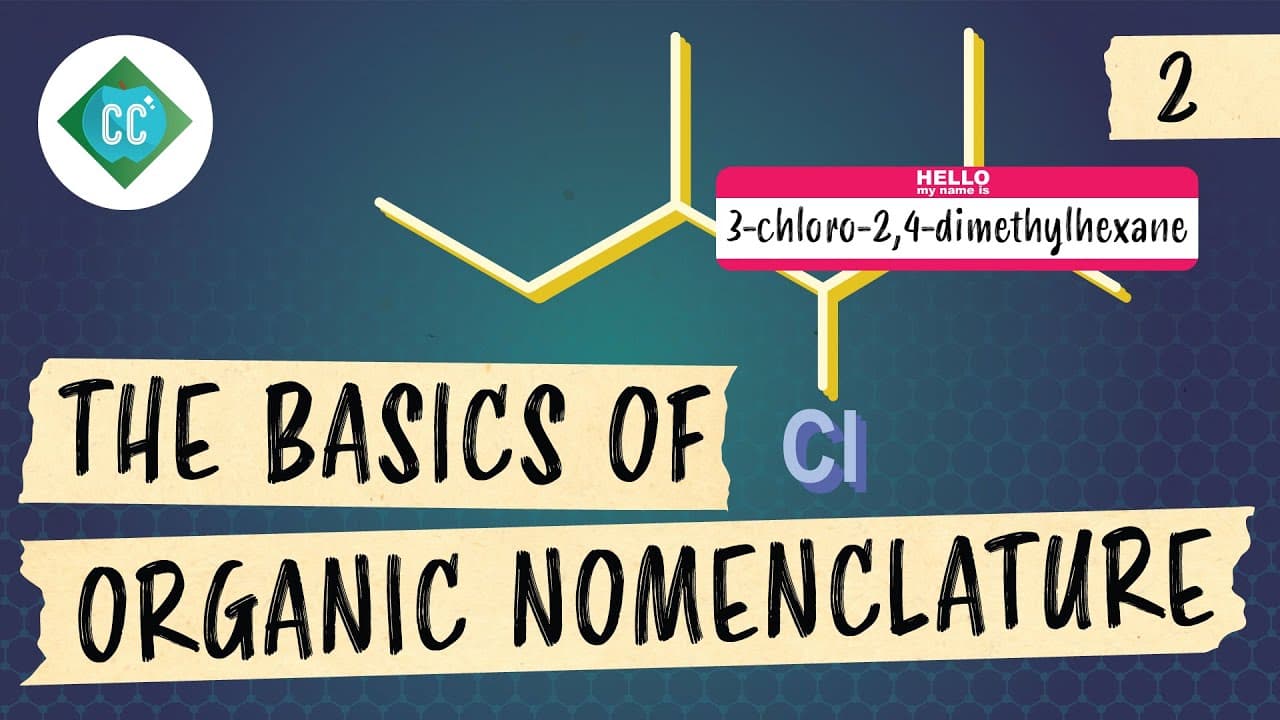
The Basics of Organic Nomenclature: Crash Course Organic Chemistry #2
TL;DR
Learn the standard rules for naming organic chemicals and how to systematically name molecules based on their structure and functional groups.
Transcript
You can review content from Crash Course Organic Chemistry with the Crash Course app available now for Android and iOS devices. Hi! I’m Deboki Chakravarti and welcome to Crash Course Organic Chemistry! Even when we speak the same language, we have different ways to say the same thing. Do you call a carbonated beverage a “pop,” “soda,” or just “Coke... Read More
Key Insights
- 🌍 Language plays a crucial role in chemistry lab communication, and IUPAC was established to ensure accurate communication among chemists globally.
- 🔎 Organic chemistry nomenclature has evolved over time, with common names given to chemicals based on their source or other characteristics.
- 🔬 IUPAC systematic naming rules provide a standardized way to name organic chemicals, using three basic steps: finding the longest carbon chain, identifying the functional group, and indicating the positions of substituents.
- 🧪 The root name of a compound is based on the longest carbon chain, with specific names for chains of up to four atoms and geometric shape names for longer chains.
- ⚡️ Alkanes are hydrocarbons with single bonds and are named by adding the suffix -ane to the root name of the chain.
- ⚛️ Alkenes and alkynes are hydrocarbons with double and triple bonds, respectively, and are named by numbering the carbons and adding the suffix -ene or -yne to the root name.
- 🔢 Substituents in organic molecules are indicated by adding prefixes before the root name, with numbering done to keep the substituents' positions as low as possible.
- 🔄 IUPAC rules for naming compounds with substituents prioritize functional group numbering over substituent numbering, and substituents are listed in alphabetical order, disregarding multipliers.
Install to Summarize YouTube Videos and Get Transcripts
Explore YouTube Video Summarizer or Get YouTube Transcript Extractor
Questions & Answers
Q: How does the IUPAC system of nomenclature help chemists communicate accurately?
The IUPAC system of nomenclature provides chemists with standard rules for naming organic chemicals, ensuring accurate communication across different regions and languages. By following these rules, chemists can easily convey the structure and functional groups of a molecule.
Q: What is the purpose of adding prefixes to the root name in systematic naming?
Adding prefixes to the root name in systematic naming allows chemists to indicate the presence and position of substituents on the carbon chain. These prefixes are numbered to ensure clarity and consistency when referring to different molecules.
Q: Why do common names for organic chemicals still persist despite the IUPAC rules?
Common names for organic chemicals are often easier to pronounce and remember than their systematic names, which can be long and complex. Additionally, common names may have historical or commercial significance that leads to their continued use in certain contexts.
Q: How does numbering the carbon chain in alkenes and alkynes differ from alkanes?
In alkenes and alkynes, the numbering of the carbon chain starts from the end closest to the double or triple bond, prioritizing these functional groups over substituents. This helps indicate the location of the functional groups within the molecule.
Q: What are some other functional groups besides alkane, alkene, and alkyne?
Some other functional groups include alcohols, aldehydes, ketones, carboxylic acids, esters, and amines. Each functional group has a specific suffix or prefix that is added to the root name in systematic naming to indicate its presence.
Summary & Key Takeaways
-
The International Union of Pure and Applied Chemistry (IUPAC) was established in 1919 to create standard rules for naming organic chemicals.
-
Common names given to organic chemicals based on their source or smell can be confusing and lack information about their structure.
-
IUPAC systematic naming involves three steps: finding the longest carbon chain, identifying the highest priority functional group, and adding numbered prefixes for substituents.
Read in Other Languages (beta)
Share This Summary 📚
Summarize YouTube Videos and Get Video Transcripts with 1-Click
Try YouTube Summary with ChatGPT & Claude or YouTube Transcript Generator
Explore More Summaries from CrashCourse 📚






Summarize YouTube Videos and Get Video Transcripts with 1-Click
Try YouTube Summary with ChatGPT & Claude or YouTube Transcript Generator