Português X Inglês - Semelhanças e Diferenças // com @EnglishWithGreg
TL;DR
A detailed comparison of Portuguese and English in phonetics, grammar, and vocabulary.
Transcript
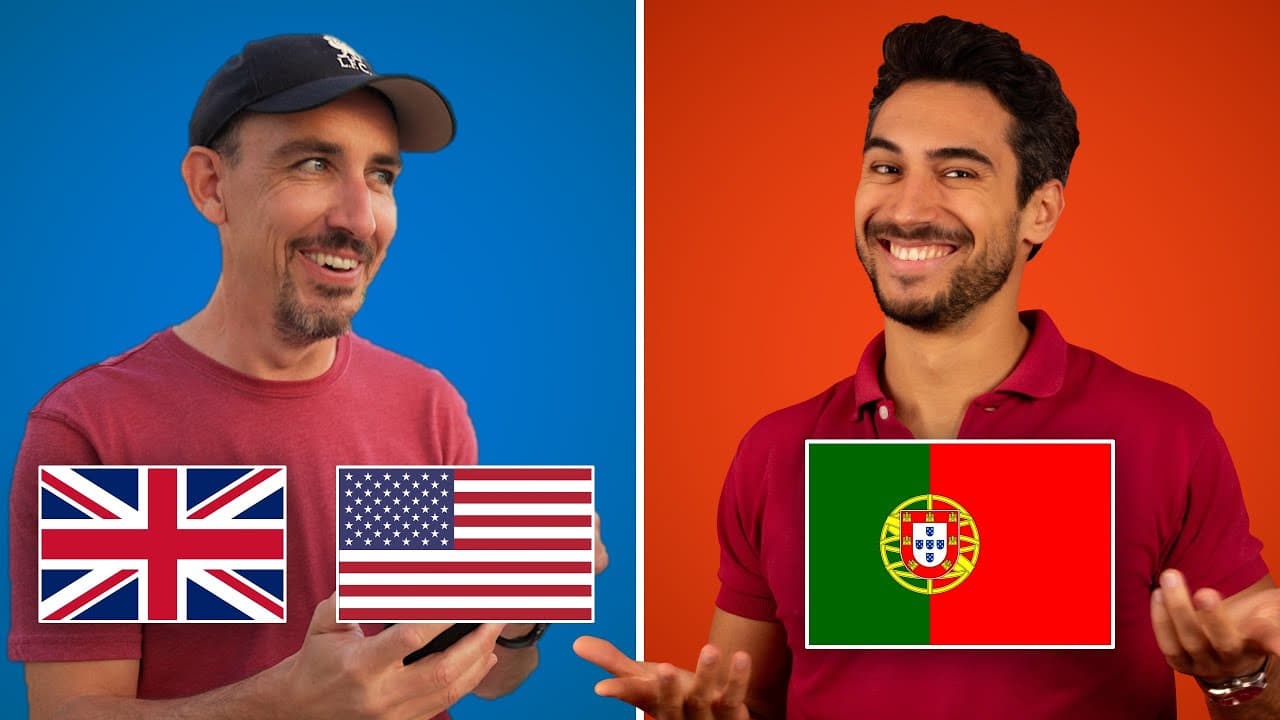
If you're new here, my name is Leonardo, and on this channel I teach European Portuguese. Yeah, and I was about as imaginative as you with the name of my channel. My name is Greg, and my YouTube channel is... English With Greg, where I teach British English to help my students speak English clearly and understand easily. I'm Portuguese, Greg is E... Read More
Key Insights
- English and Portuguese have many phonetic similarities, especially in vowel sounds, but English speakers often mispronounce due to different spelling conventions.
- Portuguese grammar is more complex than English, with more verb tenses and gendered nouns, which can be challenging for English speakers.
- Portuguese has 9 oral vowels and 5 nasal vowels, many of which have counterparts in English, although pronunciation differs.
- Consonant sounds in Portuguese are mostly similar to English, but certain sounds like the Portuguese R and L require specific attention for English speakers.
- Portuguese verbs have complex conjugation patterns that differ significantly from English, necessitating focused study for learners.
- Vocabulary acquisition can be aided by recognizing similar Latin roots in both languages, though false friends can cause confusion.
- Portuguese vocabulary has many words with endings similar to English, such as -tion in English corresponding to -ção in Portuguese.
- The video emphasizes the importance of practice and interaction with native speakers, recommending platforms like italki for language learning.
Install to Summarize YouTube Videos and Get Transcripts
Explore YouTube Video Summarizer or Get YouTube Transcript Extractor
Questions & Answers
Q: What phonetic advantage do English speakers have when learning Portuguese?
English speakers have a phonetic advantage because English is rich in sounds, with 44 different phonetic sounds. This means many sounds in European Portuguese already exist in English, aiding in learning pronunciation. However, the challenge lies in recognizing which sounds to pronounce based on spelling differences.
Q: How does Portuguese grammar compare to English grammar?
Portuguese grammar is more complex than English, with gendered nouns, more verb tenses, and intricate conjugation patterns. English speakers might find Portuguese grammar challenging due to its complexity and the need to learn rules for gender, number, and verb conjugations that do not exist in English.
Q: What are some key differences in vowel pronunciation between English and Portuguese?
Portuguese has 9 oral vowels and 5 nasal vowels. While many of these vowels exist in English, they are often longer or part of diphthongs. English speakers must learn to pronounce these vowels as short, single sounds in Portuguese, and also understand the nasalization process for vowels that do not exist in English.
Q: What is the significance of false friends in learning Portuguese vocabulary?
False friends are words that look similar in both languages but have different meanings, which can lead to misunderstandings. For example, 'excitado' means 'horny' in Portuguese, not 'excited,' and 'introduzir' means 'to put inside,' not 'to introduce.' Recognizing these differences is crucial for effective communication.
Q: How can English speakers transform English words into Portuguese equivalents?
Many English words can be transformed into Portuguese by recognizing common suffix patterns. For instance, words ending in -tion in English often end in -ção in Portuguese. Similarly, -sion becomes -são, -able becomes -ável, and -ity becomes -ade. Awareness of these patterns can help expand vocabulary quickly.
Q: What resources are recommended for improving Portuguese pronunciation?
The video recommends using a Portuguese Phonetics Guide, which can be downloaded for free, to follow along with the phonetics discussion. Additionally, a pronunciation course is available, offering detailed explanations and exercises to help learners master Portuguese pronunciation.
Q: Why is verb conjugation particularly challenging for English speakers?
Portuguese verb conjugation is challenging due to its complexity, with numerous tenses and moods that do not have direct equivalents in English. English speakers must learn various conjugation patterns and understand the contexts in which different tenses are used, which requires dedicated study and practice.
Q: What is the role of italki in language learning as mentioned in the video?
Italki is recommended as a platform for practicing language skills with native speakers. It allows learners to choose tutors based on language proficiency and offers trial lessons at reduced prices. Regular practice with tutors on italki can significantly improve language skills, as demonstrated by the host's experience with learning German.
Summary & Key Takeaways
-
The video provides a comprehensive comparison between European Portuguese and British English, focusing on phonetics, grammar, and vocabulary. It aims to be a resource for English speakers learning Portuguese.
-
Phonetics discussions highlight the similarities and differences in vowel and consonant sounds, with practical tips on pronunciation. The hosts also discuss the challenges of Portuguese spelling.
-
The grammar section covers gender, number, articles, prepositions, and verb conjugations, while the vocabulary section addresses word transformation and false friends between English and Portuguese.
Read in Other Languages (beta)
Share This Summary 📚
Summarize YouTube Videos and Get Video Transcripts with 1-Click
Try YouTube Summary with ChatGPT & Claude or YouTube Transcript Generator
Explore More Summaries from Portuguese With Leo 📚




Summarize YouTube Videos and Get Video Transcripts with 1-Click
Try YouTube Summary with ChatGPT & Claude or YouTube Transcript Generator