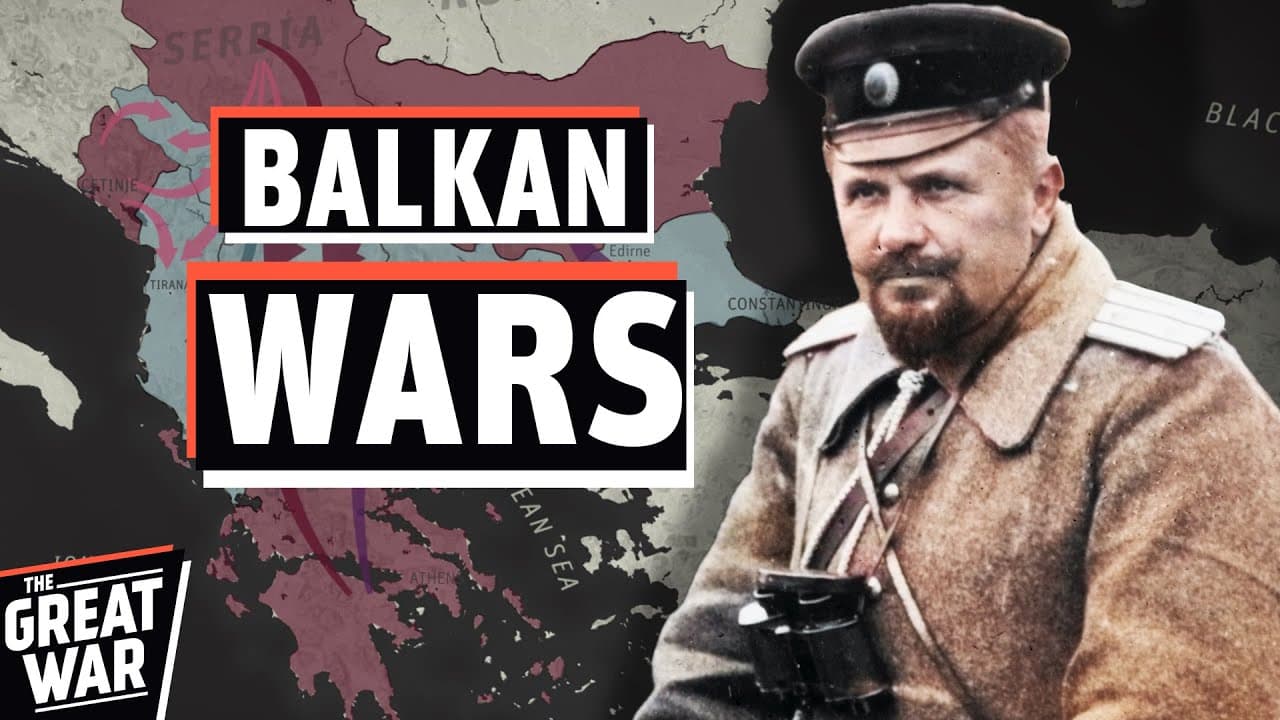
The Balkan Wars 1912-1913 (Documentary)
TL;DR
The Balkan Wars reshaped Southeastern Europe and set the stage for WWI.
Transcript
In 1912 and 1913, the Balkans were torn apart by not one, but two wars that radically changed the map, nearly dragged Europe into a general war, caused untold suffering, and helped set the stage for the First World War. The armies of the Balkan League marched together against the ailing Ottoman Empire, only for alliances to change and all turn agai... Read More
Key Insights
- The Balkan Wars were pivotal in ending Ottoman rule in Southeastern Europe, significantly altering the region's political landscape.
- Nationalism and the weakening Ottoman Empire fueled the emergence of new Balkan states, leading to conflicts over territorial claims.
- The Balkan League, comprising Serbia, Montenegro, Bulgaria, and Greece, initially united against the Ottomans but later fractured over territorial disputes.
- The First Balkan War saw the Balkan League's decisive victories over the Ottomans, but lack of post-war planning led to further conflicts.
- The Second Balkan War erupted due to disagreements over territorial spoils, involving Romania and the Ottoman Empire's attempts to regain lost territories.
- The wars resulted in significant human suffering, with atrocities committed by all sides, leading to massive displacement and ethnic tensions.
- The Great Powers' interests and interventions in the Balkans further complicated the situation, contributing to the tensions leading to World War I.
- The Balkan Wars left a legacy of resentment and geopolitical shifts that influenced alliances and conflicts in the years leading up to World War I.
Install to Summarize YouTube Videos and Get Transcripts
Explore YouTube Video Summarizer or Get YouTube Transcript Extractor
Questions & Answers
Q: What were the main causes of the Balkan Wars?
The main causes of the Balkan Wars were the weakening of the Ottoman Empire, the rise of nationalism among Balkan states, and the desire of these states to expand their territories at the Ottomans' expense. The complex web of alliances and territorial disputes among the Balkan states further intensified the situation, leading to the outbreak of the wars.
Q: How did the Balkan League form, and what was its initial purpose?
The Balkan League formed in 1912 as an alliance between Serbia, Montenegro, Bulgaria, and Greece, with the initial purpose of waging war against the Ottoman Empire to reclaim territories they considered historically theirs. The League was motivated by the weakening Ottoman control and the desire to expand their own national territories, with Russian encouragement playing a role in its formation.
Q: What were the outcomes of the First Balkan War?
The First Balkan War resulted in the Balkan League's decisive victories over the Ottoman Empire, leading to the capture of nearly all Ottoman territories in Europe. The war ended with the Treaty of London in May 1913, significantly reducing Ottoman presence in the Balkans and creating an independent Albania. However, the lack of a clear post-war territorial division among the Balkan League members sowed seeds for future conflicts.
Q: Why did the Second Balkan War occur, and what were its consequences?
The Second Balkan War occurred due to disagreements among the Balkan League members over the division of territories gained from the Ottomans. Bulgaria's dissatisfaction with the territorial distribution led to conflict with Serbia and Greece, with Romania and the Ottoman Empire also joining the fray. The war resulted in Bulgaria's territorial losses and further reshaped the Balkan political landscape, intensifying regional tensions.
Q: How did the Balkan Wars impact the civilian populations in the region?
The Balkan Wars had a devastating impact on civilian populations, with widespread atrocities committed by all sides leading to massive displacement and ethnic tensions. Many civilians suffered from violence, looting, and forced expulsions, particularly among Muslim populations who fled to Anatolia. The wars exacerbated existing ethnic and religious hostilities, contributing to long-lasting regional instability.
Q: What role did the Great Powers play in the Balkan Wars?
The Great Powers played a significant role in the Balkan Wars by influencing diplomatic negotiations and territorial settlements. While they initially sought to maintain the territorial status quo, their interests in limiting Russian influence and controlling the balance of power in the region led to interventions that complicated the situation. Their involvement indirectly contributed to the tensions that would lead to World War I.
Q: How did the Balkan Wars set the stage for World War I?
The Balkan Wars set the stage for World War I by exacerbating regional tensions and altering alliances. The conflicts increased animosity between Austria-Hungary and Serbia, with Russia's support for Serbia further straining relations with Austria-Hungary and Germany. The wars also highlighted the volatility of the Balkans, making it a flashpoint for future conflicts, as seen in the assassination of Archduke Franz Ferdinand in 1914.
Q: What were the long-term effects of the Balkan Wars on the region?
The long-term effects of the Balkan Wars included significant geopolitical changes, with the end of Ottoman rule in most of the Balkans and the establishment of new national borders. The wars left deep-seated ethnic and religious tensions, contributing to future conflicts in the region. They also influenced the alliances and hostilities that played a crucial role in the outbreak of World War I, shaping the political landscape of Europe for decades.
Summary & Key Takeaways
-
The Balkan Wars of 1912-1913 marked the end of Ottoman rule in Southeastern Europe, with the Balkan League defeating the Ottomans but later fracturing over territorial disputes. The wars reshaped the region's political landscape and contributed to the tensions leading to World War I.
-
Nationalism and the weakening Ottoman Empire led to the emergence of new Balkan states, resulting in conflicts over territorial claims. The Balkan League, initially united against the Ottomans, later fractured due to disagreements over the division of spoils.
-
The Balkan Wars resulted in significant human suffering, with atrocities committed by all sides and massive displacement of populations. The involvement of Great Powers further complicated the situation, setting the stage for World War I.
Read in Other Languages (beta)
Share This Summary 📚
Summarize YouTube Videos and Get Video Transcripts with 1-Click
Try YouTube Summary with ChatGPT & Claude or YouTube Transcript Generator
Explore More Summaries from The Great War 📚
Summarize YouTube Videos and Get Video Transcripts with 1-Click
Try YouTube Summary with ChatGPT & Claude or YouTube Transcript Generator