How to Solve Simultaneous Equations Using Elimination?
TL;DR
To solve simultaneous equations using the elimination method, manipulate the equations to make the coefficients of one variable identical. Subtract one equation from the other to eliminate a variable, and then solve for the remaining variable. Always verify your solution by substituting back into the original equations.
Transcript
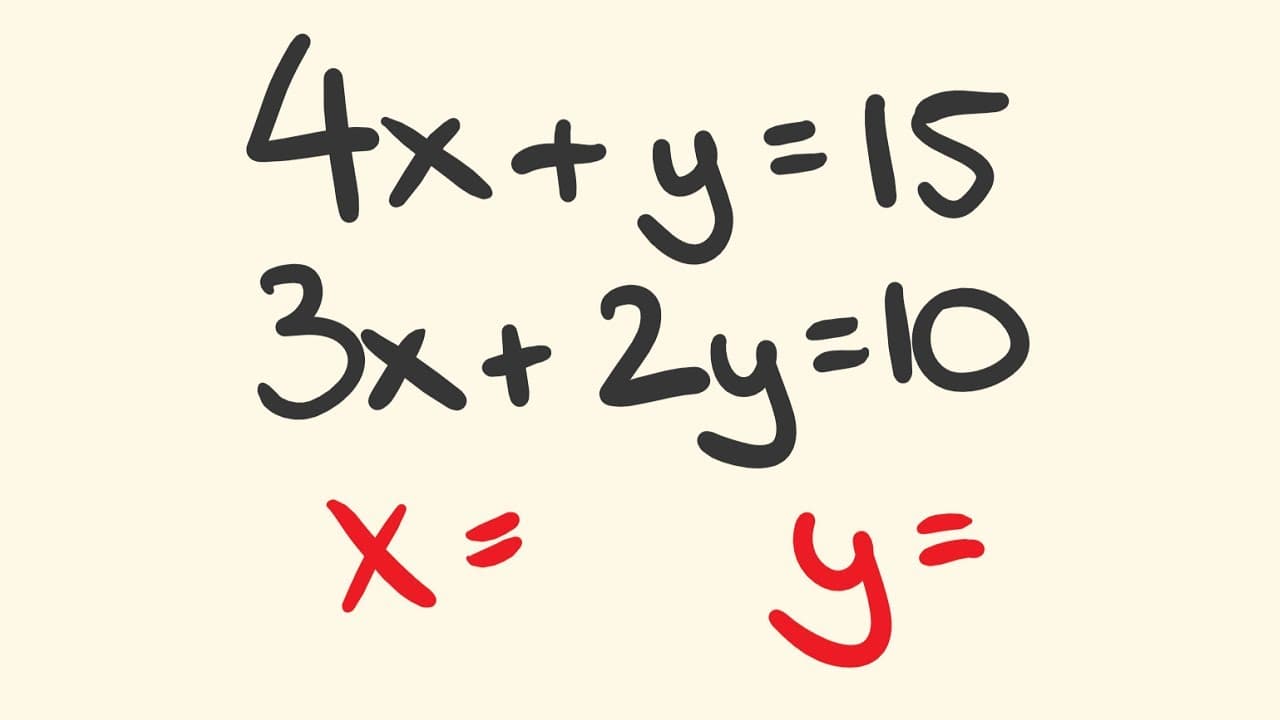
good day welcome to the tech math Channel I'm Josh today we're going to look at how to solve simultaneous equations using the elimination method so let's have a look at this example right here we have two equations the first one we have is this one we have 4x + y is equal to 15 and we have a second equation 3x + 2 y is equal to 10 and like we said ... Read More
Key Insights
- ❓ The elimination method involves manipulating equations to make the coefficients of one variable identical in both equations.
- ❓ Once the coefficients are the same, the equations can be subtracted to eliminate one variable and solve for the other.
- ✅ Checking the solution by substituting the values back into the original equations ensures the accuracy of the solution.
- ❓ The elimination method is an effective technique for solving linear simultaneous equations.
- 🪈 It is essential to understand the concept of coefficients and variables in order to apply the elimination method successfully.
- 🤩 Multiplying entire equations by a suitable factor is a key step in equalizing the coefficients of the desired variable.
- #️⃣ The elimination method can be used to solve systems of equations with any number of variables.
Install to Summarize YouTube Videos and Get Transcripts
Explore YouTube Video Summarizer or Get YouTube Transcript Extractor
Questions & Answers
Q: What is the elimination method in solving simultaneous equations?
The elimination method involves manipulating the equations to make one set of variables (either X or Y) the same in both equations, allowing one equation to be subtracted from the other to eliminate one variable.
Q: How do you make the coefficients of a variable the same in both equations?
To make the coefficients the same, you can multiply one equation (or both) by a factor that will result in the same coefficient for the desired variable.
Q: How do you solve for the value of the common variable?
Once the equations are subtracted, you will have a new equation with one variable. Solve this equation as you normally would to find the value of the variable.
Q: Why is it important to check the solution?
Checking the solution by substituting the found values back into the original equations ensures that the values satisfy both equations and confirms the accuracy of the solution.
Summary & Key Takeaways
-
This video tutorial introduces the elimination method for solving simultaneous equations.
-
The elimination method involves manipulating the equations to make the coefficients of one variable the same in both equations.
-
Once the coefficients are the same, the equations are subtracted, resulting in a new equation with one variable, which can be easily solved.
Read in Other Languages (beta)
Share This Summary 📚
Summarize YouTube Videos and Get Video Transcripts with 1-Click
Try YouTube Summary with ChatGPT & Claude or YouTube Transcript Generator
Explore More Summaries from tecmath 📚


Summarize YouTube Videos and Get Video Transcripts with 1-Click
Try YouTube Summary with ChatGPT & Claude or YouTube Transcript Generator