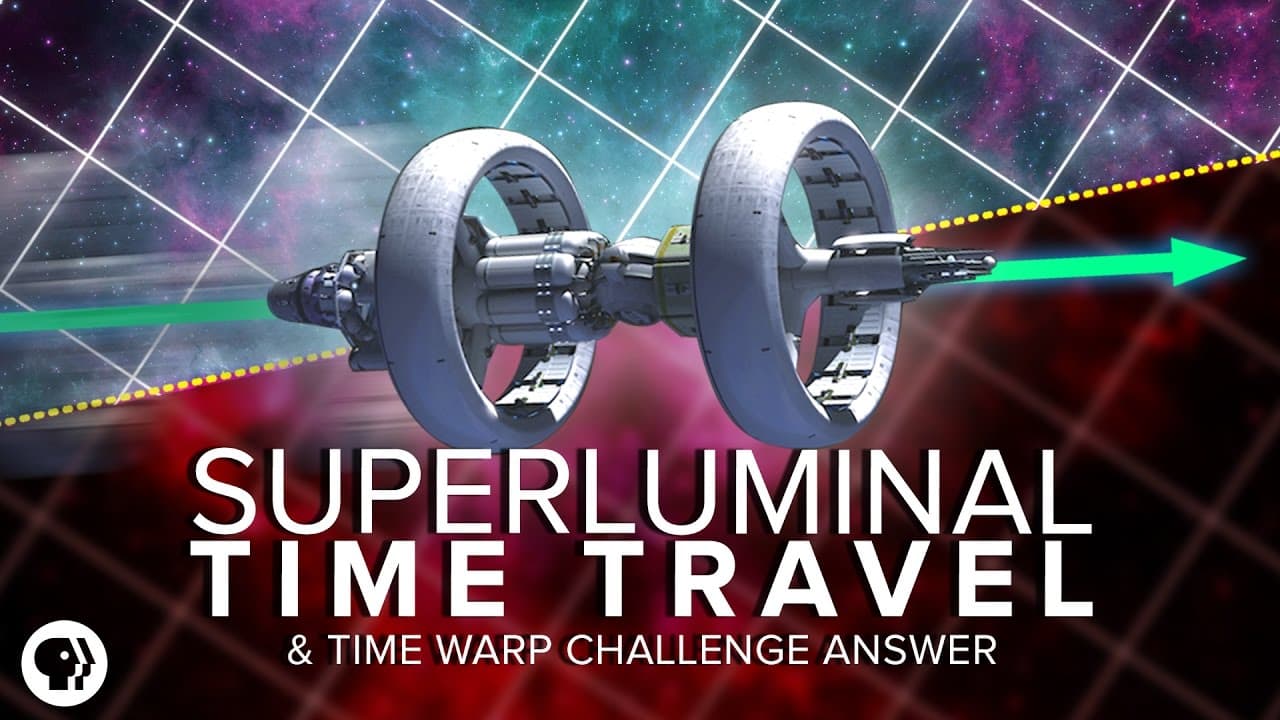
Superluminal Time Travel + Time Warp Challenge Answer
TL;DR
Explores how faster-than-light travel equates to time travel.
Transcript
Traveling faster than light and traveling backwards in time are the same thing. Today I'm going to prove that to you. Faster-than-light travel is, understandably, a staple of science fiction. The reality of the vast scale of our universe, even with our galaxy, is inconvenient for tales of star-hopping adventure or warring galactic empires. Enter th... Read More
Key Insights
- Faster-than-light travel and time travel are conceptually the same, as they both involve traversing spacetime in ways that defy conventional understanding.
- Science fiction often uses faster-than-light travel to overcome the vast distances of space, introducing concepts like warp drives and hyperspace.
- Using tachyons, hypothetical particles that move faster than light, could theoretically allow communication where responses are received before messages are sent.
- Spacetime diagrams, particularly Minkowski diagrams, help visualize how different observers perceive time and space depending on their velocities.
- Einstein's theory of relativity shows that time is not universal; instead, each observer has their own clock and perception of simultaneity.
- Superluminal paths, or paths faster than light, can theoretically lead to revisiting past spacetime intervals, suggesting time travel.
- The concept of time travel in physics is heavily reliant on reference frames and transformations, such as the Lorentz transformation.
- While faster-than-light travel suggests time travel, real-world physics prevents actual backward time travel due to the nature of spacetime and causality.
Install to Summarize YouTube Videos and Get Transcripts
Explore YouTube Video Summarizer or Get YouTube Transcript Extractor
Questions & Answers
Q: How does faster-than-light travel relate to time travel?
Faster-than-light travel relates to time travel because it involves traversing spacetime in a manner that allows for revisiting previous spacetime intervals. This suggests the possibility of traveling back in time, as superluminal paths can theoretically lead to information or objects returning to their origin before they depart.
Q: What role do reference frames play in the perception of time travel?
Reference frames are crucial in the perception of time travel because they determine how different observers perceive time and space. Lorentz transformations allow us to shift between these frames, showing how superluminal paths can appear as time travel from certain perspectives, even if they don't represent real-world trajectories.
Q: What is the significance of Minkowski spacetime diagrams in this context?
Minkowski spacetime diagrams are significant because they provide a visual representation of how time and space are interconnected. They help illustrate how different observers, based on their velocities, perceive events in spacetime, and how superluminal paths can lead to revisiting past intervals, suggesting time travel.
Q: Can tachyons enable time travel or communication across time?
Tachyons, hypothetical particles that move faster than light, theoretically enable communication where responses are received before messages are sent. This thought experiment demonstrates the potential for time travel or communication across time, although tachyons remain speculative and are not proven to exist in reality.
Q: How does Einstein's theory of relativity influence our understanding of time travel?
Einstein's theory of relativity influences our understanding of time travel by showing that time is not universal. Each observer has their own clock and perception of simultaneity, dependent on their velocity. This relativity of time allows for theoretical constructs like superluminal paths that suggest time travel, though practical limitations exist.
Q: What are the limitations of real-world physics on time travel?
The limitations of real-world physics on time travel stem from the nature of spacetime and causality. While theoretical constructs suggest the possibility of time travel, actual backward time travel is prevented due to the consistent forward flow of time and the causal evolution of matter, which cannot be reversed in reality.
Q: What is the 'time warp challenge' mentioned in the video?
The 'time warp challenge' is a thought experiment or challenge proposed in the video to explore the implications of faster-than-light travel. It involves a race to claim an exoplanet using different speeds and technologies, illustrating how superluminal travel can lead to revisiting past spacetime intervals, suggesting time travel.
Q: How does science fiction contribute to the discussion of faster-than-light travel?
Science fiction contributes to the discussion by introducing concepts like warp drives, hyperspace, and other methods to overcome the vast distances of space. These fictional constructs inspire real-world physics discussions on faster-than-light travel and its implications, including the potential for time travel, even if they remain speculative.
Summary & Key Takeaways
-
The video discusses the equivalence between faster-than-light travel and time travel, using concepts from physics and science fiction. It explains how different reference frames and spacetime diagrams illustrate this relationship.
-
Einstein's theory of relativity is central to understanding time and space, showing that each observer experiences time differently based on their velocity, with no universal clock governing all.
-
Theoretical constructs like tachyons and superluminal paths suggest possibilities for time travel, but real-world physics imposes limitations that prevent actual backward time travel.
Read in Other Languages (beta)
Share This Summary 📚
Summarize YouTube Videos and Get Video Transcripts with 1-Click
Try YouTube Summary with ChatGPT & Claude or YouTube Transcript Generator
Explore More Summaries from PBS Space Time 📚
Summarize YouTube Videos and Get Video Transcripts with 1-Click
Try YouTube Summary with ChatGPT & Claude or YouTube Transcript Generator