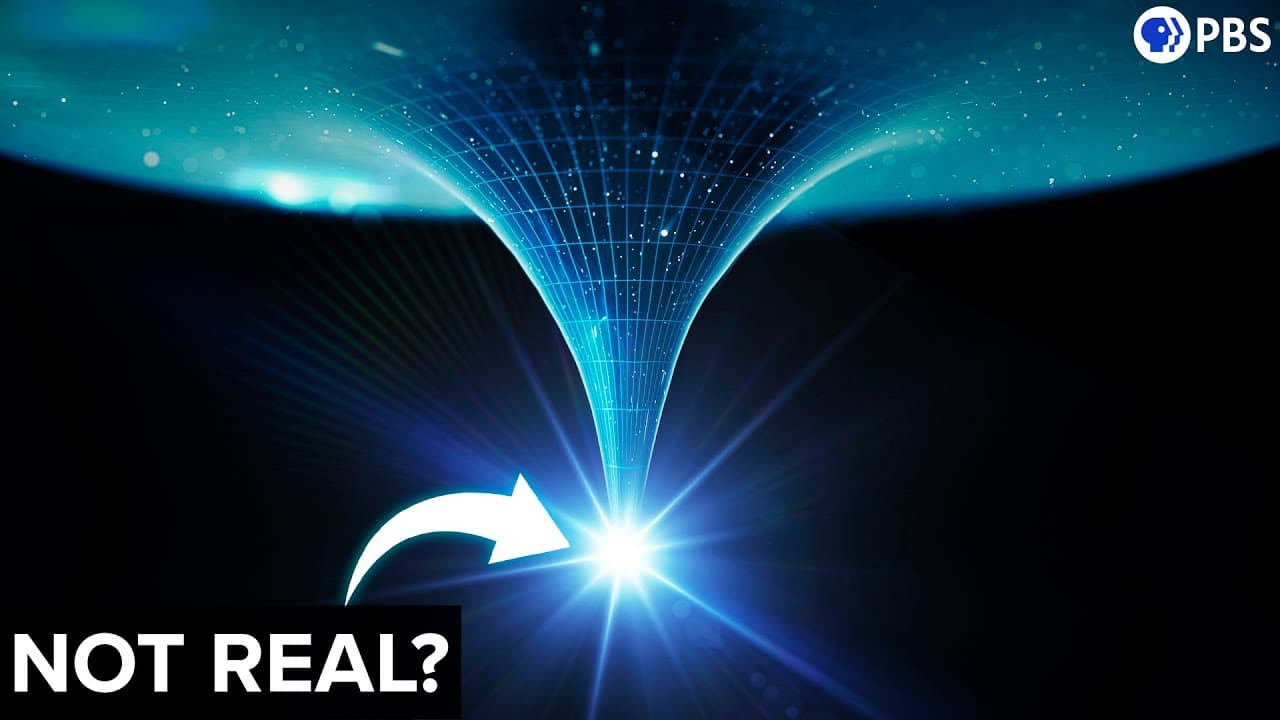
What if Singularities DO NOT Exist?
TL;DR
Roy Kerr questions the inevitability of black hole singularities.
Transcript
It's not too often that a giant of physics threatens to overturn an idea held to be self-evident by generations of physicists. Well, that may be the fate of the famous Penrose Singularity Theorem if we're to believe a recent paper by Roy Kerr. Long story short, the terrible singularity at the heart of the black hole may be no more. A few hundred y... Read More
Key Insights
- Roy Kerr's recent paper challenges the Penrose Singularity Theorem, suggesting that singularities at the center of black holes may not exist.
- The Penrose Singularity Theorem, developed by Sir Roger Penrose, posits that singularities are unavoidable in black holes based on general relativity.
- Kerr argues that the theorem's reliance on geodesic incompleteness doesn't necessarily imply singularities, using the concept of affine parameters.
- Kerr's objections highlight the difference between null geodesics and massive particle paths, questioning the interpretation of bounded affine parameters.
- Kerr's paper suggests that real black holes, which rotate, are better described by the Kerr metric, not the Schwarzschild metric used in Penrose's theorem.
- The Kerr metric describes rotating black holes with a ring singularity, which Kerr argues is a mathematical fiction rather than a physical singularity.
- Kerr's analysis indicates that not all null geodesics terminate at a singularity in rotating black holes, challenging the inevitability of singularities.
- If Kerr's ideas hold, they could provide a way to understand black holes without invoking quantum mechanics, offering a new perspective on singularities.
Install to Summarize YouTube Videos and Get Transcripts
Explore YouTube Video Summarizer or Get YouTube Transcript Extractor
Questions & Answers
Q: What is the Penrose Singularity Theorem?
The Penrose Singularity Theorem, developed by Sir Roger Penrose, asserts that singularities are unavoidable in black holes if an event horizon exists. It suggests that the paths of objects in spacetime, known as geodesics, must terminate inside a black hole, indicating a point of infinite density where the laws of physics break down.
Q: How does Roy Kerr challenge the Penrose Singularity Theorem?
Roy Kerr challenges the theorem by arguing that the interpretation of geodesic incompleteness, used by Penrose to infer singularities, is flawed. He contends that bounded affine parameters, which describe the paths of massless objects like light, do not necessarily indicate a breakdown of spacetime, thereby questioning the inevitability of singularities.
Q: What is the significance of the Kerr metric?
The Kerr metric is significant because it describes rotating black holes, which are more realistic representations of actual astrophysical black holes. Unlike the Schwarzschild metric used in the Penrose theorem, the Kerr metric accounts for rotation, resulting in different predictions about the structure and behavior of black holes, including the nature of singularities.
Q: What does Kerr argue about the ring singularity in the Kerr metric?
Kerr argues that the ring singularity in the Kerr metric is not a true physical singularity but rather a mathematical convenience. He suggests that the gravitational field of a rotating black hole can be represented without assuming a point of infinite density, challenging the notion that singularities are inevitable in rotating black holes.
Q: Why is Kerr's paper considered controversial?
Kerr's paper is considered controversial because it challenges a widely accepted theorem in physics, suggesting that singularities may not be an inherent feature of black holes. His arguments question decades of theoretical work and propose that a complete understanding of black holes may not require quantum mechanics, sparking debates within the scientific community.
Q: How could Kerr's ideas impact the understanding of black holes?
If Kerr's ideas are validated, they could revolutionize the understanding of black holes by removing the need for singularities. This would allow physicists to develop new theories about the interior of black holes without relying on a unified theory of quantum gravity, potentially leading to new insights into the fundamental nature of spacetime.
Q: What is the role of affine parameters in Kerr's argument?
Affine parameters play a crucial role in Kerr's argument as they are used to describe the paths of massless objects, like light, in spacetime. Kerr argues that the bounded nature of these parameters does not imply a breakdown of spacetime, challenging the interpretation that leads to the conclusion of singularities in the Penrose theorem.
Q: What future research could be inspired by Kerr's paper?
Kerr's paper could inspire future research into alternative models of black holes that do not rely on singularities. It may also prompt further examination of the Kerr metric and its implications for the structure of black holes, as well as encourage the development of new theoretical frameworks that reconcile general relativity with quantum mechanics without assuming singularities.
Summary & Key Takeaways
-
Roy Kerr challenges the Penrose Singularity Theorem, proposing that singularities in black holes may not be inevitable. His argument focuses on the interpretation of geodesic incompleteness and bounded affine parameters, suggesting that these do not necessarily imply the existence of singularities.
-
Kerr's analysis uses the Kerr metric, which describes rotating black holes, to argue against the inevitability of singularities. He suggests that the ring singularity in the Kerr metric is a mathematical convenience, and that real black holes may not have true singularities.
-
If Kerr's ideas are validated, they could offer a new understanding of black holes without requiring a theory of quantum gravity. This challenges the long-held belief that singularities are an unavoidable consequence of general relativity and opens new avenues for theoretical exploration.
Read in Other Languages (beta)
Share This Summary 📚
Summarize YouTube Videos and Get Video Transcripts with 1-Click
Try YouTube Summary with ChatGPT & Claude or YouTube Transcript Generator
Explore More Summaries from PBS Space Time 📚
Summarize YouTube Videos and Get Video Transcripts with 1-Click
Try YouTube Summary with ChatGPT & Claude or YouTube Transcript Generator