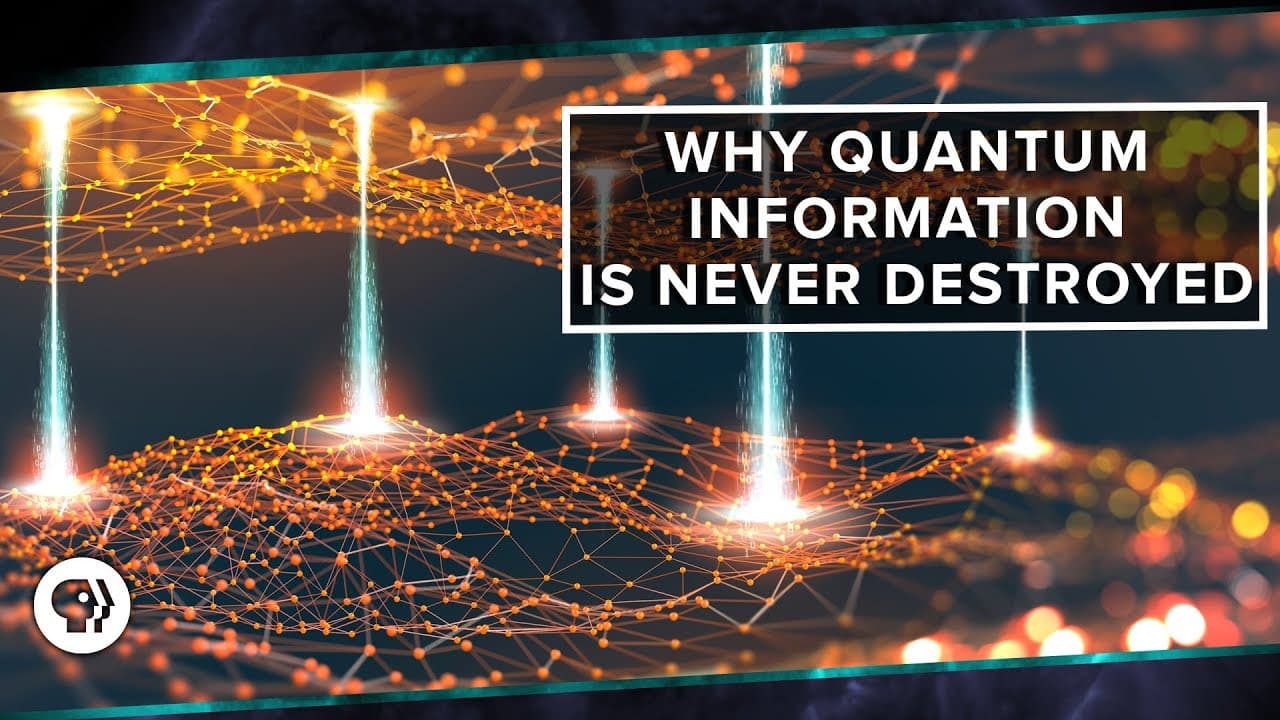
Why Quantum Information is Never Destroyed
TL;DR
Quantum mechanics ensures information is never lost, preserving time-reversal symmetry.
Transcript
Thanks to Curiosity Stream for supporting PBS Digital Studios. If you have perfect knowledge of every single particle in the universe, can you use the laws of physics to rewind all the way back to the Big Bang? Is the entire history of the universe perfectly knowable? Or has information somehow been lost along the way? [Intro Music] The laws of phy... Read More
Key Insights
- Deterministic laws of physics allow for future predictions but don't guarantee perfect past predictions, highlighting the importance of time-reversal symmetry in conserving information.
- Noether's theorem connects symmetries in physics equations to conservation laws, although time-reversal symmetry isn't directly covered by it, it's crucial for the conservation of information.
- Quantum mechanics, through the Schrödinger equation, ensures time-reversal symmetry and information conservation by maintaining the probabilities of quantum states.
- Unitarity in quantum mechanics ensures that the sum of probabilities remains one, preventing different quantum states from merging into the same state and thus preserving information.
- The Copenhagen interpretation of quantum mechanics challenges information conservation due to wave function collapse, while other interpretations like many-worlds preserve time reversibility.
- Black holes and Hawking radiation present a potential challenge to the conservation of information, leading to the black hole information paradox.
- Quantum randomness and the uncertainty principle seem to oppose determinism, yet quantum information encompasses the wave function's full content, not just measurable outcomes.
- The episode hints at future explorations into black hole thermodynamics and particle physics, promising deeper insights into these complex topics.
Install to Summarize YouTube Videos and Get Transcripts
Explore YouTube Video Summarizer or Get YouTube Transcript Extractor
Questions & Answers
Q: What is the significance of time-reversal symmetry in quantum mechanics?
Time-reversal symmetry is crucial in quantum mechanics as it ensures the conservation of information. It implies that the laws of physics are not only deterministic in predicting the future but also in reconstructing the past. This symmetry ensures that information about the past is preserved and can be theoretically retrieved, maintaining the integrity of quantum systems across time.
Q: How does the Schrödinger equation contribute to the conservation of information?
The Schrödinger equation governs the time evolution of quantum systems, ensuring that the wave function's probabilities remain consistent over time. This consistency, known as unitarity, prevents different quantum states from collapsing into the same state, thereby conserving information. It guarantees that the probabilities of all possible states add up to one, preserving the complete information content of the wave function.
Q: What role does unitarity play in quantum mechanics?
Unitarity is a fundamental principle in quantum mechanics that ensures the total probability of all possible outcomes of a quantum event remains constant at one. This principle prevents the merging of different quantum states into a single state, thereby preserving information over time. Unitarity is essential for maintaining the deterministic nature of quantum mechanics, allowing for time-reversal symmetry and ensuring that information is never lost.
Q: How does the Copenhagen interpretation affect information conservation?
The Copenhagen interpretation of quantum mechanics suggests that the act of measurement collapses the wave function, potentially altering it and making it impossible to trace back to its original state. This collapse challenges the conservation of information, as it implies that information about the pre-measurement state is lost. This interpretation contrasts with others that preserve time-reversibility and information, such as the many-worlds interpretation.
Q: What is the black hole information paradox?
The black hole information paradox arises from the apparent contradiction between quantum mechanics' principle of information conservation and the effect of Hawking radiation, which suggests that black holes can destroy information. As black holes emit Hawking radiation and eventually evaporate, it seems that the information about the matter that fell into the black hole is lost, challenging the fundamental tenets of quantum mechanics and sparking ongoing debates in theoretical physics.
Q: How does quantum randomness relate to determinism in quantum mechanics?
Quantum randomness, characterized by the uncertainty principle, seems to conflict with determinism as it implies inherent unpredictability in measurement outcomes. However, quantum mechanics remains deterministic at the level of the wave function, which encodes the full probability distribution of possible outcomes. This means that while individual measurements may appear random, the underlying quantum state evolves predictably, preserving information across time.
Q: What is the significance of Noether's theorem in the context of information conservation?
Noether's theorem links symmetries in physical laws to conservation laws, explaining how certain quantities remain constant over time. While time-reversal symmetry isn't directly covered by Noether's theorem, it's essential for information conservation. This symmetry ensures that the laws governing a system's evolution are consistent backward and forward in time, preserving information and maintaining the determinism of quantum mechanics.
Q: What future topics are hinted at in the episode?
The episode hints at future explorations into black hole thermodynamics and particle physics, promising to delve deeper into these complex areas. These topics are critical for understanding the fundamental nature of the universe and addressing unresolved questions like the black hole information paradox. The series aims to provide insights into how these advanced concepts relate to the conservation of information and the laws of physics.
Summary & Key Takeaways
-
The episode explores the concept of information conservation in quantum mechanics, emphasizing the role of time-reversal symmetry in ensuring that information is never lost. It examines the deterministic nature of physical laws and how they predict future states but not necessarily past states.
-
The Schrödinger equation's role in preserving information through unitarity is discussed, highlighting how quantum mechanics maintains the probabilities of quantum states, preventing information loss. The episode also touches on different interpretations of quantum mechanics and their implications for information conservation.
-
Black holes are introduced as a potential challenge to information conservation, with the episode setting the stage for future discussions on black hole thermodynamics and particle physics. The importance of understanding these concepts is underscored, with a promise of deeper exploration in upcoming episodes.
Read in Other Languages (beta)
Share This Summary 📚
Summarize YouTube Videos and Get Video Transcripts with 1-Click
Try YouTube Summary with ChatGPT & Claude or YouTube Transcript Generator
Explore More Summaries from PBS Space Time 📚



Summarize YouTube Videos and Get Video Transcripts with 1-Click
Try YouTube Summary with ChatGPT & Claude or YouTube Transcript Generator