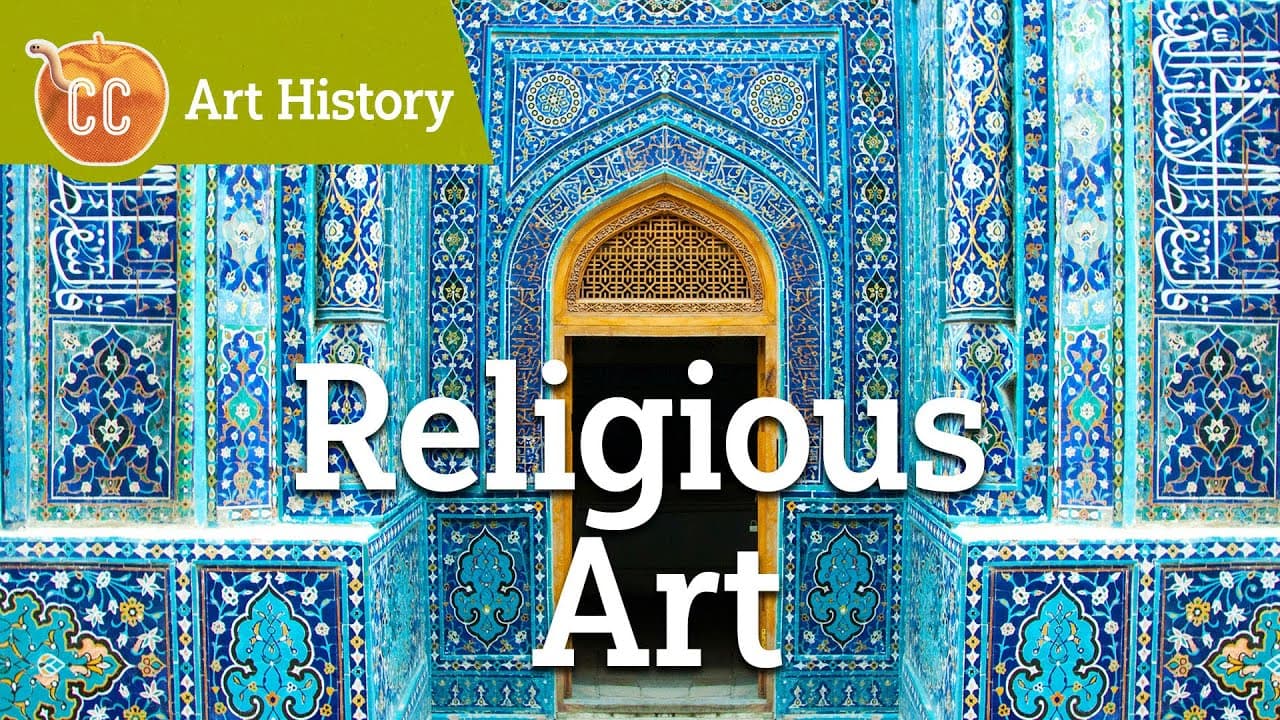
How Do Religions Use Art?: Crash Course Art History #8
TL;DR
Exploration of religious art's diverse purposes and expressions.
Transcript
In 1931, James Hampton began receiving visions from God. Hampton was a custodian working in Washington, D.C., and following his visions, he started collecting shiny things: tin foil, jelly jars, and old lightbulbs. He called himself the Director, Special Projects for the State of Eternity. Hampton’s collection grew until he had filled a rented... Read More
Key Insights
- Religious art serves diverse purposes beyond honoring deities, including instructing followers and evoking spiritual feelings.
- The Egyptian Book of the Dead uses art to guide the deceased through the afterlife, showing the instructional role of religious imagery.
- Zen Buddhist rock gardens and Rothko Chapel paintings evoke peace and meditation, highlighting art's role in inducing spiritual states.
- The Lindau Gospels' ornate cover and Rothko Chapel's use of light illustrate how religious art manipulates light to inspire awe and reverence.
- Sacred spaces like synagogues and mosques use architecture and design to communicate spiritual beliefs and support worship practices.
- Islamic art's aniconic nature, using geometric designs and calligraphy, reflects theological beliefs about depicting living beings.
- Temporary art forms like Tibetan sand mandalas and Indian kolams emphasize the transient nature of life and spiritual practices.
- Religious art provides a platform for contemplating existential questions, fostering reflection and community engagement.
Install to Summarize YouTube Videos and Get Transcripts
Explore YouTube Video Summarizer or Get YouTube Transcript Extractor
Questions & Answers
Q: What is the significance of the Egyptian Book of the Dead in religious art?
The Egyptian Book of the Dead serves as a guide for the deceased, using art to illustrate the journey through the afterlife. It provides detailed instructions and imagery to prepare individuals for what to expect, reflecting the instructional role of religious art in ancient Egyptian beliefs.
Q: How does the Rothko Chapel evoke spiritual qualities without being tied to a specific religion?
The Rothko Chapel uses large canvases and the manipulation of light to create an impression of depth, inviting viewers to look beyond reality. Its triptych format, common in religious art, and the changing appearance with light create a meditative space, evoking spiritual contemplation without specific religious ties.
Q: Why is Islamic art often aniconic, and how does it reflect theological beliefs?
Islamic art is aniconic, avoiding depictions of living beings, due to the belief that only God can create life. This theological principle leads to the use of geometric designs, architecture, and calligraphy, emphasizing symmetry and repetition to inspire awe while aligning with religious doctrines.
Q: What role does light play in religious art, as seen in the Lindau Gospels and Rothko Chapel?
Light is used in religious art to inspire awe and convey spiritual significance. In the Lindau Gospels, light reflects off the gold and jewels to emphasize Jesus's triumph. In the Rothko Chapel, light alters the appearance of paintings, creating a dynamic, meditative experience, symbolizing the divine across cultures.
Q: How do temporary art forms like sand mandalas and kolams reflect spiritual themes?
Temporary art forms like Tibetan sand mandalas and Indian kolams emphasize the impermanence of life. The meticulous creation and subsequent destruction of these artworks symbolize the transient nature of existence, aligning with spiritual themes of life’s fleeting beauty and the cycle of creation and dissolution.
Q: What is the function of religious art in sacred spaces like synagogues and mosques?
In sacred spaces, religious art is integral to the architecture, enhancing spiritual experiences. Synagogues use detailed paintings to tell biblical stories, while mosques employ geometric designs and prayer niches to direct worship. These elements communicate beliefs and support religious practices, merging art with sacred architecture.
Q: How does the minimalist rock garden at Ryōan-ji exemplify open-ended religious art?
The minimalist rock garden at Ryōan-ji represents open-ended religious art by providing a space for personal interpretation. Unlike symbolic art, its elements don't have fixed meanings, allowing individuals to experience peace and meditation uniquely. This reflects Zen Buddhism's emphasis on personal spiritual exploration and tranquility.
Q: What questions does religious art help humans articulate, according to the content?
Religious art helps articulate existential questions about the nature of existence, the unexplainable aspects of life, and the mysteries beyond what is visible. It provides a platform for contemplating suffering, love, and the human experience, fostering reflection and community engagement across cultures and time periods.
Summary & Key Takeaways
-
Religious art encompasses a wide range of purposes, from instruction to evoking spiritual feelings, as demonstrated by diverse examples like the Egyptian Book of the Dead and Zen rock gardens. These artworks serve as guides and meditative tools, reflecting the varied roles of art in religious contexts.
-
Sacred spaces often integrate art into their architecture, as seen in synagogues and mosques, where design elements communicate spiritual beliefs. Islamic art's focus on geometric patterns and calligraphy stems from theological principles, showcasing the intersection of faith and artistic expression.
-
Temporary artworks like Tibetan sand mandalas and Indian kolams highlight the impermanence of life, emphasizing spiritual themes of transience. Religious art invites contemplation of life's mysteries, offering a shared space for reflection and community, transcending cultural and temporal boundaries.
Read in Other Languages (beta)
Share This Summary 📚
Summarize YouTube Videos and Get Video Transcripts with 1-Click
Try YouTube Summary with ChatGPT & Claude or YouTube Transcript Generator
Explore More Summaries from CrashCourse 📚


Summarize YouTube Videos and Get Video Transcripts with 1-Click
Try YouTube Summary with ChatGPT & Claude or YouTube Transcript Generator