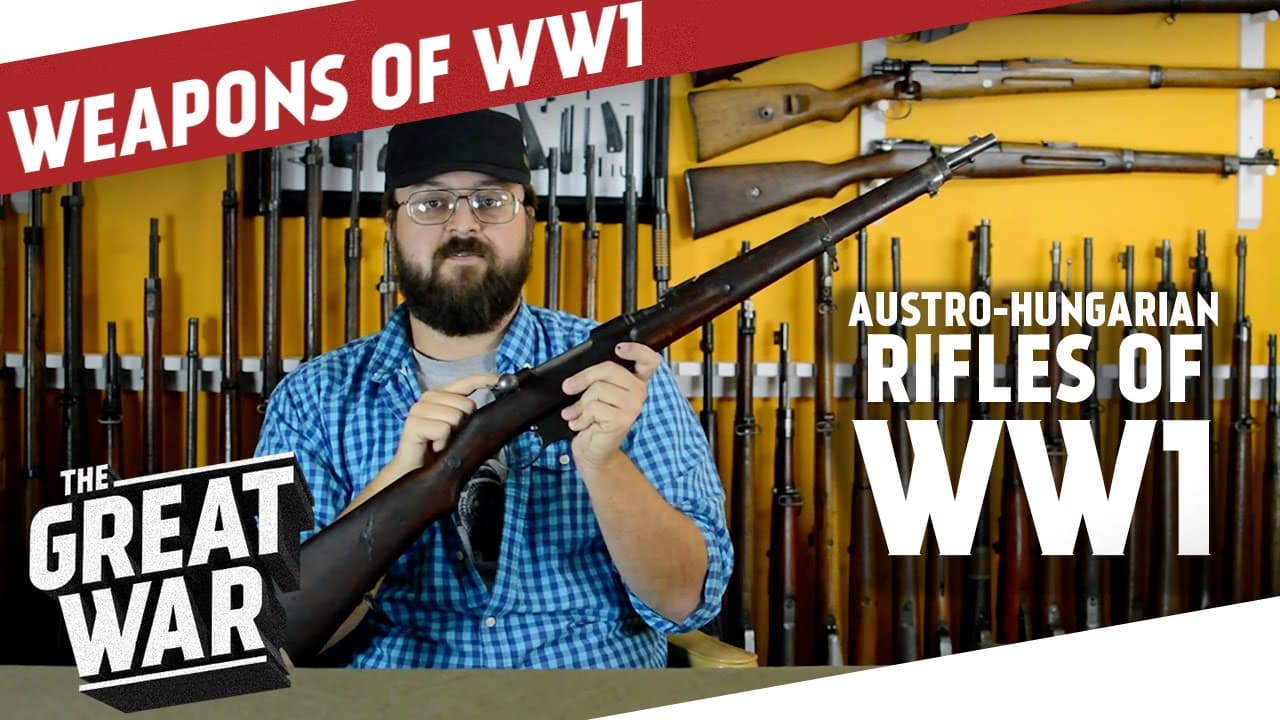
Austro-Hungarian Rifles of WW1 I THE GREAT WAR - Special feat. C&Rsenal
TL;DR
Exploration of Austro-Hungarian rifles' evolution and usage in WW1.
Transcript
I am Indy Neidell. And I am Flo And welcome to a Great war special episode about Austro-Hungarian Rifles of the 1st World War. Say what you got a little bit about what you got for us today. OK! So, Let me start off with the rifles. I am gonna go over to the Mannlicher 1888/90 Now, this was a sort of old rifle for WW1. This was the previous rifle f... Read More
Key Insights
- The Mannlicher 1888/90 rifle, initially outdated, was retained due to severe attrition and manufacturing challenges during WW1.
- Ferdinand Mannlicher introduced two rifles with different locking mechanisms; the wedge-lock was chosen for its simplicity.
- The transition from black powder to smokeless cartridges marked a significant evolution in rifle technology.
- En bloc loading was a major innovation by Mannlicher, allowing quicker reloading but posed issues in muddy trench conditions.
- The Mannlicher 1895 was a significant improvement, featuring a smokeless cartridge and better design for infantry use.
- The Stutzen model was a versatile short rifle, preferred for its practicality and adaptability in the field.
- Despite initial concerns, Mannlicher rifles proved durable and were used through WW2, with later models adapting to more powerful cartridges.
- Straight pull mechanisms influenced future auto-loading rifles, highlighting their importance in firearm evolution.
Install to Summarize YouTube Videos and Get Transcripts
Explore YouTube Video Summarizer or Get YouTube Transcript Extractor
Questions & Answers
Q: What was the main reason for the continued use of the Mannlicher 1888/90 rifle during WW1?
The Mannlicher 1888/90 rifle continued to be used during World War I primarily due to severe attrition and manufacturing challenges. Despite being outdated, Austria-Hungary faced difficulties in producing enough modern rifles to meet the demands of their large standing army, necessitating the use of older models from existing stockpiles.
Q: What were the key innovations introduced by Ferdinand Mannlicher in his rifle designs?
Ferdinand Mannlicher introduced several key innovations in his rifle designs, including the wedge-lock mechanism, which was simpler and suited for black powder cartridges. Another significant innovation was the en bloc loading system, which allowed for faster reloading by using a five-round packet that stayed in the gun until the last round was chambered, after which the clip would fall out.
Q: How did the transition to smokeless cartridges impact Austro-Hungarian rifles?
The transition to smokeless cartridges had a profound impact on Austro-Hungarian rifles. It necessitated the re-barreling and reconfiguration of existing models to accommodate the new, more powerful ammunition. This shift marked a significant technological advancement, as smokeless cartridges offered better performance and reduced fouling compared to black powder cartridges, prompting rapid adaptation in rifle designs.
Q: What were the challenges associated with the Mannlicher's en bloc loading system?
The Mannlicher's en bloc loading system, while innovative, presented challenges, particularly in trench warfare conditions. The system had a hole at the bottom of the magazine, which was prone to allowing mud and debris to enter, potentially causing malfunctions. This vulnerability made the rifles less ideal for the harsh and muddy environments of World War I trenches.
Q: What improvements did the Mannlicher 1895 rifle introduce?
The Mannlicher 1895 rifle introduced several improvements, including the use of a truly smokeless cartridge, which offered more power while being compatible with older models. It featured a longer, more balanced design with an improved sight for better accuracy. Despite being lightweight, it was robust and well-suited for infantry use, maintaining the Mannlicher magazine system with updated clips for easier handling in low-light conditions.
Q: Why was the Stutzen model considered versatile and practical?
The Stutzen model was considered versatile and practical due to its short and handy design, making it easier to maneuver in various combat situations. It featured a stacking hook, bayonet mount, and multiple sling positions, allowing soldiers to carry it comfortably on their back or shoulder. These features made it a preferred choice for different troops, including cavalry and artillery, before and during World War I.
Q: How did the Mannlicher rifles fare during and after World War II?
Mannlicher rifles fared well during and after World War II, despite initial concerns about their durability. They proved reliable in combat, and many were converted to use the more powerful 8x56mm rimmed cartridge in the 1930s. This adaptation extended their service life, and they continued to be used by both Austria and Hungary, reflecting their robustness and effectiveness even in later conflicts.
Q: What role did straight pull mechanisms play in the evolution of firearms?
Straight pull mechanisms played a crucial role in the evolution of firearms by influencing the development of auto-loading rifles. These mechanisms required innovations to convert linear force into rotary locking force, a principle essential for automatic cycling in firearms. The research and designs from straight pull rifles laid the groundwork for future advancements in semi-automatic and automatic weaponry, demonstrating their lasting impact on firearm technology.
Summary & Key Takeaways
-
The video discusses the evolution and significance of Austro-Hungarian rifles during World War I, focusing on the Mannlicher series. It covers the challenges faced due to attrition and the transition to smokeless cartridges.
-
Ferdinand Mannlicher's innovations, particularly the wedge-lock and en bloc loading, are highlighted as key advancements in rifle technology. The video also explores the practical challenges these rifles faced in trench warfare.
-
The Mannlicher 1895 and Stutzen models are examined for their design improvements and continued use through World War II. The influence of straight pull mechanisms on future firearm developments is also discussed.
Read in Other Languages (beta)
Share This Summary 📚
Summarize YouTube Videos and Get Video Transcripts with 1-Click
Try YouTube Summary with ChatGPT & Claude or YouTube Transcript Generator
Explore More Summaries from The Great War 📚



Summarize YouTube Videos and Get Video Transcripts with 1-Click
Try YouTube Summary with ChatGPT & Claude or YouTube Transcript Generator