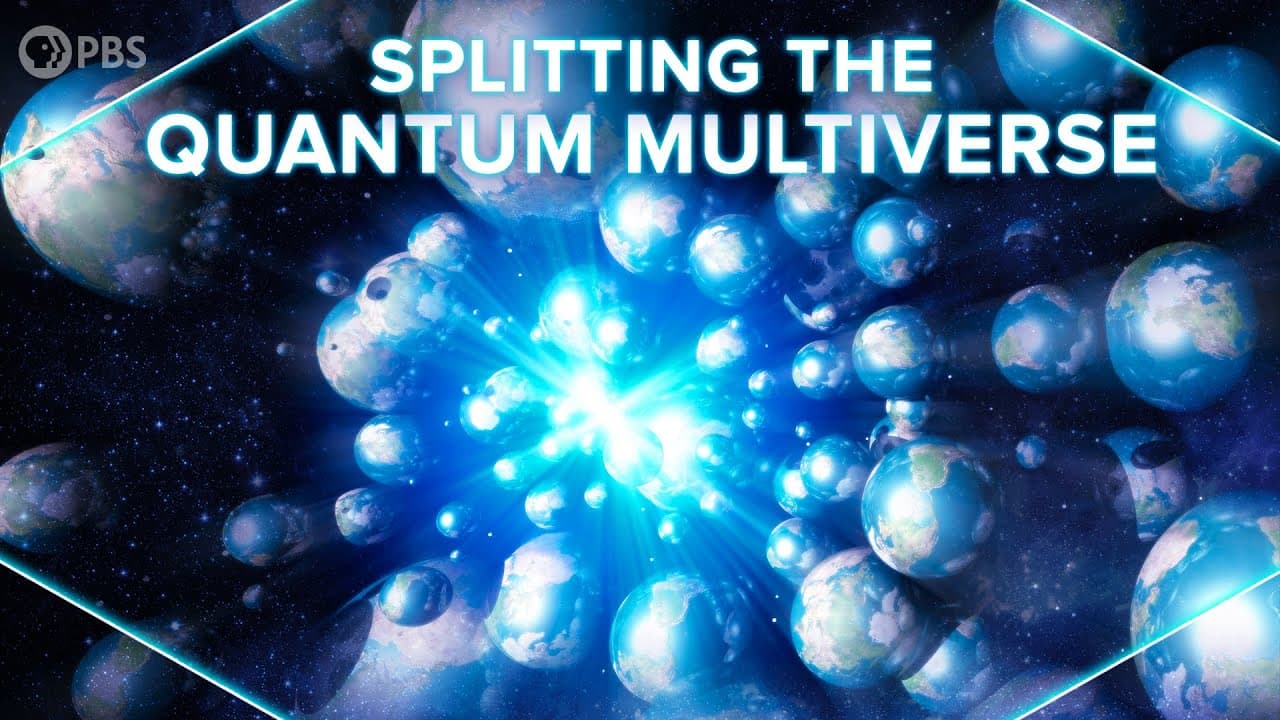
How Decoherence Splits The Quantum Multiverse
TL;DR
Quantum decoherence explains why we can't see multiple histories macroscopically.
Transcript
On the quantum scale, we can see these multiple histories play out and even talk to each other. So why can't we see that happen on our familiar large scale world? Many physicists believe that the answer lies in a process known as quantum decoherence. The Heisenberg cut - is it the share of proceeds you send to Walter White to avoid, well, getting c... Read More
Key Insights
- Quantum decoherence is the process that explains why we cannot observe multiple quantum histories on a macroscopic scale.
- The Heisenberg cut refers to the elusive boundary between quantum and classical worlds, challenging the notion of wavefunction collapse.
- Wavefunctions describe possible outcomes of quantum systems, evolving over time according to the Schrodinger equation.
- Quantum coherence allows for interference patterns, as seen in the double-slit experiment, where wavefunctions maintain phase relations.
- Decoherence occurs when phase relations are disturbed, causing loss of interference patterns and visibility of alternate histories.
- Observing which slit a photon passes through introduces decoherence, disrupting the interference pattern.
- The decoherence hypothesis suggests that wavefunction collapse is not caused by observation but by loss of phase information.
- In the Many Worlds interpretation, decoherence explains how we lose sight of alternate histories, leaving us on a single branch of the wavefunction.
Install to Summarize YouTube Videos and Get Transcripts
Explore YouTube Video Summarizer or Get YouTube Transcript Extractor
Questions & Answers
Q: What is quantum decoherence?
Quantum decoherence is a process that explains why we cannot observe multiple quantum histories on a macroscopic scale. It involves the loss of phase information between different parts of a wavefunction, leading to the disappearance of interference patterns and the inability to distinguish alternate histories. This process challenges the traditional notion of wavefunction collapse, suggesting that it is not directly caused by observation or measurement.
Q: How does the double-slit experiment demonstrate quantum coherence?
The double-slit experiment demonstrates quantum coherence by showing how wavefunctions maintain phase relations, allowing for interference patterns. In the experiment, a photon passes through two slits simultaneously, creating a probability wave that ultimately collapses into a single position on a screen. The interference pattern results from the coherent merging of alternate histories, where the wavefunctions of individual photons maintain consistent phase relations, leading to constructive and destructive interference.
Q: What causes decoherence in a quantum system?
Decoherence in a quantum system is caused by disturbances in phase relations between different parts of a wavefunction. This can occur when external particles interact with the system, introducing random phase offsets that disrupt coherence. As a result, interference patterns disappear, and the visibility of alternate histories is lost. This process is not due to conscious observation but rather the interaction of the system with its environment, leading to a perceived collapse of the wavefunction.
Q: How does decoherence relate to the Many Worlds interpretation?
In the Many Worlds interpretation of quantum mechanics, decoherence explains how alternate histories become invisible, leaving us on a single branch of the wavefunction. According to this view, wavefunction collapse is an illusion, and all possible histories continue to exist. Decoherence occurs when phase information is lost, preventing different histories from interacting and merging. This interpretation challenges traditional views, suggesting that we only perceive a single history due to our limited perspective within the wavefunction.
Q: What role does phase information play in quantum coherence?
Phase information is crucial for maintaining quantum coherence, as it determines the interference patterns observed in experiments like the double-slit experiment. Coherent wavefunctions have consistent phase relations, allowing for constructive and destructive interference. When phase information is disturbed, decoherence occurs, leading to the loss of interference patterns and the inability to distinguish alternate histories. Maintaining phase information is essential for observing quantum phenomena and understanding the behavior of quantum systems.
Q: How does the concept of the Heisenberg cut relate to quantum decoherence?
The Heisenberg cut refers to the elusive boundary between the quantum and classical worlds, challenging the notion of wavefunction collapse. In the context of quantum decoherence, it suggests that there is no clear dividing line where the wavefunction collapses due to observation or measurement. Instead, decoherence explains how phase information is lost, leading to the disappearance of interference patterns and the perceived collapse of the wavefunction. This challenges traditional views and provides insight into the quantum-classical boundary.
Q: Why is it difficult to observe multiple histories on a macroscopic scale?
Observing multiple histories on a macroscopic scale is difficult due to quantum decoherence, which causes the loss of phase information between different parts of a wavefunction. As a quantum system interacts with its environment, phase relations are disturbed, leading to the disappearance of interference patterns and the inability to distinguish alternate histories. This process is not due to conscious observation but rather the interaction of the system with its environment, resulting in a perceived collapse of the wavefunction and a single observed history.
Q: What is the significance of the decoherence hypothesis in quantum mechanics?
The decoherence hypothesis is significant in quantum mechanics as it provides an explanation for the disappearance of interference patterns and the inability to observe multiple histories on a macroscopic scale. It suggests that wavefunction collapse is not caused by conscious observation but by the loss of phase information. This hypothesis challenges traditional views of quantum mechanics and offers insight into the quantum-classical boundary, particularly in the context of the Many Worlds interpretation, where decoherence explains how alternate histories become invisible.
Summary & Key Takeaways
-
The video explores quantum decoherence, a process explaining why we can't observe multiple histories on a macroscopic scale. It challenges the notion of wavefunction collapse, suggesting that consciousness and measurement don't directly cause it. Instead, decoherence results from losing phase information, preventing the visibility of alternate histories.
-
Wavefunctions describe quantum systems, evolving over time according to the Schrodinger equation. Coherence, as demonstrated in the double-slit experiment, allows for interference patterns. Decoherence disrupts these patterns by disturbing phase relations, leading to a loss of visibility of multiple histories and a perceived wavefunction collapse.
-
The Many Worlds interpretation of quantum mechanics suggests that wavefunction collapse is an illusion. Decoherence explains how alternate histories become invisible, leaving us stranded on a single branch of the wavefunction. This understanding challenges traditional views and provides insight into the quantum-classical boundary.
Read in Other Languages (beta)
Share This Summary 📚
Summarize YouTube Videos and Get Video Transcripts with 1-Click
Try YouTube Summary with ChatGPT & Claude or YouTube Transcript Generator
Explore More Summaries from PBS Space Time 📚


Summarize YouTube Videos and Get Video Transcripts with 1-Click
Try YouTube Summary with ChatGPT & Claude or YouTube Transcript Generator