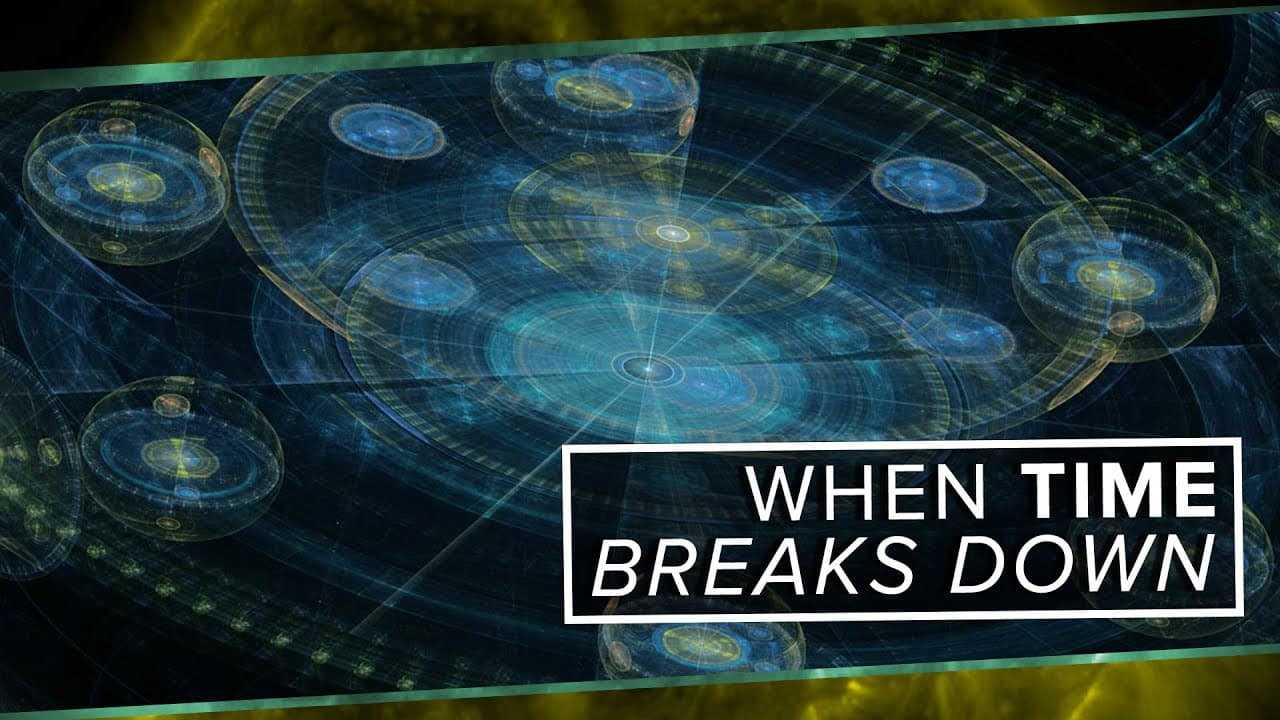
When Time Breaks Down
TL;DR
Explores the relationship between motion, matter, and time.
Transcript
In the last episode, we saw how matter feels mass because of the energy of its internal moving parts. You might want to watch that episode now, because today we're going to go even deeper and explore the connection between matter, motion, and the nature of time. The watched pot never boils. A boring college lecture lasts forever. While weekends a... Read More
Key Insights
- Time perception varies based on attention and internal neural clocks, affecting how we experience its passage.
- Atomic clocks, made from vibrating atoms, are the most accurate timekeepers, with minimal daily drift.
- Time's flow is linked to motion; faster objects appear to have slower clocks, leading to time dilation.
- Elementary particles, like quarks and electrons, experience time differently due to their high-speed motion.
- Einstein's photon clock thought experiment illustrates how time dilation occurs at high speeds.
- Gravitational fields also cause time dilation, where deeper fields result in slower ticking clocks.
- Confined light-speed particles give matter both mass and a sense of time through internal interactions.
- The direction and structure of time are influenced by the inability of matter to reach light speed.
Install to Summarize YouTube Videos and Get Transcripts
Explore YouTube Video Summarizer or Get YouTube Transcript Extractor
Questions & Answers
Q: How does motion affect time perception?
Motion affects time perception through time dilation, a phenomenon where faster-moving objects experience slower clocks relative to stationary observers. This is based on Einstein's theory of relativity, where the speed of light remains constant for all observers, causing moving clocks to tick slower than stationary ones.
Q: What role do atomic clocks play in understanding time?
Atomic clocks are crucial in understanding time as they provide the most accurate measurement of time, with minimal drift. They rely on the consistent vibrations of atoms, such as cesium, to measure seconds precisely. This accuracy helps test theories like relativity and understand time dilation effects.
Q: Why are elementary particles considered timeless?
Elementary particles, like quarks and electrons, are considered timeless because they move at such high speeds that they experience time differently. In essence, these particles are bound by forces that prevent them from experiencing time as we do, making them appear timeless in their interactions and motion.
Q: What is the photon clock thought experiment?
The photon clock thought experiment involves a photon bouncing between two mirrors, with each bounce representing a tick of the clock. This experiment illustrates time dilation by showing that as the clock moves at high speeds, the photon takes longer to complete a bounce, causing the clock to tick slower compared to a stationary one.
Q: How does gravitational time dilation occur?
Gravitational time dilation occurs because clocks in stronger gravitational fields tick slower than those in weaker fields. According to Einstein's general relativity, a gravitational field is indistinguishable from an accelerating frame, leading to slower ticking clocks deeper in the gravitational field due to increased distance for photon travel.
Q: What is the connection between mass and time in matter?
The connection between mass and time in matter lies in the confinement of light-speed particles within atoms. This confinement gives matter its mass and allows it to experience time through internal interactions. The bundling of these particles results in the evolution of matter, similar to time perception in our brains.
Q: Why can't matter reach the speed of light?
Matter can't reach the speed of light due to the energy required to accelerate it to such speeds. As an object's speed increases, its relativistic mass increases, requiring exponentially more energy to continue accelerating. This limitation prevents matter from achieving light speed, preserving its structure and allowing it to experience time.
Q: Is time a real dimension, and what defines its direction?
Time is considered a real dimension in the framework of spacetime, where it exists alongside spatial dimensions. Its direction, often referred to as the arrow of time, is defined by entropy, which tends to increase in isolated systems. This increase in disorder gives time its perceived forward direction.
Summary & Key Takeaways
-
This episode delves into the intricate relationship between motion, matter, and time, using Einstein's photon clock thought experiment to explain time dilation. It highlights how the speed of light affects time perception and how gravitational fields contribute to this phenomenon.
-
The discussion extends to atomic clocks, which are highly accurate due to their reliance on atomic vibrations. The episode also explores how elementary particles experience time differently because of their high speeds, making them essentially timeless.
-
Time dilation is further explained through the effects of high-speed motion and gravitational fields, showing how confined light-speed particles contribute to the perception of time and mass in matter. The episode raises questions about the nature and direction of time.
Read in Other Languages (beta)
Share This Summary 📚
Summarize YouTube Videos and Get Video Transcripts with 1-Click
Try YouTube Summary with ChatGPT & Claude or YouTube Transcript Generator
Explore More Summaries from PBS Space Time 📚



Summarize YouTube Videos and Get Video Transcripts with 1-Click
Try YouTube Summary with ChatGPT & Claude or YouTube Transcript Generator