How Does Gravity Warp the Flow of Time?
TL;DR
Gravity affects time, causing dilation due to spacetime curvature.
Transcript
Over the course of your life your feet will age approximately 1 second more than your head due to gravitational time dilation - and that’s assuming that your life is long and that you’re quite tall. But that tiny difference in flow of time may be what keeps you stuck to this planet at all. Albert Einstein really enjoyed imagining people falling off... Read More
Key Insights
- Gravitational time dilation causes time to pass differently at varying heights, with feet aging faster than the head over a lifetime.
- Einstein's equivalence principle suggests no experiment can distinguish between freefall and being in space without gravity.
- General relativity explains gravity through spacetime curvature, where mass and energy influence the flow of time and space.
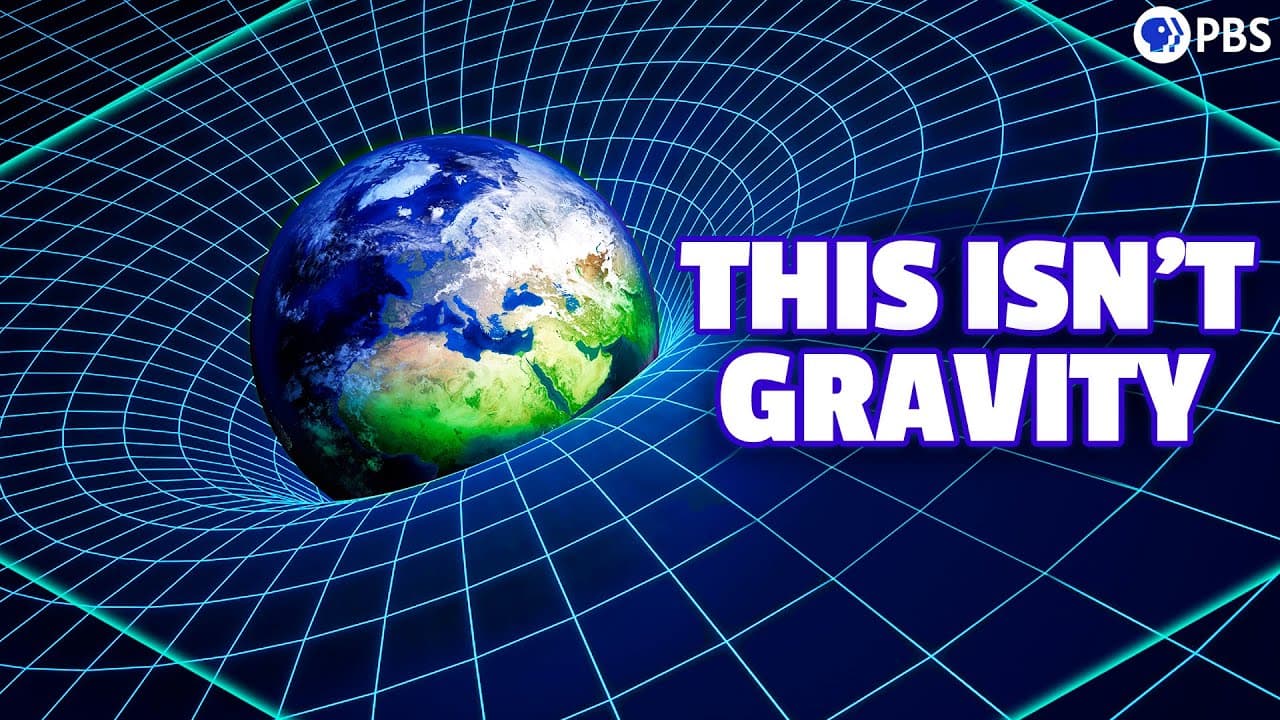
- The rubber sheet analogy is an oversimplification, as time curvature plays a significant role in gravitational effects.
- Time dilation in gravitational fields is analogous to time dilation experienced in accelerating frames due to the equivalence principle.
- The concept of time dilation is rooted in the constancy of the speed of light and its implications in special relativity.
- Artificial gravity in rotating frames provides insights into gravitational time dilation through comparisons with inertial frames.
- Gravitational time dilation is a fundamental aspect of gravity, where slowed time contributes to gravitational attraction.
Install to Summarize YouTube Videos and Get Transcripts
Explore YouTube Video Summarizer or Get YouTube Transcript Extractor
Questions & Answers
Q: What is gravitational time dilation?
Gravitational time dilation is a phenomenon where time passes at different rates in a gravitational field. This occurs because the presence of mass and energy curves spacetime, affecting the flow of time. As a result, clocks closer to massive objects tick slower compared to those further away, leading to differences in aging and time perception.
Q: How does the equivalence principle relate to gravitational time dilation?
The equivalence principle, proposed by Einstein, states that there is no local experiment that can distinguish between freefall in a gravitational field and being in a space without gravity. This principle implies that the effects of acceleration and gravity are indistinguishable, leading to the conclusion that time dilation experienced in accelerating frames must also occur in gravitational fields.
Q: Why is the rubber sheet analogy insufficient to explain gravity?
The rubber sheet analogy simplifies gravity by depicting spacetime curvature as a two-dimensional surface with a mass causing a depression. However, this analogy fails to capture the full picture, as it overlooks the significant role of time curvature in gravitational effects. In reality, both space and time are curved by mass and energy, influencing how objects move and experience time.
Q: How does special relativity contribute to understanding gravitational time dilation?
Special relativity introduces the concept of time dilation due to relative motion, where moving clocks appear to tick slower. This principle, combined with the constancy of the speed of light, provides a foundation for understanding gravitational time dilation. By extending these ideas to accelerating frames and applying the equivalence principle, we can comprehend how time dilation occurs in gravitational fields.
Q: What role does artificial gravity play in understanding time dilation?
Artificial gravity, created through rotation or acceleration, simulates gravitational effects and provides insights into time dilation. By comparing time passage in rotating frames to inertial frames, we can observe time dilation similar to that experienced in gravitational fields. This comparison helps illustrate the equivalence principle and the fundamental connection between acceleration, gravity, and time dilation.
Q: How does time dilation affect aging at different heights?
Due to gravitational time dilation, time passes at different rates depending on height in a gravitational field. Clocks closer to the ground, experiencing stronger gravitational pull, tick slower compared to those at higher altitudes. Over a lifetime, this results in a small but measurable difference in aging, with feet aging slightly more than the head due to being closer to the Earth's mass.
Q: Why is the connection between time and gravity significant?
The connection between time and gravity is significant because it reveals the fundamental nature of gravitational attraction. Gravitational time dilation, where time slows in a gravitational field, contributes to the force of gravity. This relationship highlights the intricate interplay between spacetime curvature and mass, emphasizing how time itself influences gravitational behavior and the structure of the universe.
Q: What is the impact of time curvature in gravitational fields?
Time curvature in gravitational fields is a crucial factor in gravitational attraction. While spatial curvature contributes to the bending of paths, it is the curvature of time that primarily influences the movement of objects. This time curvature causes time to pass differently at various points in a gravitational field, leading to the experience of gravitational force and the attraction between masses.
Summary & Key Takeaways
-
Gravitational time dilation is a phenomenon where time slows down in a gravitational field, causing differences in aging at different heights. Einstein's equivalence principle and general relativity explain this effect through the curvature of spacetime, where mass and energy influence time and space.
-
The equivalence principle suggests that freefall in a gravitational field is indistinguishable from floating in space. This principle, combined with the constancy of the speed of light, leads to gravitational time dilation, where time passes differently in gravitational fields compared to inertial frames.
-
Artificial gravity, created through rotation or acceleration, can mimic gravitational effects, providing insights into time dilation. The interplay between time and gravity is complex, with slowed time contributing to gravitational attraction, highlighting the deep connection between time and gravity in curved spacetime.
Read in Other Languages (beta)
Share This Summary 📚
Summarize YouTube Videos and Get Video Transcripts with 1-Click
Try YouTube Summary with ChatGPT & Claude or YouTube Transcript Generator
Explore More Summaries from PBS Space Time 📚
Summarize YouTube Videos and Get Video Transcripts with 1-Click
Try YouTube Summary with ChatGPT & Claude or YouTube Transcript Generator