Composite Functions and Inverse Functions | Precalculus
TL;DR
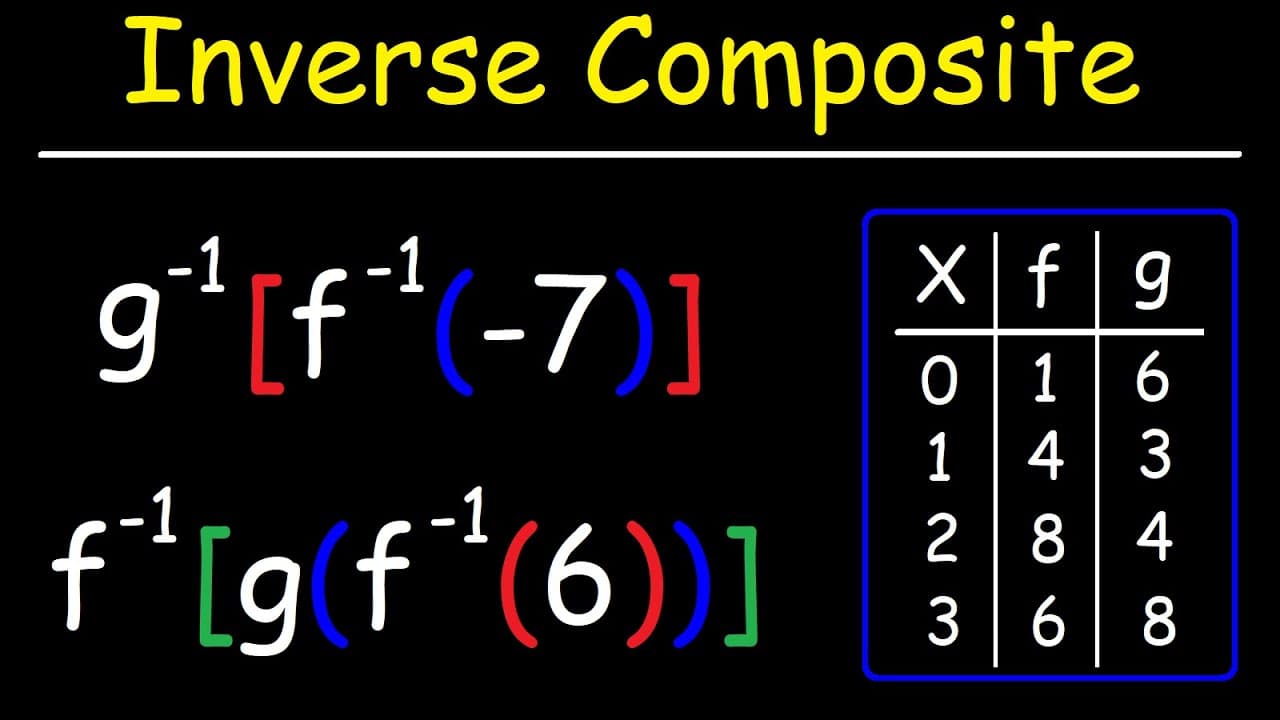
This video explains how to evaluate composite functions and inverse functions using data tables.
Transcript
in this video we're going to talk about composite functions and inverse functions combine so let's start with the basics using the data table that we have on the right side evaluate this expression what is the value of f of 2. F of 2 if we look at the function f and the x value 2 it will give us a value of 8. so F of 2 is equal to 8. now what is f ... Read More
Key Insights
- ❓ Composite functions involve evaluating multiple functions together.
- ❣️ Inverse functions are obtained by switching the x and y values of the original function.
- ❣️ When evaluating composite functions, you look for the y value in regular functions and the x value in inverse functions.
- ☺️ The inverse of a function can be found by looking for the corresponding x value.
- 🪈 The order of operations in composite functions is important.
- ❓ Practice and familiarity with the functions make evaluating composite and inverse functions easier.
- ❓ Composite functions with inverse functions can be evaluated by following the same principles.
Install to Summarize YouTube Videos and Get Transcripts
Explore YouTube Video Summarizer or Get YouTube Transcript Extractor
Questions & Answers
Q: What is the difference between composite functions and inverse functions?
Composite functions involve combining multiple functions together by substituting the output of one function into another. Inverse functions, on the other hand, are obtained by switching the x and y values of the original function.
Q: How do you evaluate composite functions?
To evaluate composite functions, you substitute the output of one function into another function. For regular functions, you look for the y value. For inverse functions, you look for the x value.
Q: What is the inverse of f of negative 7?
To find the inverse of f of negative 7, you look for the x value in the function f where the y value is -7. In this case, the inverse is 4, as f of 4 is equal to -7.
Q: How do you evaluate the inverse of G of 5?
Since G of 5 is a y value, to find the inverse, you look for the corresponding x value. In this case, the inverse of G of 5 is 4.
Summary & Key Takeaways
-
Composite functions involve evaluating multiple functions together by substituting the output of one function as the input for another function.
-
Inverse functions are obtained by switching the x and y values of the original function.
-
When evaluating composite functions, you look for the y value in regular functions and the x value in inverse functions.
Read in Other Languages (beta)
Share This Summary 📚
Summarize YouTube Videos and Get Video Transcripts with 1-Click
Try YouTube Summary with ChatGPT & Claude or YouTube Transcript Generator
Explore More Summaries from The Organic Chemistry Tutor 📚
Summarize YouTube Videos and Get Video Transcripts with 1-Click
Try YouTube Summary with ChatGPT & Claude or YouTube Transcript Generator