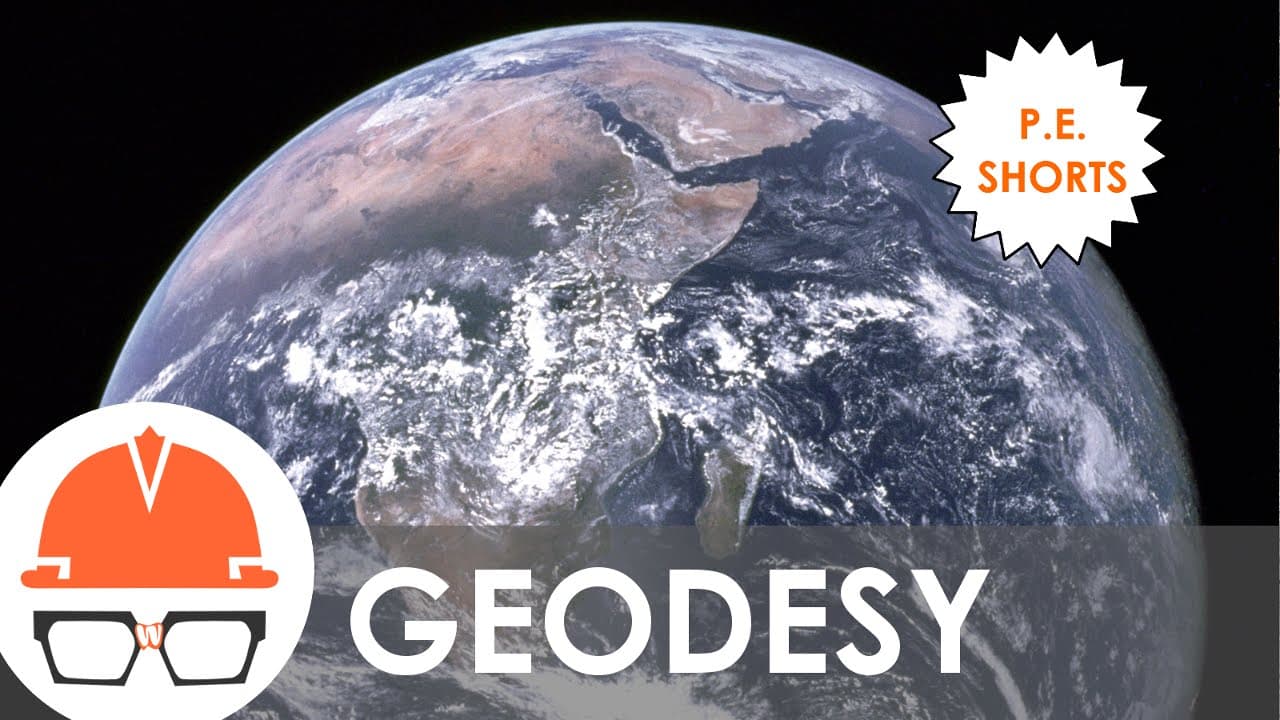
Sphere Earth Conspiracy - Geodesy
TL;DR
Geodesy explains Earth's shape as an oblate spheroid, aiding navigation and mapping.
Transcript
This year has seen more then the usual number of references to flat Earth conspiracies in the news Including some very fascinating Twitter tirades. I think thats as good a reason as any to talk about a field of engineering and Earth science that you may have never heard of before. Geodesy Im Grady, and this is Practical Engineering shorts. Where we... Read More
Key Insights
- Geodesy is the science that helps us understand the shape and size of the Earth, crucial for navigation and mapping.
- The Earth is not a perfect sphere but an oblate spheroid, bulging at the equator due to its rotation.
- Geodesists use reference ellipsoids to create accurate models of Earth's shape for geodetic computations.
- GPS technology relies on these geodetic models to provide precise location data across the globe.
- Understanding Earth's shape is vital for defining boundaries between land parcels, states, and countries.
- Short distances can assume flat Earth for calculations, but long distances require more complex geodetic methods.
- Geodesy provides the mathematical framework necessary for accurate global positioning and navigation.
- The field of geodesy supports various sciences and technologies by providing a structured model of Earth.
Install to Summarize YouTube Videos and Get Transcripts
Explore YouTube Video Summarizer or Get YouTube Transcript Extractor
Questions & Answers
Q: What is geodesy and why is it important?
Geodesy is the science that deals with the measurement and representation of the Earth, including its gravitational field, in a three-dimensional time-varying space. It is crucial for navigation, mapping, and understanding Earth's shape, enabling precise location data and boundary definitions essential for various technologies and sciences.
Q: Why is the Earth not considered a perfect sphere?
The Earth is not a perfect sphere due to its rotation, which causes it to bulge at the equator, making it an oblate spheroid. This bulging affects calculations over long distances, necessitating more complex models like ellipsoids for accurate geodetic computations and navigation systems.
Q: How do GPS systems use geodesy?
GPS systems rely on geodetic models, specifically reference ellipsoids, to provide precise location data. These models account for Earth's oblate spheroid shape, enabling accurate calculations of distances and positions across the globe, essential for navigation and mapping technologies.
Q: What role do reference ellipsoids play in geodesy?
Reference ellipsoids are mathematical models used in geodesy to approximate the shape of the Earth. They serve as the basis for geodetic computations, allowing for accurate mapping, navigation, and positioning by providing a standardized framework to represent Earth's oblate spheroid form.
Q: How does geodesy help in defining land boundaries?
Geodesy provides the mathematical framework needed to define precise boundaries between land parcels, states, and countries. By accurately representing Earth's shape and size, geodesy ensures that boundaries are consistently and accurately mapped, which is essential for legal and administrative purposes.
Q: Why can't we use simple Cartesian coordinates for long-distance calculations on Earth?
Simple Cartesian coordinates assume a flat Earth, which works for short distances but fails over long distances due to Earth's curvature. Geodesy uses more complex models like ellipsoids to account for Earth's oblate spheroid shape, enabling accurate calculations for navigation and mapping over long distances.
Q: What is the significance of the oblate spheroid model in geodesy?
The oblate spheroid model is significant in geodesy as it closely represents Earth's true shape, accounting for its equatorial bulge. This model allows for accurate geodetic computations, essential for navigation, mapping, and understanding spatial relationships on a global scale, supporting various technologies.
Q: How does geodesy support other sciences and technologies?
Geodesy supports other sciences and technologies by providing a precise model of Earth's shape and size, enabling accurate location data and mapping. This foundational framework is crucial for navigation, environmental monitoring, land surveying, and any technology requiring precise geospatial information.
Summary & Key Takeaways
-
Geodesy is the field of science that characterizes the Earth's shape and size, which is crucial for navigation and mapping tasks. This discipline helps answer how pilots navigate over oceans and how boundaries are defined. It uses mathematical frameworks to address the complexities of Earth's true form.
-
The Earth is not a perfect sphere but an oblate spheroid, which complicates calculations over long distances. Geodesists use reference ellipsoids to match Earth's shape for accurate geodetic computations, forming the basis for systems like latitude and longitude used in GPS technology.
-
Understanding Earth's shape is essential for precise global positioning, helping define land boundaries and aiding various sciences. Geodesy provides a structured model of Earth, supporting technologies that rely on accurate location data, demonstrating its importance in modern navigation and mapping.
Read in Other Languages (beta)
Share This Summary 📚
Summarize YouTube Videos and Get Video Transcripts with 1-Click
Try YouTube Summary with ChatGPT & Claude or YouTube Transcript Generator
Explore More Summaries from Practical Engineering 📚





Summarize YouTube Videos and Get Video Transcripts with 1-Click
Try YouTube Summary with ChatGPT & Claude or YouTube Transcript Generator