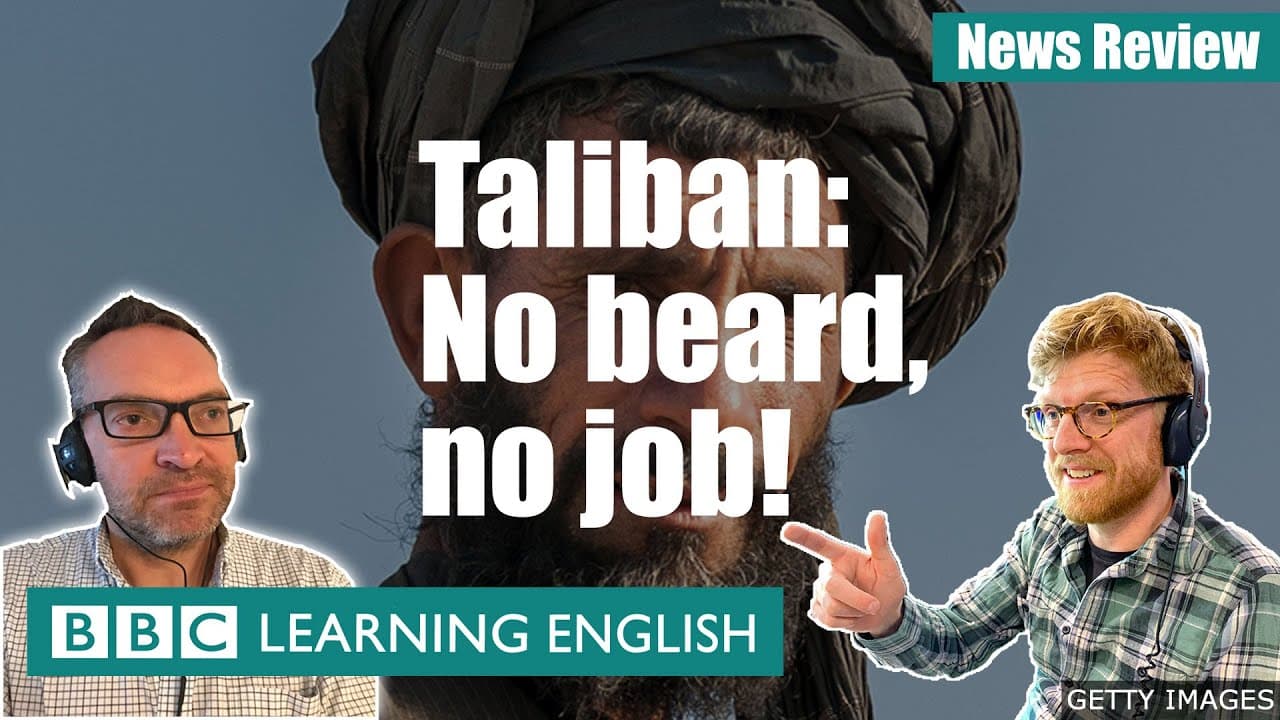
Taliban: No beard, no job!: BBC News Review
TL;DR
Taliban mandates beards for Afghan government workers.
Transcript
'No beard, no job' for government workers in Afghanistan. This is News Review from BBC Learning English. I'm Rob and joining me to talk about the language behind the headlines is Neil. Hello Neil. Hi there, Rob, and hello everyone. If you'd like to test yourself on the vocabulary we look at in this programme, there is a quiz on our website at bbcle... Read More
Key Insights
- The Taliban government in Afghanistan has announced a new rule requiring male government employees to have beards, linking this to religious adherence.
- This mandate is part of a broader series of restrictions imposed by the Taliban since they regained control of Afghanistan in August.
- Key vocabulary from the news includes 'hardliners,' 'bars,' and 'show up,' each offering different connotations related to the story.
- 'Hardliners' refers to individuals with strong, unwavering beliefs, often used in political contexts to describe those with extreme views.
- 'Bars' is used as a verb to mean officially preventing something from happening, similar to banning or stopping an action.
- 'Show up' is a phrasal verb meaning to appear or arrive at a place, often used in informal contexts.
- The Ministry for the Propagation of Virtue and Prevention of Vice is enforcing these new rules, threatening job loss for non-compliance.
- The Taliban's actions reflect their strict interpretation of Islamic law, impacting everyday life and employment in Afghanistan.
Install to Summarize YouTube Videos and Get Transcripts
Explore YouTube Video Summarizer or Get YouTube Transcript Extractor
Questions & Answers
Q: What new rule has the Taliban imposed on government workers in Afghanistan?
The Taliban has imposed a rule requiring male government workers in Afghanistan to have beards. This mandate is part of a broader series of restrictions reflecting their strict interpretation of Islamic principles. Non-compliance with this rule could result in job loss, illustrating the Taliban's control over personal and professional aspects of life.
Q: What is the significance of the term 'hardliners' in the context of the Taliban's new rules?
In the context of the Taliban's new rules, 'hardliners' refers to individuals within the Taliban who hold strict, unwavering beliefs about how society should be governed. These individuals often have the most extreme interpretations of Islamic law, influencing the implementation of policies such as the beard mandate for government workers.
Q: How does the term 'bars' relate to the Taliban's recent actions?
The term 'bars' is used to describe the Taliban's action of officially preventing government workers without beards from working. It is a verb indicating the enforcement of restrictions, similar to banning or stopping, and highlights the authoritative measures the Taliban is employing to ensure adherence to their rules.
Q: What does the phrasal verb 'show up' mean in the discussed content?
In the discussed content, 'show up' is a phrasal verb meaning to appear or arrive at a place. It is used to describe the expectation that government workers in Afghanistan must 'show up' at work with beards, emphasizing the requirement for physical appearance compliance as part of their professional obligations.
Q: What role does the Ministry for the Propagation of Virtue and Prevention of Vice play in the new Taliban rules?
The Ministry for the Propagation of Virtue and Prevention of Vice is responsible for enforcing the new Taliban rules, such as the beard mandate for government workers. This ministry is tasked with ensuring adherence to Islamic principles, and non-compliance with their rules can result in severe consequences, including job loss.
Q: What other restrictions have the Taliban imposed since their takeover?
Since their takeover, the Taliban has imposed several restrictions, including the beard mandate for government workers. These restrictions are part of a broader effort to enforce their strict interpretation of Islamic law, affecting various aspects of life in Afghanistan, from personal appearance to professional conduct.
Q: How does the Taliban's beard mandate affect everyday life in Afghanistan?
The Taliban's beard mandate affects everyday life in Afghanistan by imposing strict personal appearance requirements on government workers, linking job security to adherence to Islamic principles. This reflects the broader impact of the Taliban's governance style, which prioritizes religious conformity over individual freedoms, influencing both personal and professional spheres.
Q: What resources does BBC Learning English provide to understand the discussed vocabulary?
BBC Learning English provides various resources to understand the discussed vocabulary, including quizzes and detailed explanations of terms like 'hardliners,' 'bars,' and 'show up.' These resources aim to enhance comprehension of news-related language and are available on their website, offering interactive ways to learn and apply new vocabulary.
Summary & Key Takeaways
-
The Taliban government has instituted a rule requiring Afghan government workers to have beards, reflecting their strict interpretation of Islamic principles. This is part of a series of new restrictions imposed since their takeover in August.
-
Key terms discussed include 'hardliners,' referring to those with rigid beliefs, 'bars,' meaning to officially prevent something, and 'show up,' which means to appear at a location.
-
The Ministry for the Propagation of Virtue and Prevention of Vice is enforcing these rules, with non-compliance potentially resulting in job loss, illustrating the Taliban's influence on daily life in Afghanistan.
Read in Other Languages (beta)
Share This Summary 📚
Summarize YouTube Videos and Get Video Transcripts with 1-Click
Try YouTube Summary with ChatGPT & Claude or YouTube Transcript Generator
Explore More Summaries from BBC Learning English 📚




Summarize YouTube Videos and Get Video Transcripts with 1-Click
Try YouTube Summary with ChatGPT & Claude or YouTube Transcript Generator