What Is Hypnotism and How Does It Work?
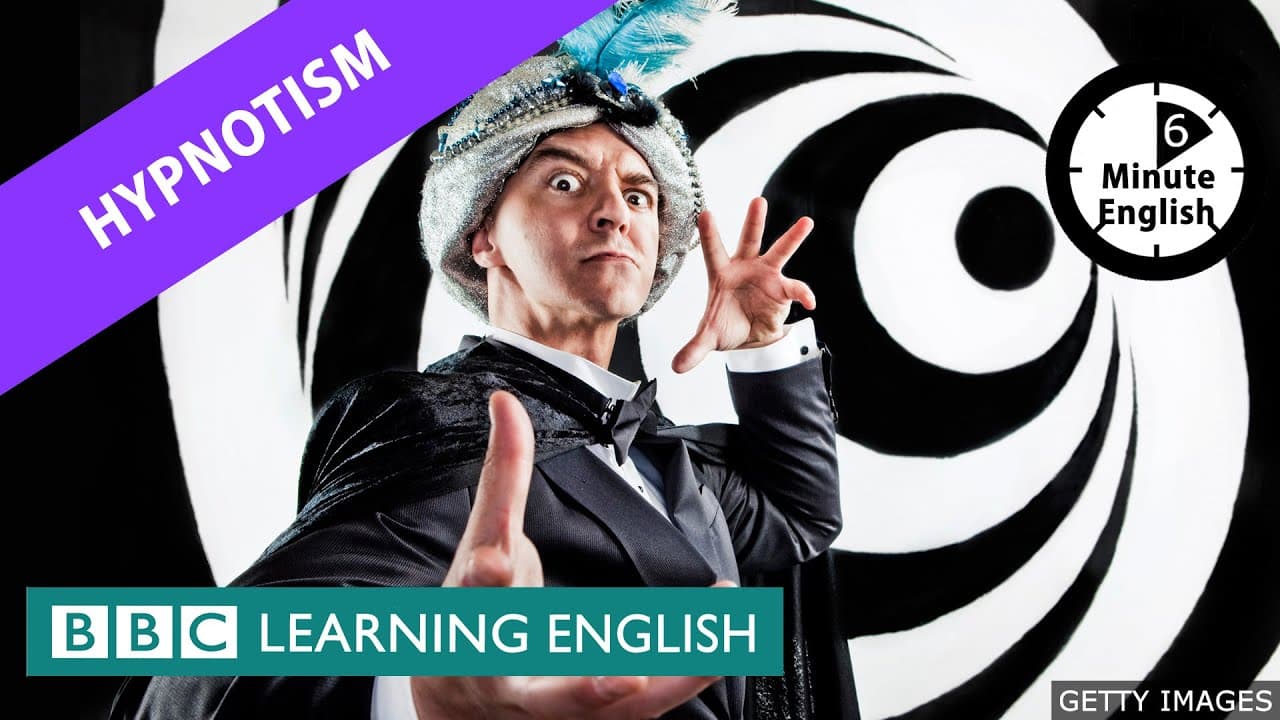
TL;DR
Hypnotism is a technique that induces a trance state where individuals can lose some control over their thoughts, often used for entertainment and therapy. The process relies on two key factors: absorption, which is being engrossed in an activity, and attention, which involves focusing on specific stimuli. Hypnotism has therapeutic benefits, including treating phobias and assisting in smoking cessation.
Transcript
Hello. This is 6 Minute English from BBC Learning English. I'm Rob. And I'm Sam. Now, Sam, look into my eyes! You are feeling sleepy! Relax! What are you doing, Rob? Trying to hypnotise me? Well, since hypnotism is the topic of this programme, I thought I'd give it a try! So how do you feel, Sam? Are you under my spell? Hmmm, I don't think so, Rob.... Read More
Key Insights
- Hypnotism involves a trance state where individuals are not fully in control, often used for entertainment or therapy.
- The ability to be hypnotised is linked to absorption and attention, not intelligence or gender.
- Absorption refers to becoming so engrossed in an activity that you lose track of time.
- Attention involves focusing on specific information to the exclusion of others, essential for hypnotism.
- Stage hypnotists use soothing speech to help subjects become absorbed in the hypnotic process.
- Franz Mesmer, a German doctor, was pivotal in popularising hypnotism, leading to the term 'mesmerised.'
- Hypnotism can help treat phobias and aid in quitting smoking by influencing subconscious behavior.
- The vocabulary related to hypnotism includes terms like trance, suggestible, hone in, and mesmerised.
Install to Summarize YouTube Videos and Get Transcripts
Explore YouTube Video Summarizer or Get YouTube Transcript Extractor
Questions & Answers
Q: What is the primary topic discussed in the programme?
The primary topic discussed in the programme is hypnotism. The hosts explore its use in entertainment and therapy, the factors influencing one's susceptibility to hypnosis, and the vocabulary associated with hypnotic practices. They also delve into the historical figure Franz Mesmer, whose name is linked to hypnotism.
Q: What are the two key factors that determine hypnotisability?
The two key factors determining hypnotisability are absorption and attention. Absorption refers to the ability to become deeply engrossed in an activity, losing track of time. Attention involves the capacity to focus intently on specific information, excluding other distractions, which is crucial for entering a hypnotic state.
Q: Who was Franz Mesmer, and why is he significant?
Franz Mesmer was a German doctor known for popularising hypnotism in Europe. His work was so influential that the term 'mesmerised' was derived from his name, signifying a state of complete focus and attention. Mesmer's contributions significantly shaped the understanding and practice of hypnotism.
Q: How does hypnotism help in treating phobias?
Hypnotism helps in treating phobias by accessing the subconscious mind, where deep-seated fears and responses reside. Through hypnotic suggestion, individuals can reframe their perceptions and reactions to phobic stimuli, reducing anxiety and fear. This therapeutic approach allows for behavioral changes at a subconscious level.
Q: What role does suggestibility play in hypnotism?
Suggestibility, the tendency to be easily influenced by others, is often mistakenly believed to be crucial for hypnotism. However, the programme explains that hypnotism relies more on absorption and attention. While suggestibility might aid the process, the ability to become deeply absorbed and focused is more important for achieving a hypnotic state.
Q: How do stage hypnotists facilitate the hypnotic process?
Stage hypnotists facilitate the hypnotic process by speaking in soothing, gentle tones to help individuals become absorbed and focused. This technique encourages subjects to relax and concentrate on the hypnotist's voice or an object, such as a swinging watch, which aids in guiding them into a trance state.
Q: What vocabulary is associated with hypnotism?
The vocabulary associated with hypnotism includes terms like 'trance,' which describes a state of altered consciousness; 'suggestible,' meaning easily influenced; 'lose track of time,' referring to deep absorption; 'get sucked into,' indicating involuntary involvement; 'hone in on,' meaning to focus intently; and 'mesmerised,' describing complete fixation of attention.
Q: What was the outcome of the quiz question in the programme?
The quiz question in the programme asked which famous hypnotist's name became a verb associated with hypnotic trances. The correct answer was Franz Mesmer, a German doctor whose work in hypnotism led to the term 'mesmerised.' This highlights his significant impact on the field and its vocabulary.
Summary & Key Takeaways
-
Hypnotism is discussed as both an entertainment form and a therapeutic tool, involving a trance state where individuals lose some control. The discussion includes the vocabulary associated with hypnotism and its effects.
-
Professor Amir Raz explains that the ability to be hypnotised depends on absorption and attention rather than intelligence or gender. Absorption involves getting engrossed in activities, while attention requires focusing on specific stimuli.
-
Franz Mesmer, a significant figure in the history of hypnotism, became synonymous with the practice, leading to the term 'mesmerised.' Hypnotism can aid in treating phobias and smoking cessation by accessing the subconscious.
Read in Other Languages (beta)
Share This Summary 📚
Summarize YouTube Videos and Get Video Transcripts with 1-Click
Try YouTube Summary with ChatGPT & Claude or YouTube Transcript Generator
Explore More Summaries from BBC Learning English 📚

Summarize YouTube Videos and Get Video Transcripts with 1-Click
Try YouTube Summary with ChatGPT & Claude or YouTube Transcript Generator