What Is Principal Component Analysis (PCA) and How Does It Work?
TL;DR
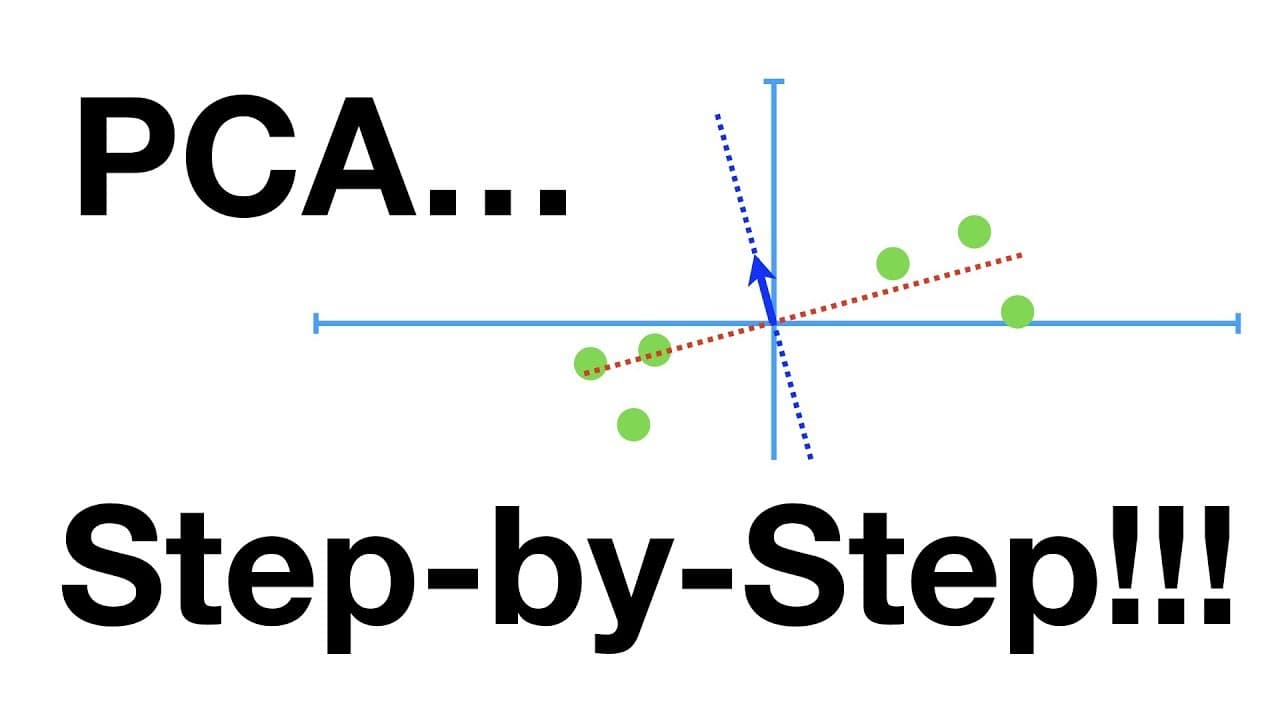
Principal Component Analysis (PCA) transforms high-dimensional data into 2D plots, enabling easier visualization and interpretation. By using Singular Value Decomposition (SVD), PCA identifies key variables and clusters in the data, calculates eigenvalues and eigenvectors, and summarizes the data's variability through principal components.
Transcript
StatQuest breaks it down into bite-sized pieces, hooray! Hello, I'm Josh Starmer and welcome to StatQuest. In this StatQuest we're going to go through Principal Component Analysis (PCA) one step at a time using Singular Value Decomposition (SVD). You'll learn about what PCA does, how it does it, and how to use it to get deeper insight into your dat... Read More
Key Insights
- ✋ PCA with SVD simplifies high-dimensional data visualization for better insights.
- 🖐️ Eigenvalues and eigenvectors play crucial roles in determining data variability and directions in PCA.
- 💻 The scree plot visualizes the proportional variation captured by each principal component in PCA.
- ❓ Optimizing data fitting along principal components enhances the accuracy of data representation.
- 🤩 PCA identifies key variables and clusters in data for effective analysis.
- ❓ PC1 and PC2 usually account for significant data variation in PCA, simplifying data visualization.
- 🦻 Eigenvalues indicate the variation explained by each principal component, aiding in data interpretation.
Install to Summarize YouTube Videos and Get Transcripts
Explore YouTube Video Summarizer or Get YouTube Transcript Extractor
Questions & Answers
Q: How does PCA using SVD simplify high-dimensional data visualization?
PCA with SVD simplifies high-dimensional data by identifying principal components, calculating eigenvalues/vectors, and creating 2D plots for better data interpretation, leading to insightful analysis.
Q: What is the significance of eigenvalues and eigenvectors in PCA?
Eigenvalues quantify the variation explained by each principal component, while eigenvectors determine the direction and magnitude of influence of variables in the data, aiding in data reduction and analysis.
Q: How does PCA optimize the fitting of the data to the principal components?
PCA optimizes data fitting by minimizing/maximizing squared distances from data points to the origin along principal components, ensuring a comprehensive representation of data variability.
Q: Why is the scree plot important in PCA analysis?
The scree plot showcases the percentage of variation accounted for by each principal component, helping in determining the significance of each component in capturing data variability.
Summary & Key Takeaways
-
StatQuest breaks down Principal Component Analysis (PCA) using Singular Value Decomposition (SVD) to simplify high-dimensional data visualization.
-
PCA identifies key variables for clustering data, calculates eigenvalues and vectors, and creates 2D projections for data interpretation.
-
By understanding PCA with SVD, complex data relationships can be visualized and analyzed effectively.
Read in Other Languages (beta)
Share This Summary 📚
Summarize YouTube Videos and Get Video Transcripts with 1-Click
Try YouTube Summary with ChatGPT & Claude or YouTube Transcript Generator
Explore More Summaries from StatQuest with Josh Starmer 📚




Summarize YouTube Videos and Get Video Transcripts with 1-Click
Try YouTube Summary with ChatGPT & Claude or YouTube Transcript Generator