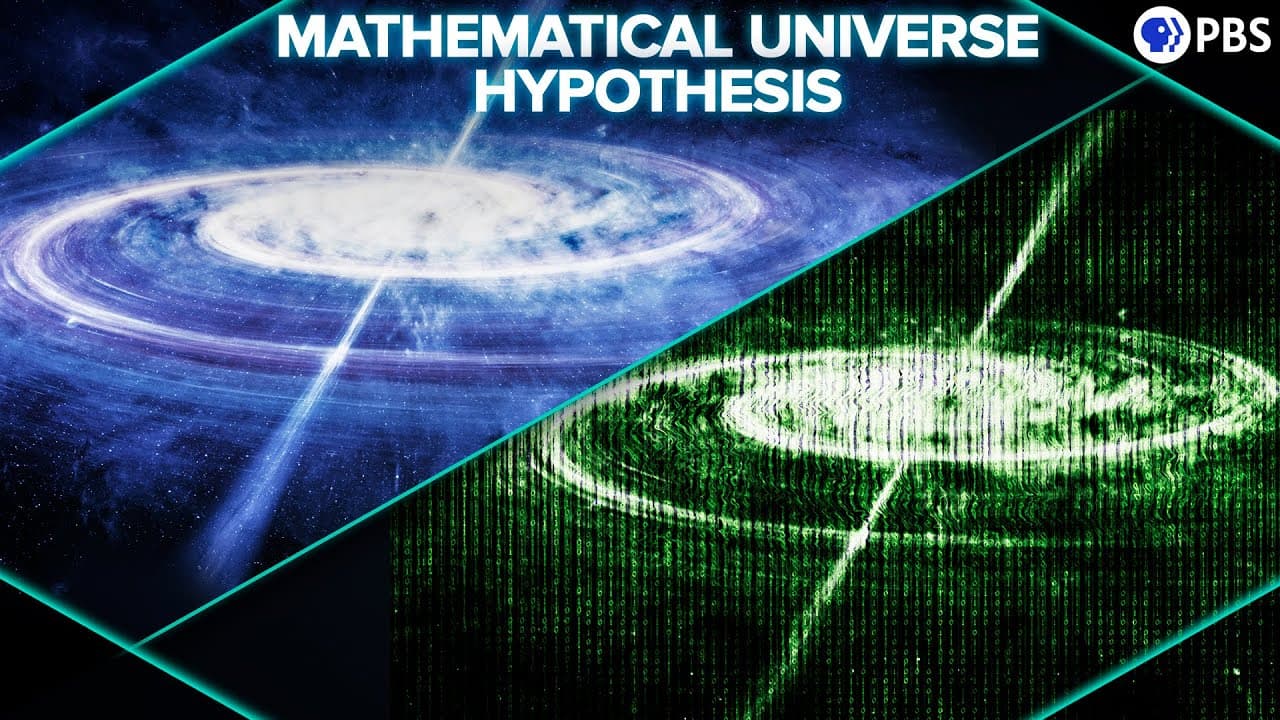
What If The Universe Is Math?
TL;DR
Explores the Mathematical Universe Hypothesis and its implications.
Transcript
Cats are curious and fluffty. They’re also made of cells that are made of molecules that are made of atoms that are made of particles that are made of quantum fields. But quantum fields are neither curious nor fluffy. They have no subjective qualities and have questionable physicality. They seem to be completely describable by only numbers, and the... Read More
Key Insights
- The Mathematical Universe Hypothesis suggests that our physical reality is fundamentally a mathematical structure, implying that all aspects of the universe can be described by mathematical equations.
- Eugene Wigner's observation on the effectiveness of mathematics in natural sciences highlights the mysterious precision with which mathematical equations describe physical phenomena.
- Max Tegmark's hypothesis posits that if mathematical existence equals physical existence, then all self-consistent mathematical structures could exist as physical realities.
- The theory suggests a hierarchy of emergence, where complex phenomena arise from simpler mathematical laws, with theories at the top being language-heavy and those at the bottom being math-heavy.
- The idea challenges traditional views by proposing that mathematical structures do not need physical implementation to exist, only the potential for implementation.
- Critics argue that mathematics may not be fundamental to reality, citing Gödel's incompleteness theorems which suggest that not all mathematical statements can be proven true or false.
- The hypothesis raises philosophical questions about the nature of existence, suggesting that if everything possible exists, then existence itself might be the default state.
- The theory remains untestable with current scientific methods, relying instead on anthropic reasoning and philosophical exploration to evaluate its plausibility.
Install to Summarize YouTube Videos and Get Transcripts
Explore YouTube Video Summarizer or Get YouTube Transcript Extractor
Questions & Answers
Q: What is the Mathematical Universe Hypothesis?
The Mathematical Universe Hypothesis, proposed by Max Tegmark, posits that our external physical reality is fundamentally a mathematical structure. This means that the universe is not just described by mathematics but is, in essence, made of mathematics. It suggests that all aspects of reality can be understood through mathematical equations, extending the idea that mathematics is not merely a tool but the very fabric of existence.
Q: How does the hypothesis relate to the concept of a multiverse?
The Mathematical Universe Hypothesis suggests that if mathematical existence equates to physical existence, then all self-consistent mathematical structures could manifest as physical realities. This leads to the idea of a multiverse, where each possible mathematical structure corresponds to a different universe. Tegmark's Level 4 multiverse encompasses an infinite number of such universes, each governed by its own set of mathematical laws.
Q: What are some criticisms of the Mathematical Universe Hypothesis?
Critics argue that mathematics may not be fundamental to reality, pointing to Kurt Gödel's incompleteness theorems, which indicate that within any mathematical system, there are statements that cannot be proven true or false. This suggests that mathematics might be a human construct rather than a cosmic language. Additionally, the hypothesis remains untestable with current scientific methods, relying on philosophical reasoning rather than empirical evidence.
Q: How does the hypothesis challenge traditional views of reality?
The hypothesis challenges traditional views by proposing that the universe is not merely described by mathematics but is fundamentally mathematical in nature. This shifts the perspective from mathematics as a descriptive tool to mathematics as the essence of existence. It suggests that all self-consistent mathematical structures have physical existence, leading to a potentially infinite multiverse and questioning the nature of reality itself.
Q: What philosophical questions does the hypothesis raise?
The hypothesis raises several philosophical questions, including the nature of existence and reality. It suggests that if everything possible exists, then existence might be the default state rather than nothingness. This aligns with the Principle of Fecundity, which posits that all possible things exist. It also questions whether mathematical structures need physical implementation to exist or if potential for implementation suffices.
Q: Is the Mathematical Universe Hypothesis testable?
Currently, the Mathematical Universe Hypothesis is not testable with existing scientific methods. It relies on anthropic reasoning and philosophical exploration to evaluate its plausibility. The hypothesis suggests that we should expect to find ourselves in the most typical mathematical structure capable of supporting our existence, but without knowing what structures are possible, this remains speculative.
Q: What is the significance of Gödel's incompleteness theorems in this context?
Gödel's incompleteness theorems are significant because they suggest limitations within mathematical frameworks, indicating that not all mathematical statements can be proven true or false. This challenges the idea that mathematics is a perfect, cosmic language and poses a problem for the Mathematical Universe Hypothesis, which relies on the internal consistency of mathematical structures to assert their physical existence.
Q: How does the hypothesis view the relationship between mathematics and physical reality?
The hypothesis views mathematics as the fundamental essence of physical reality, suggesting that mathematical existence is equivalent to physical existence. It proposes that the universe is not just described by mathematical equations but is itself a mathematical structure. This perspective challenges the traditional view of mathematics as a descriptive tool and suggests that all self-consistent mathematical structures manifest as physical realities.
Summary & Key Takeaways
-
The Mathematical Universe Hypothesis, proposed by Max Tegmark, suggests that our universe is fundamentally a mathematical structure, where physical reality is described by mathematical equations. This idea extends the notion that mathematics is not just a tool for describing the universe but is the universe itself.
-
The hypothesis implies that all self-consistent mathematical structures could exist as physical realities, leading to the concept of a multiverse where each possible mathematical structure manifests as a universe. This challenges traditional views of reality and raises philosophical questions about the nature of existence.
-
Critics of the hypothesis point to Gödel's incompleteness theorems, which suggest limitations in mathematical frameworks, and argue that mathematics may not be fundamental to reality. The hypothesis remains untestable with current scientific methods, relying on philosophical exploration for evaluation.
Read in Other Languages (beta)
Share This Summary 📚
Summarize YouTube Videos and Get Video Transcripts with 1-Click
Try YouTube Summary with ChatGPT & Claude or YouTube Transcript Generator
Explore More Summaries from PBS Space Time 📚
Summarize YouTube Videos and Get Video Transcripts with 1-Click
Try YouTube Summary with ChatGPT & Claude or YouTube Transcript Generator