What Are Atoms Made Of and Why Are They Important?
TL;DR
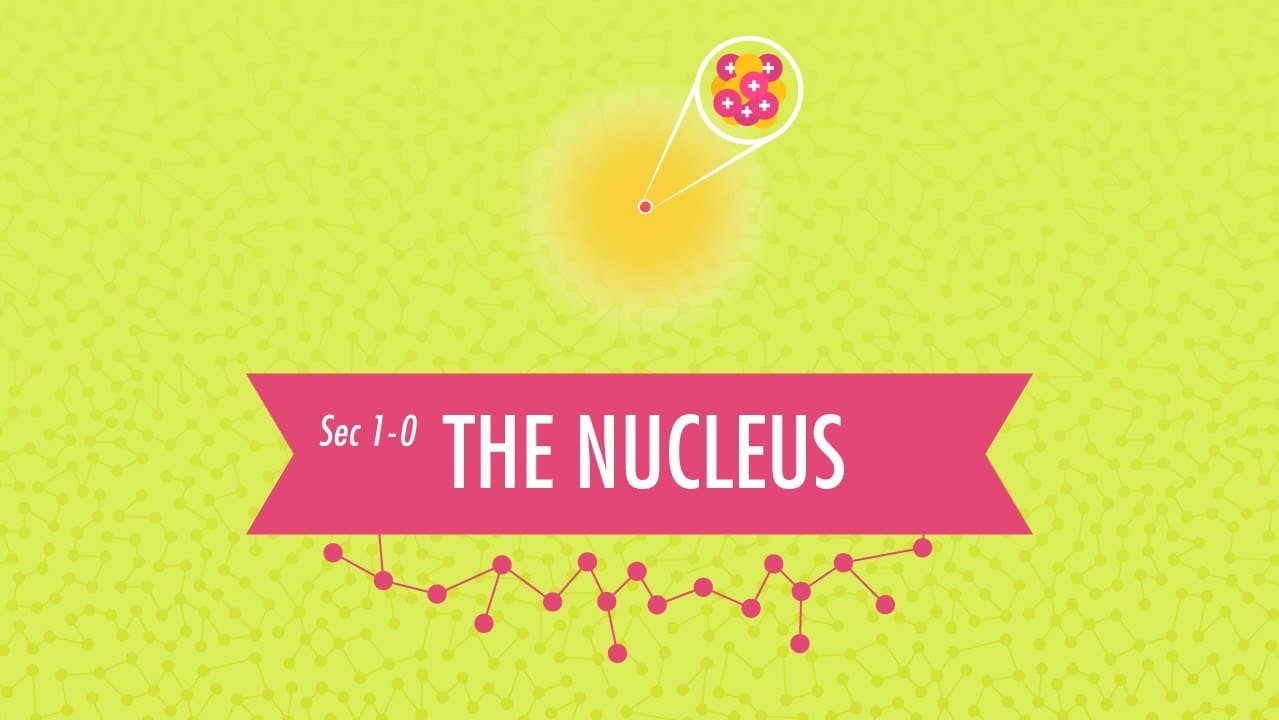
Atoms are composed of protons, neutrons, and electrons, with the nucleus containing protons and neutrons. The number of protons determines the element, while neutrons stabilize the nucleus. Isotopes vary in neutron count but share chemical properties, affecting atomic mass. Understanding atomic structure reveals chemistry's role in forming everything.
Transcript
Hello, I'm Hank Green and I want to teach you chemistry. But please, do not run away screaming. If you give me five minutes to try to convince you that chemistry is not torture, but instead the amazing and beautiful science of stuff, and if you give it a chance it will not only blow your mind but also give you a deeper understanding of your world. ... Read More
Key Insights
- Atoms are composed of three subatomic particles: protons, neutrons, and electrons.
- The number of protons in an atom's nucleus determines its element and is called the atomic number.
- Neutrons stabilize the nucleus by acting as a buffer between protons.
- Isotopes are variations of elements with different numbers of neutrons but the same number of protons.
- Relative atomic mass is an average of the masses of an element's isotopes.
- Nuclei are stable and largely unchanging, held together by the strong nuclear force.
- Electrons orbit the nucleus and are responsible for chemical reactions and properties.
- Einstein's work on Brownian motion provided evidence for the existence of atoms.
Install to Summarize YouTube Videos and Get Transcripts
Explore YouTube Video Summarizer or Get YouTube Transcript Extractor
Questions & Answers
Q: What are the components of an atom?
An atom is composed of three primary subatomic particles: protons, neutrons, and electrons. Protons and neutrons reside in the nucleus, while electrons orbit around it. Protons carry a positive charge, neutrons are neutral, and electrons have a negative charge. The interaction of these particles determines the atom's properties and behavior in chemical reactions.
Q: How does the atomic number define an element?
The atomic number of an element is defined by the number of protons in its nucleus. This number is unique to each element and determines its position on the periodic table. For example, an atom with 47 protons is always silver. The atomic number is the key identifier for elements, as it remains constant regardless of the atom's isotopic or chemical state.
Q: What role do neutrons play in an atom?
Neutrons play a crucial role in stabilizing an atom's nucleus. They act as a buffer between protons, which are positively charged and naturally repel each other. By providing this stabilization, neutrons help maintain the integrity of the nucleus, allowing atoms to exist in a stable form. The number of neutrons can vary, leading to different isotopes of the same element.
Q: What are isotopes and how do they differ?
Isotopes are variants of a particular chemical element that have the same number of protons but different numbers of neutrons. This difference in neutron count results in varying atomic masses but identical chemical properties. For instance, silver has isotopes with mass numbers 107 and 109, meaning they have different neutron counts but remain chemically similar.
Q: How is relative atomic mass calculated?
Relative atomic mass is calculated as the weighted average of the atomic masses of an element's isotopes, based on their natural abundance. It considers the different isotopes' masses and their relative proportions in a sample. This results in a value that is typically not a whole number, reflecting the presence of multiple isotopes with varying neutron counts.
Q: What evidence supports the existence of atoms?
One of the key pieces of evidence supporting the existence of atoms is Einstein's explanation of Brownian motion. In 1905, Einstein mathematically demonstrated that the random motion of pollen grains in water was due to collisions with atomic particles. This provided strong empirical support for the existence of atoms, which had been theorized but not conclusively proven until then.
Q: Why is the nucleus considered stable?
The nucleus is considered stable due to the strong nuclear force, which is one of the four fundamental forces of physics. This force binds protons and neutrons together, overcoming the repulsive electromagnetic force between positively charged protons. The stability of the nucleus is crucial for the atom's integrity and is a defining characteristic of elements.
Q: What is the role of electrons in chemical reactions?
Electrons play a fundamental role in chemical reactions, as they are involved in forming chemical bonds between atoms. The arrangement and movement of electrons determine how atoms interact, share, or transfer electrons to achieve stable electronic configurations. This electron behavior underpins the chemical properties of elements and the formation of molecules and compounds.
Summary & Key Takeaways
-
Atoms consist of protons, neutrons, and electrons, with protons defining the element. Neutrons provide stability, and isotopes vary in neutron count. Understanding atomic structure is crucial for grasping chemistry's role in forming matter.
-
The nucleus is the atom's core, containing protons and neutrons, while electrons orbit around. Protons determine the atomic number, crucial for identifying elements. Neutrons help stabilize the nucleus, preventing protons from repelling each other.
-
Isotopes are different forms of the same element with varying neutron numbers, affecting atomic mass. Despite their differences, isotopes share chemical properties. Einstein's work on Brownian motion confirmed atoms' existence, highlighting their fundamental role in chemistry.
Read in Other Languages (beta)
Share This Summary 📚
Summarize YouTube Videos and Get Video Transcripts with 1-Click
Try YouTube Summary with ChatGPT & Claude or YouTube Transcript Generator
Explore More Summaries from CrashCourse 📚





Summarize YouTube Videos and Get Video Transcripts with 1-Click
Try YouTube Summary with ChatGPT & Claude or YouTube Transcript Generator