Is The Wave Function The Building Block of Reality?
TL;DR
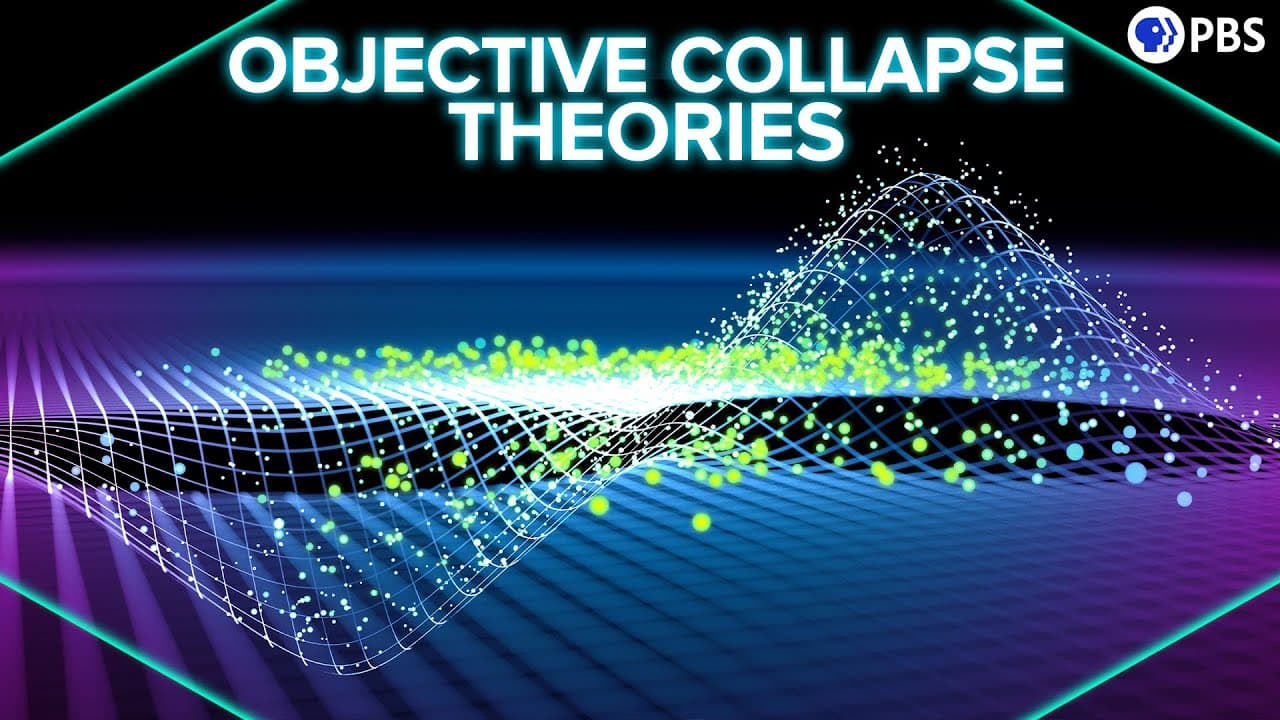
Explores wave function collapse theories in quantum mechanics.
Transcript
Thank you to Wren for supporting PBS. In the world of quantum mechanics, it’s no big deal for particles to be in multiple different states at the same time, or to teleport between locations, or to influence each other faster than light. But somehow, none of this strangeness makes its way to the familiar scale of human beings - even though our world... Read More
Key Insights
- Quantum mechanics allows particles to exist in multiple states simultaneously, unlike the classical world we observe.
- Wave function collapse is a central concept in quantum mechanics, describing how particles acquire definite properties upon measurement.
- The Copenhagen interpretation suggests wave function collapse is real, but lacks clarity on how or where it occurs.
- Objective collapse theories propose wave functions are real entities that collapse objectively, independent of observation.
- GRW theory introduces a non-linear term to the Schrödinger equation to model wave function collapse.
- Theories like Continuous Spontaneous Localization suggest wave function collapse is influenced by a fluctuating field.
- Penrose and Diósi propose gravity as the cause of wave function collapse, suggesting gravity isn't quantum.
- Objective collapse models are testable, offering potential experimental paths to understanding quantum mechanics.
Install to Summarize YouTube Videos and Get Transcripts
Explore YouTube Video Summarizer or Get YouTube Transcript Extractor
Questions & Answers
Q: What is the wave function in quantum mechanics?
The wave function in quantum mechanics is a mathematical description of the quantum state of a system. It provides information about the probabilities of a particle's properties, such as position or momentum, being found in particular states. The wave function is fundamental to quantum mechanics, as it encapsulates the uncertainties and potentialities inherent in quantum systems.
Q: How does wave function collapse occur?
Wave function collapse occurs when a measurement is made on a quantum system, causing the wave function to 'collapse' from a superposition of states to a single state. This process is central to the Copenhagen interpretation of quantum mechanics, which posits that the act of measurement causes the wave function to assume a definite state, although the exact mechanism and timing of this collapse remain subjects of debate and exploration.
Q: What is the Copenhagen interpretation of quantum mechanics?
The Copenhagen interpretation, developed by Niels Bohr and Werner Heisenberg, is one of the earliest and most widely taught interpretations of quantum mechanics. It suggests that quantum particles do not have definite properties until measured. The act of measurement causes the wave function to collapse into one of the possible states. However, it does not specify how or where this collapse occurs, leaving room for various interpretations and theories.
Q: What are objective collapse theories?
Objective collapse theories propose that wave functions are real, physical entities that collapse independently of observation or consciousness. These theories introduce modifications to the Schrödinger equation, adding non-linear terms that cause wave functions to collapse in a way that explains the quantum-classical transition. Unlike other interpretations, objective collapse theories offer testable predictions, making them distinct and significant in the study of quantum mechanics.
Q: How does GRW theory explain wave function collapse?
GRW theory, proposed by Giancarlo Ghirardi, Alberto Rimini, and Tullio Weber, adds a non-linear term to the Schrödinger equation to model wave function collapse. It suggests that wave functions undergo rare and random 'hits' that cause them to collapse to specific values. This process is more likely in systems with many particles, explaining why macroscopic objects appear classical while microscopic systems remain quantum.
Q: What role does gravity play in wave function collapse according to Penrose and Diósi?
Penrose and Diósi propose that gravity causes wave function collapse, offering an explanation for the quantum-classical transition and why gravity cannot be quantized like other forces. They suggest that the superposition of different space-time geometries is unstable, causing the wave function to collapse. This theory posits that gravity and quantum mechanics are fundamentally opposed, with gravity causing quantum systems to decohere into classical states.
Q: How can objective collapse models be tested?
Objective collapse models can be tested by attempting to place macroscopic objects in quantum superposition and measuring the time it takes for the superposition to collapse. The collapse time is expected to be proportional to the object's size. Indirect tests involve looking for signs of collapse, such as radiation emitted by jostled quantum wave functions. Experiments are ongoing to explore these predictions and provide insights into the nature of quantum mechanics.
Q: What challenges exist in testing objective collapse models?
Testing objective collapse models is challenging due to the need for precise measurements and the difficulty of isolating quantum systems from environmental influences. Experiments require minimizing background noise and interference, often conducted in controlled environments like underground laboratories. Despite these challenges, researchers continue to develop innovative methods to test the predictions of objective collapse models, hoping to gain a deeper understanding of quantum mechanics.
Summary & Key Takeaways
-
The video discusses the concept of wave function collapse in quantum mechanics, exploring various theories that explain how particles transition from quantum to classical states. Objective collapse theories propose that wave functions are real entities that collapse independently of observation, offering an explanation grounded in classical mechanics.
-
GRW theory introduces a non-linear term to the Schrödinger equation to model wave function collapse, suggesting that as the number of particles increases, the likelihood of collapse also increases. Penrose and Diósi propose that gravity causes wave function collapse, offering a solution to why gravity cannot be quantized like other forces.
-
Objective collapse models are distinct theories with unique predictions, making them testable unlike other interpretations of quantum mechanics. Experiments are being conducted to measure indirect signs of collapse models, which could provide insights into one of the biggest unanswered questions in physics.
Read in Other Languages (beta)
Share This Summary 📚
Summarize YouTube Videos and Get Video Transcripts with 1-Click
Try YouTube Summary with ChatGPT & Claude or YouTube Transcript Generator
Explore More Summaries from PBS Space Time 📚




Summarize YouTube Videos and Get Video Transcripts with 1-Click
Try YouTube Summary with ChatGPT & Claude or YouTube Transcript Generator