What Is the Russell Paradox and Its Implications?
TL;DR
The Russell Paradox arises from set theory and reveals the complexities of undecidability in mathematics. It illustrates that some propositions may be true but unprovable within a given system. Creative solutions, such as redefining parameters, can help navigate these paradoxes.
Transcript
today we're going to look at a result called the russell paradox it's part of our general effort to really understand what undecidability is all about because in the end we're going to move forward in time and we're going to redo and re-examine alan turing's halting problem paradox for his turing machines and to understand it completely and totally... Read More
Key Insights
- 😫 The Russell Paradox emerged from attempts to axiomatize arithmetic using set theory.
- 😫 Undecidability and paradoxes are inherent in mathematics, requiring deep understanding of the nature of propositions and sets.
- 🤔 Lateral thinking can offer creative solutions to paradoxes, challenging traditional logical frameworks.
- 😫 Gödel's incompleteness theorem demonstrated that no set of propositions can be completely proven from within itself, highlighting the fundamental limits of formal systems.
Install to Summarize YouTube Videos and Get Transcripts
Explore YouTube Video Summarizer or Get YouTube Transcript Extractor
Questions & Answers
Q: What is the Russell Paradox and how did it arise?
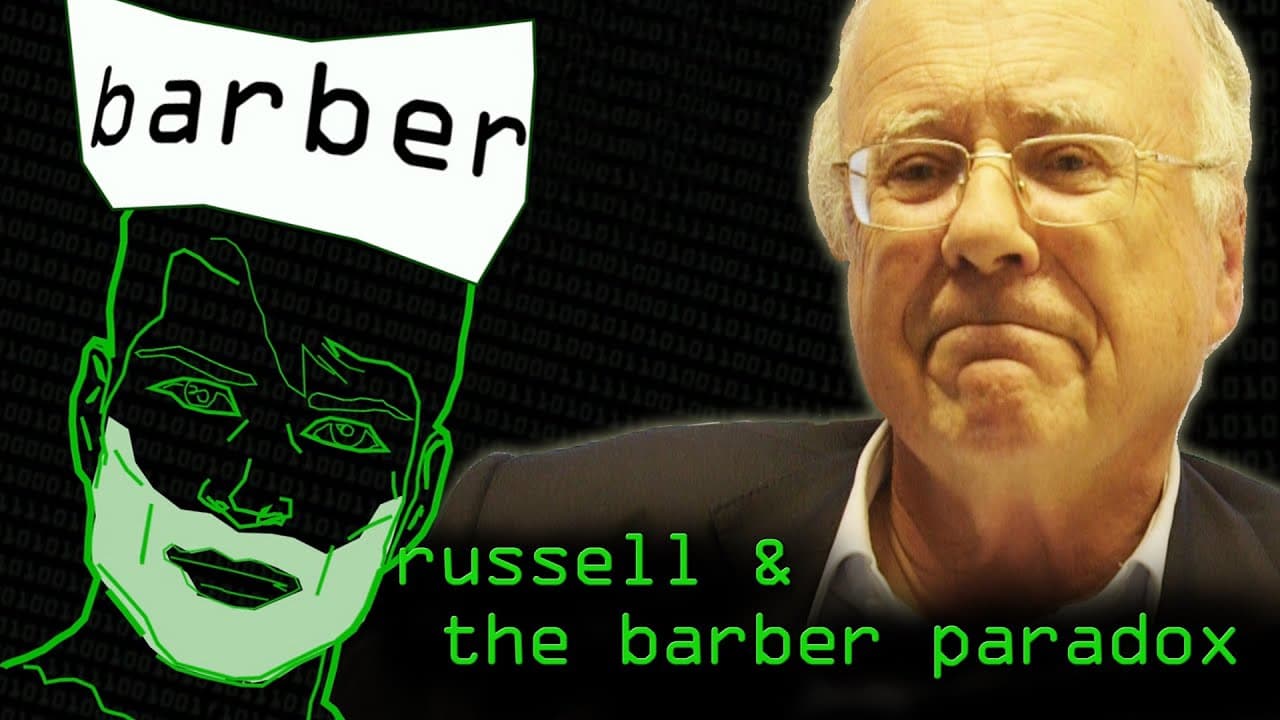
The Russell Paradox is a result of attempting to axiomatize arithmetic using set theory. It arose when considering the set of all sets that are not members of themselves.
Q: How does the Russell Paradox demonstrate undecidability?
The paradox shows that certain propositions within a system may be undecidable, meaning that it is impossible to determine their truth or falsehood based on the given axioms.
Q: What are some ways to resolve the Russell Paradox?
One approach is to consider the barber as a woman, removing the need for the barber to shave themselves. Another solution is to make a special amendment to the local laws, stating that the barber himself is required to be bearded.
Q: How did Kurt Gödel's work impact the understanding of the Russell Paradox?
Gödel's incompleteness theorem, published in 1931, showed that any system of mathematically logical propositions powerful enough to derive new results would always have true but unprovable theorems. This further emphasized the incompleteness and undecidability within mathematics.
Summary & Key Takeaways
-
The Russell Paradox originated from the efforts of Bertrand Russell and Alfred North Whitehead to axiomatize arithmetic using set theory.
-
The paradox arises when considering the set of all sets that are not members of themselves, leading to an undecidable situation.
-
The paradox can be resolved through lateral thinking, such as considering the barber as a woman or making a special amendment to the local laws.
Read in Other Languages (beta)
Share This Summary 📚
Summarize YouTube Videos and Get Video Transcripts with 1-Click
Try YouTube Summary with ChatGPT & Claude or YouTube Transcript Generator
Explore More Summaries from Computerphile 📚




Summarize YouTube Videos and Get Video Transcripts with 1-Click
Try YouTube Summary with ChatGPT & Claude or YouTube Transcript Generator