The World At War 1917 I THE GREAT WAR - Week 128
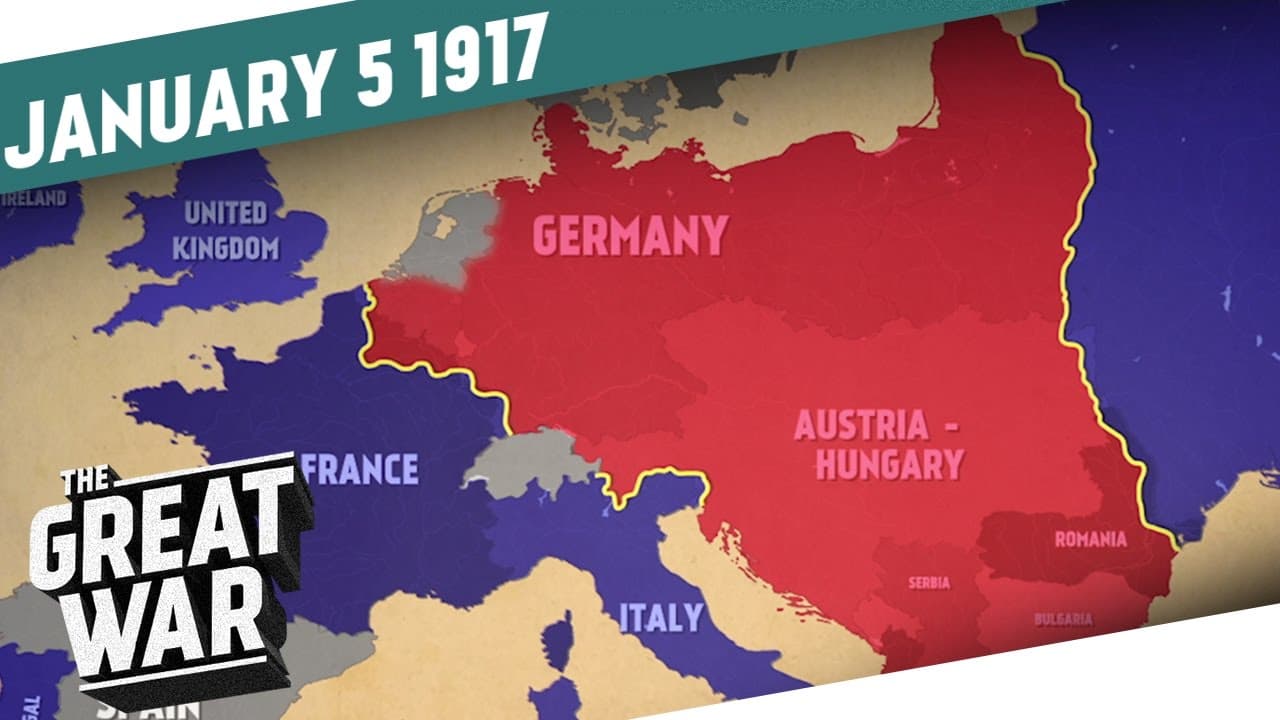
TL;DR
1917 sees ongoing global war with no peace in sight.
Transcript
1916 had seen the three largest battles in human history thus far take place simultaneously. It had seen the development of the concept of an air FORCE; it had seen a gigantic naval battle, one of the greatest military humiliations in British history, and the war growing ever larger as Romania joined the fray. And now... it’s 1917. I’m Indy Neidell... Read More
Key Insights
- 1916 witnessed the largest battles in history with simultaneous engagements, marking a significant escalation in warfare tactics and technology.
- The assassination of Rasputin in Russia was a pivotal event, reflecting internal political turmoil amidst the ongoing global conflict.
- The Eastern Front remains the longest continuous front in history, stretching from the Black Sea to the Gulf of Riga, with many areas remaining static.
- The Western Front saw significant troop numbers, with the British forces expanding from 160,000 in 1914 to over 1.5 million by the end of 1916.
- Romania's entry into the war expanded the conflict's scope, with Central Powers making gains despite logistical challenges and troop exhaustion.
- Peace negotiations were attempted but failed, with both sides making demands that were unacceptable to the other, prolonging the conflict.
- The battle of Verdun is highlighted as a symbol of the war's futility, with massive casualties and no decisive outcome.
- The year 1917 begins with ten active war fronts globally, indicating no quick resolution and a continuation of the bloody conflict.
Install to Summarize YouTube Videos and Get Transcripts
Explore YouTube Video Summarizer or Get YouTube Transcript Extractor
Questions & Answers
Q: What were the major battles in 1916?
1916 saw three of the largest battles in history: the Battle of Verdun, the Battle of the Somme, and the Battle of Jutland. Verdun was particularly notable for its duration and intensity, lasting ten months and resulting in massive casualties without a decisive victory for either side.
Q: How did the assassination of Rasputin affect Russia?
Rasputin's assassination in December 1916 was a significant event in Russian history, reflecting the internal political instability within the country. His influence over the Russian royal family had been controversial, and his death marked a turning point in the lead-up to the Russian Revolution, which would dramatically alter the nation's involvement in the war.
Q: What was the state of the Eastern Front at the end of 1916?
By the end of 1916, the Eastern Front was the longest continuous front in history, stretching from the Black Sea to the Gulf of Riga. Many areas remained static, with entrenched positions and little movement. The front was characterized by harsh conditions and prolonged engagements, contributing to the war's overall stalemate.
Q: Why did peace negotiations fail in late 1916?
Peace negotiations failed due to irreconcilable demands from both sides. The Allies demanded reparation and recognition of national rights, while Germany's conditions for withdrawing from Belgium included maintaining control over strategic locations. These conflicting interests made any agreement impossible, ensuring the continuation of the war.
Q: What were the troop numbers on the Western Front by the end of 1916?
By the end of 1916, the Western Front saw a significant increase in troop numbers. The British Expeditionary Force expanded from 160,000 men in 1914 to over 1.5 million. German forces faced 169 Allied divisions, including French, British, Belgian, and Russian troops, reflecting the scale and intensity of the conflict.
Q: How did Romania's involvement impact the war?
Romania's entry into the war in 1916 expanded the conflict, adding complexity to the Eastern Front. The Central Powers, including Germany, Austria-Hungary, Bulgaria, and Turkey, made gains in Romania despite logistical challenges and troop exhaustion. Romania's involvement highlighted the war's growing scope and the strategic importance of Eastern Europe.
Q: What was the significance of the Battle of Verdun?
The Battle of Verdun, lasting ten months, was one of the war's most significant and grueling battles. It epitomized the war's futility, with massive casualties and no decisive victory. Verdun became a symbol of the war's horrors, with historian Alistair Horne describing it as an intensification of the First World War's tragedies.
Q: What were the conditions for peace proposed by the Allies?
The Allies' conditions for peace included securing reparation for violated rights, recognition of nationalities, and the free existence of small states. They demanded a settlement to end causes threatening nations and ensure future security. These terms were unacceptable to Germany, particularly regarding Belgium, leading to the continuation of the war.
Summary & Key Takeaways
-
As 1917 begins, World War I continues with ten active fronts globally, and peace remains elusive. The previous year saw massive battles, such as Verdun, which epitomized the war's horrors and futility. Despite attempts at peace talks, conflicting demands from both sides prevent any resolution.
-
The assassination of Rasputin in Russia highlights the internal challenges faced by nations involved in the war. The Western Front remains heavily fortified, with significant troop increases, and Romania's involvement adds complexity to the Eastern Front, despite logistical difficulties for the Central Powers.
-
The Great War continues to expand, with no end in sight. The failed peace negotiations underscore the deep divisions and strategic interests at play. The conflict's impact is felt across Europe and beyond, with battles raging from the Middle East to Africa and Eastern Europe.
Read in Other Languages (beta)
Share This Summary 📚
Summarize YouTube Videos and Get Video Transcripts with 1-Click
Try YouTube Summary with ChatGPT & Claude or YouTube Transcript Generator
Explore More Summaries from The Great War 📚
Summarize YouTube Videos and Get Video Transcripts with 1-Click
Try YouTube Summary with ChatGPT & Claude or YouTube Transcript Generator