How to Calculate Normal Force in Circular Motion
TL;DR
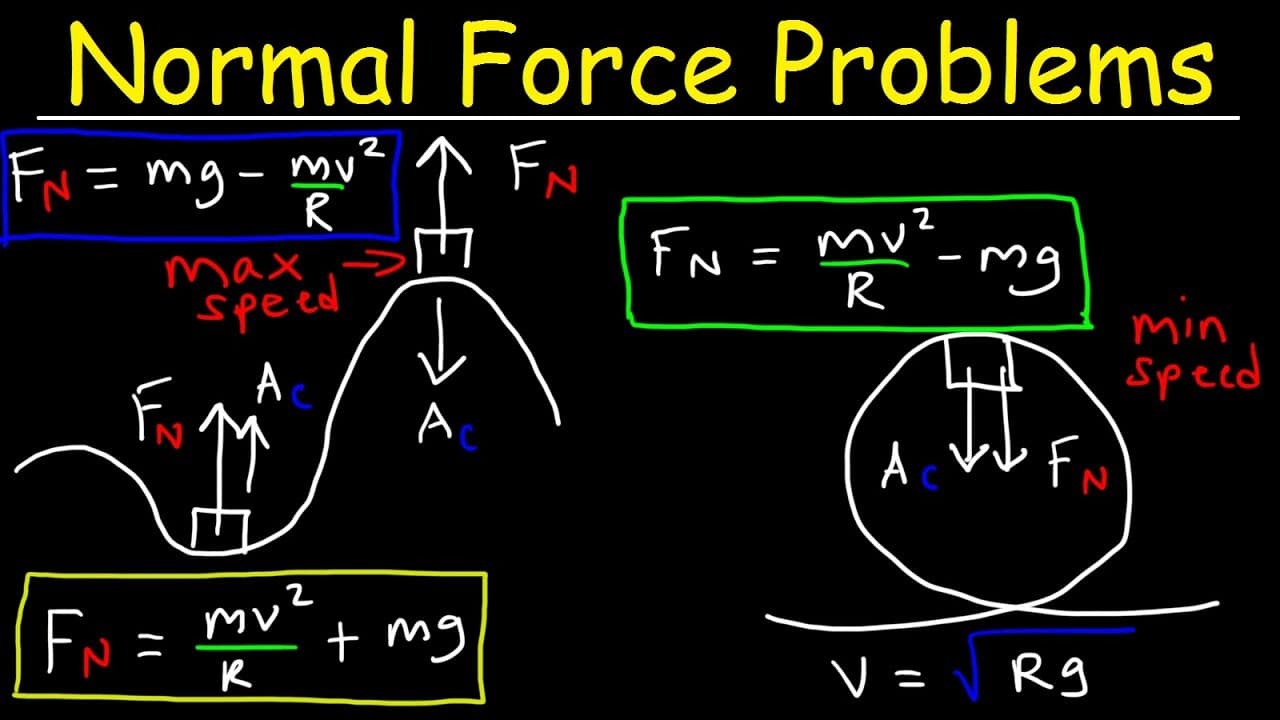
To calculate the normal force for an object in circular motion, it depends on its position: at the top, it's the difference between the weight force and centripetal force, while at the bottom, it's their sum. The critical speeds required to maintain contact with the surface can be found using the formula for maximum speed, which is the square root of the radius times gravity, and for minimum speed as well.
Transcript
calculate the normal force of a five kilogram box moving at a speed of 15 meters per second at points a and b shown below so here we have the box now once it reaches point a what is the normal force at point a and what about at point b is the normal force going to be greater at a or at b what would you say the normal force is going to be larger at ... Read More
Key Insights
- 🏋️ The normal force is the force exerted by a surface perpendicular to it and varies based on the weight force, centripetal force, and acceleration.
- 😘 In circular motion, the normal force can be greater or lower at different points depending on the direction and magnitude of the forces involved.
- 😚 If the normal force becomes negative, it means the object loses contact with the surface.
- 😥 The maximum speed at a certain point in circular motion is determined by the balance between centripetal force and weight force, avoiding loss of contact with the surface.
- 🎢 The minimum speed for a roller coaster at the top of a circle is required to prevent passengers from falling out, ensuring that the centripetal force exceeds the weight force.
- 🖐️ Normal force plays a crucial role in maintaining contact and stability in various situations involving circular motion.
- 🐎 The radius of curvature and the acceleration due to gravity are fundamental parameters in calculating the normal force and determining speed thresholds.
Install to Summarize YouTube Videos and Get Transcripts
Explore YouTube Video Summarizer or Get YouTube Transcript Extractor
Questions & Answers
Q: Why is the normal force greater at point A compared to point B in circular motion?
At point A, the ground has to support the weight of the box and cause it to turn upward, making it harder to do. Therefore, the normal force at point A is greater than at point B, where there is no upward force from the ground.
Q: What happens if the normal force at point B becomes negative?
If the normal force at point B becomes negative, it means the box loses contact with the road. This indicates that the car is moving fast enough to go off in a tangent and fly off the road.
Q: How is the maximum speed at point B calculated?
The maximum speed at point B is calculated by taking the square root of the radius multiplied by the acceleration due to gravity. This speed represents the threshold beyond which the box will lose contact with the road.
Q: How is the minimum speed for a roller coaster at the top of the circle calculated?
The minimum speed for a roller coaster at the top of the circle is calculated using the square root of the radius multiplied by the acceleration due to gravity. This speed prevents the passengers from falling out.
Summary & Key Takeaways
-
The normal force at point A is the sum of the centripetal force and the weight force, while at point B, it is the difference between the weight force and the centripetal force.
-
The normal force at point A is greater than at point B because the ground has to support the weight of the box and cause it to turn upward.
-
If the normal force at point B becomes negative, it means the box loses contact with the road.
-
The maximum speed at point B, without losing contact, is calculated by taking the square root of the radius multiplied by the acceleration due to gravity.
-
For a roller coaster traveling upside down at the top of a circle, the normal force is the difference between the centripetal force and the weight force.
-
The minimum speed for the roller coaster to prevent passengers from falling out is calculated using the square root of the radius multiplied by the acceleration due to gravity.
Read in Other Languages (beta)
Share This Summary 📚
Summarize YouTube Videos and Get Video Transcripts with 1-Click
Try YouTube Summary with ChatGPT & Claude or YouTube Transcript Generator
Explore More Summaries from The Organic Chemistry Tutor 📚

Summarize YouTube Videos and Get Video Transcripts with 1-Click
Try YouTube Summary with ChatGPT & Claude or YouTube Transcript Generator