What Are Polygons and How Do You Calculate Their Angles?
TL;DR
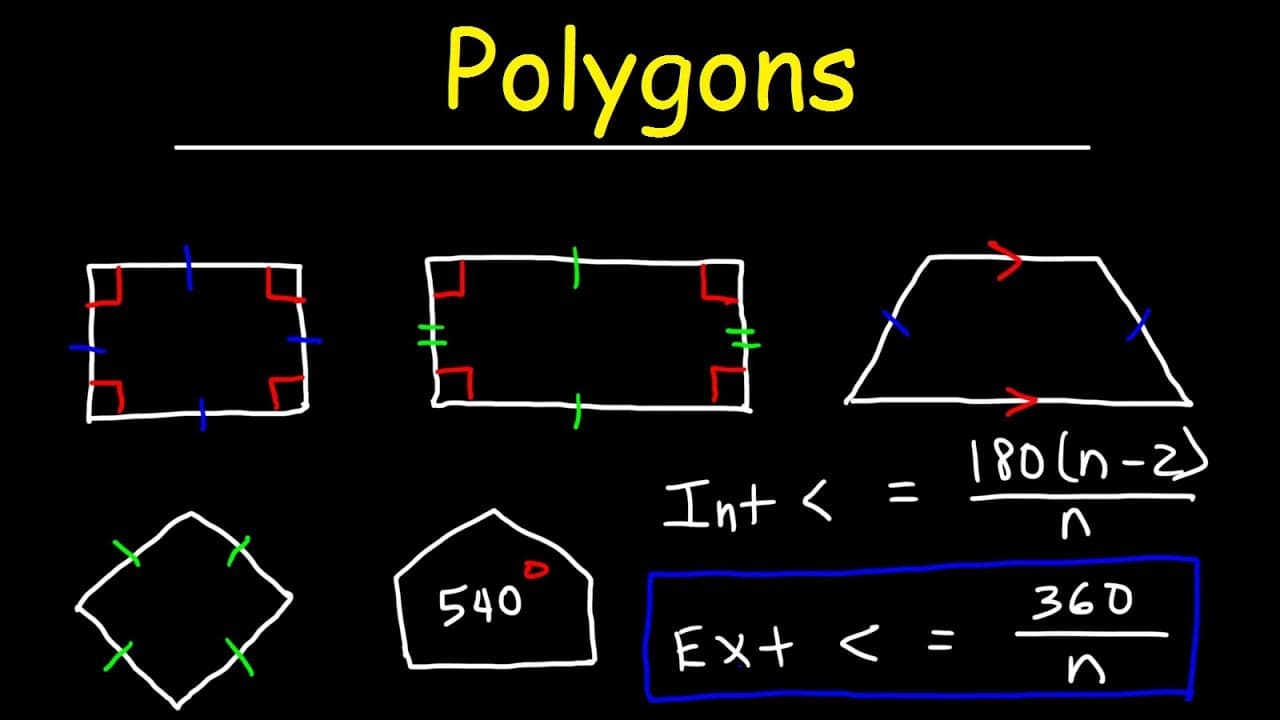
Polygons are two-dimensional closed figures made up of straight line segments. Their names include triangles, quadrilaterals, pentagons, and more, each with specific properties. The sum of interior angles in a polygon can be calculated using the formula 180 × (n - 2), where n is the number of sides.
Transcript
in this video we're gonna focus on polygons so let's go over some examples a three-sided polygon is known as a triangle that's the first one need to know a four-sided polygon is known as a quadrilateral now there's different types of quadrilaterals that you need to be familiar with so let me give you a few of them so this is another four-sided poly... Read More
Key Insights
- 😚 Polygons are two-dimensional, closed figures composed of straight line segments.
- 🙃 Regular polygons have congruent sides and angles, while irregular polygons do not.
- 🙃 The sum of interior angles in a polygon can be found using the formula 180 * (n - 2), where n is the number of sides.
- 🔺 Each interior angle in a regular polygon can be found by dividing the sum of interior angles by the number of sides.
Install to Summarize YouTube Videos and Get Transcripts
Explore YouTube Video Summarizer or Get YouTube Transcript Extractor
Questions & Answers
Q: What are some examples of four-sided polygons?
Some examples of four-sided polygons are squares and rectangles. Squares have all sides and angles congruent, while rectangles have congruent angles and opposite sides congruent.
Q: How can you determine if a figure is a polygon?
To determine if a figure is a polygon, you should check if it is two-dimensional, closed, composed of straight line segments, and without any line intersections. If these characteristics are met, it is a polygon.
Q: What is the formula for calculating the sum of interior angles in a polygon?
The formula is 180 * (n - 2), where n represents the number of sides in the polygon. For example, a triangle (3 sides) has a sum of interior angles of 180, a quadrilateral (4 sides) has a sum of interior angles of 360, and so on.
Q: How do you calculate the measure of each interior angle in a regular polygon?
For a regular polygon, you divide the sum of interior angles by the number of sides. So, for example, if you have a regular hexagon (6 sides) with a sum of interior angles of 720, each interior angle would measure 120 degrees (720 / 6).
Summary & Key Takeaways
-
The video explains the names of different polygons, such as triangles, squares, rectangles, trapezoids, rhombuses, pentagons, hexagons, heptagons, octagons, nonagons, and decagons.
-
It covers the properties of regular polygons, which have congruent sides and angles, as well as the characteristics that define a polygon (two-dimensional, closed figure, composed of straight line segments).
-
The video also introduces formulas for finding the sum of interior angles in a polygon, as well as the measure of each interior and exterior angle in regular polygons.
Read in Other Languages (beta)
Share This Summary 📚
Summarize YouTube Videos and Get Video Transcripts with 1-Click
Try YouTube Summary with ChatGPT & Claude or YouTube Transcript Generator
Explore More Summaries from The Organic Chemistry Tutor 📚






Summarize YouTube Videos and Get Video Transcripts with 1-Click
Try YouTube Summary with ChatGPT & Claude or YouTube Transcript Generator