How Electron Spin Makes Matter Possible
TL;DR
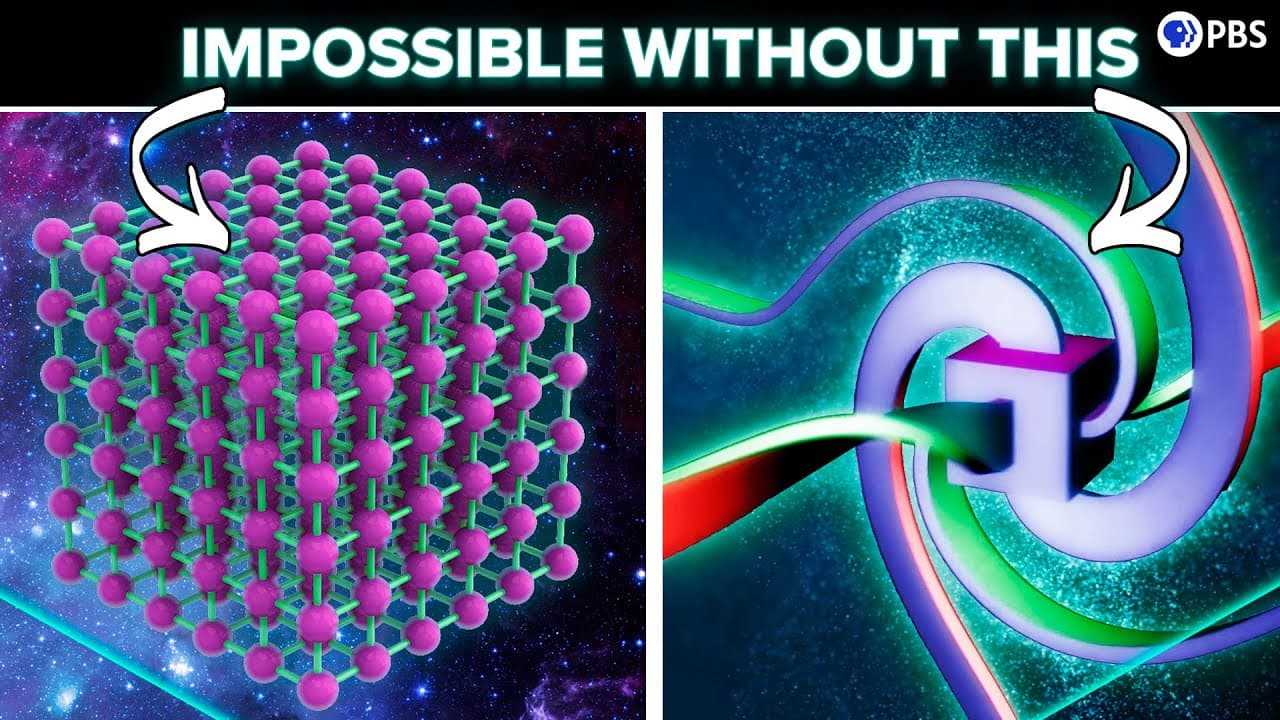
Electron spin prevents matter from collapsing, enabling structure.
Transcript
Today I’m going to explain why you are not falling through your chair right now using one simple fact, and one object. The fact is that all electrons are the same as each other, and the object is a structurally critical item of my clothing. There’s a chance this episode could get a little weird. By now we’ve established that quantum spin is very we... Read More
Key Insights
- Electron spin is a crucial factor that prevents matter from collapsing, allowing for the structure and stability of the universe.
- Fermions, particles with half-integer spin, obey the Pauli exclusion principle, preventing them from occupying the same quantum state.
- Bosons, particles with integer spin, can occupy the same quantum state, allowing phenomena like laser beams with stacked photons.
- The spin-statistics theorem explains the behavior of fermions and bosons, relying on their wavefunctions and rotational symmetries.
- A 360-degree rotation of a fermion introduces a negative sign in its wavefunction, distinguishing it from bosons.
- The belt trick, inspired by Paul Dirac, visually demonstrates the unique rotational properties of fermions.
- Wavefunctions of fermions are antisymmetric, meaning swapping two fermions changes the wavefunction's sign.
- The unobservability of the wavefunction's phase change ensures that fermions remain indistinguishable in practice.
Install to Summarize YouTube Videos and Get Transcripts
Explore YouTube Video Summarizer or Get YouTube Transcript Extractor
Questions & Answers
Q: Why don't we fall through matter?
We don't fall through matter because of the properties of fermions, such as electrons, which obey the Pauli exclusion principle. This principle, derived from their half-integer spin and antisymmetric wavefunctions, prevents fermions from occupying the same quantum state, maintaining the structure and stability of matter.
Q: What is the significance of fermions having half-integer spin?
Fermions having half-integer spin means they require a 720-degree rotation to return to their original state, unlike bosons with integer spin. This property, combined with their indistinguishability, leads to the Pauli exclusion principle, which is essential for the structure of atoms and the diversity of matter.
Q: How does the belt trick illustrate fermion behavior?
The belt trick visually demonstrates the unique rotational properties of fermions. By rotating a belt 720 degrees, it can be untwisted without changing the orientation of the ends, analogous to how fermions return to their original state. A 360-degree rotation introduces a twist, representing the antisymmetric nature of fermion wavefunctions.
Q: What is the spin-statistics theorem?
The spin-statistics theorem explains the relationship between the spin of particles and their statistical behavior. It dictates that particles with half-integer spin, like fermions, have antisymmetric wavefunctions and obey the Pauli exclusion principle, while particles with integer spin, like bosons, have symmetric wavefunctions and can occupy the same quantum state.
Q: Why are bosons able to occupy the same quantum state?
Bosons, with integer spin, have symmetric wavefunctions, allowing them to occupy the same quantum state without restriction. This property enables phenomena like lasers, where multiple photons can be in the same state, unlike fermions, which are restricted by the Pauli exclusion principle due to their antisymmetric wavefunctions.
Q: What role does the wavefunction play in quantum mechanics?
In quantum mechanics, the wavefunction describes the probability amplitude of a particle's properties, such as position or momentum. While we can't observe the wavefunction directly, its square gives the probability distribution of an observable. For fermions, the antisymmetric nature of their wavefunctions underpins the Pauli exclusion principle and the structure of matter.
Q: How does a 360-degree rotation affect a fermion's wavefunction?
A 360-degree rotation of a fermion introduces a negative sign in its wavefunction, indicating a phase shift. This behavior is due to their half-integer spin and is crucial for their antisymmetric wavefunctions. It contrasts with bosons, whose wavefunctions remain unchanged under a 360-degree rotation, reflecting their integer spin.
Q: What is the Pauli exclusion principle?
The Pauli exclusion principle states that no two fermions can occupy the same quantum state simultaneously. This principle arises from their antisymmetric wavefunctions and half-integer spin, ensuring the stability and structure of matter. It is fundamental to the diversity of atoms and the existence of chemistry, as it prevents fermions from collapsing into identical states.
Summary & Key Takeaways
-
Electron spin, a fundamental quantum property, is essential for the structure of matter, as it prevents particles from collapsing into the same state. Fermions, like electrons, have a unique rotational symmetry requiring a 720-degree rotation to return to their original state, which is crucial for the Pauli exclusion principle.
-
The Pauli exclusion principle, derived from the spin-statistics theorem, ensures that no two fermions can occupy the same quantum state, allowing for the diversity of matter and chemistry. Bosons, in contrast, can occupy the same state, enabling phenomena like lasers.
-
The belt trick, a visual analogy, illustrates how a 720-degree rotation of a fermion is equivalent to no rotation, while a 360-degree rotation introduces a negative sign. This antisymmetric behavior of fermions' wavefunctions is key to their indistinguishability and the stability of matter.
Read in Other Languages (beta)
Share This Summary 📚
Summarize YouTube Videos and Get Video Transcripts with 1-Click
Try YouTube Summary with ChatGPT & Claude or YouTube Transcript Generator
Explore More Summaries from PBS Space Time 📚




Summarize YouTube Videos and Get Video Transcripts with 1-Click
Try YouTube Summary with ChatGPT & Claude or YouTube Transcript Generator