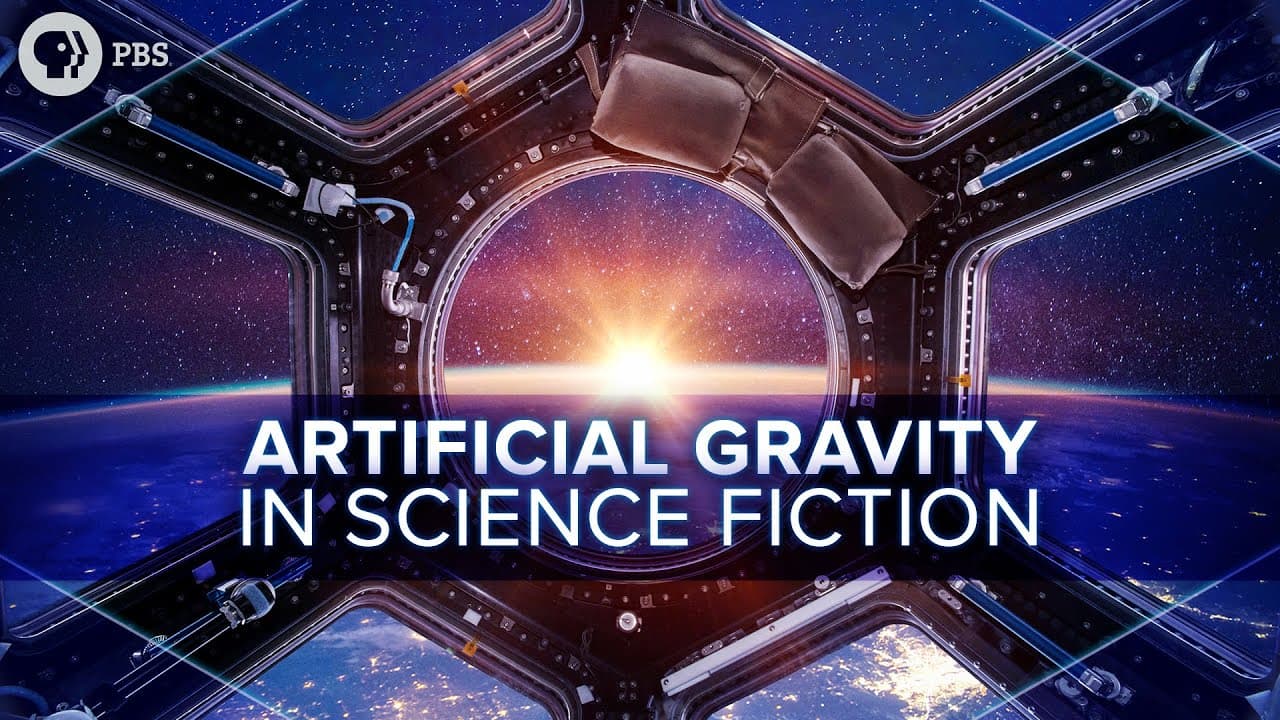
What's the Most Realistic Artificial Gravity in Sci-Fi?
TL;DR
Explores realistic artificial gravity in sci-fi using rotation.
Transcript
[MUSIC PLAYING] Artificial gravity, it's an essential plot element in most science fiction stories. But do any of those stories actually get artificial gravity right? [MUSIC PLAYING] Whether you realize it or not, artificial gravity is essential to most sci-fi sagas. Think about it. Jean-Luc Picard loses some gravitas if he's floating around like ... Read More
Key Insights
- Artificial gravity is a common trope in sci-fi, often conflicting with known physics, except for rotation-based methods.
- Rotation can simulate gravity by creating a force that pushes objects outward, similar to carnival rides like the Gravitron.
- The Coriolis effect in rotating spaceships can cause unexpected physical sensations and movements, often overlooked in sci-fi.
- Larger rotating structures reduce Coriolis effects but require strong materials to withstand mechanical stresses.
- The video game 'Halo' achieves a realistic balance with its large rotating structures, using feasible materials like steel.
- 'Babylon 5' uses a rotating cylinder for artificial gravity, minimizing Coriolis effects and providing a compact, plausible design.
- The concept of space and time as illusions is discussed, suggesting that temporal order is not a universal fact.
- The discussion includes the philosophical implications of relativity on free will and the nature of time.
Install to Summarize YouTube Videos and Get Transcripts
Explore YouTube Video Summarizer or Get YouTube Transcript Extractor
Questions & Answers
Q: What is the main method used to simulate artificial gravity in sci-fi?
The main method used to simulate artificial gravity in sci-fi is rotation. By rotating a spaceship or space station, a force is generated that pushes objects outward, creating an effect similar to gravity. This method is considered the most realistic approach, as it aligns with known physics principles.
Q: How does the Coriolis effect impact rotating spaceships?
The Coriolis effect in rotating spaceships can cause unexpected physical sensations and movements. It occurs when objects move within a rotating frame, causing apparent deviations from straight-line motion. This effect can make people feel heavier or lighter, affect balance, and create dizziness, especially in smaller or faster rotating structures.
Q: Why is 'Halo' considered a realistic depiction of artificial gravity?
'Halo' is considered a realistic depiction of artificial gravity because it uses a large rotating structure with a radius of 5,000 kilometers. This size minimizes the Coriolis effect, making it undetectable in ordinary human activities. Additionally, the structure's design allows it to withstand mechanical stresses using feasible materials like steel.
Q: What are the challenges of creating large rotating structures for artificial gravity?
Creating large rotating structures for artificial gravity presents challenges such as minimizing the Coriolis effect while ensuring the structure can withstand mechanical stresses. Larger structures reduce these effects but require strong materials to prevent them from being torn apart. Balancing size and material strength is crucial for realistic designs.
Q: How does 'Babylon 5' approach artificial gravity differently?
'Babylon 5' approaches artificial gravity by using a rotating cylinder instead of a ring. The cylinder's design, with a length of 8 kilometers and a radius of 0.5 kilometers, spins around its longitudinal axis. This configuration minimizes the Coriolis effect, making it mostly unnoticeable in day-to-day activities, except during rapid movements.
Q: What philosophical implications are discussed regarding space and time?
The video discusses the philosophical implications of space and time, suggesting that temporal order is not a universal fact. It explores the idea that space and time might be illusions, with different self-consistent ways to arrange events. This challenges traditional concepts of past, present, and future, and questions the nature of free will.
Q: Does the video address the direction of time?
The video does not address the direction of time in detail, as it is a complex topic, especially in the context of relativity. It suggests that the direction of time is more involved and requires further exploration in future episodes. The video encourages viewers to engage with these concepts through additional resources.
Q: What resources are recommended for understanding space and time concepts?
The video recommends using the provided description resources and additional reading materials to understand space and time concepts. It emphasizes that grasping these ideas requires building a conceptual framework over time. Viewers are encouraged to explore books and other educational materials to deepen their understanding.
Summary & Key Takeaways
-
The video analyzes artificial gravity in sci-fi, focusing on rotation-based methods as the most realistic approach. It examines examples from '2001: A Space Odyssey,' 'Ringworld,' 'Halo,' and 'Babylon 5,' highlighting their strengths and weaknesses in depicting artificial gravity.
-
Rotation-induced gravity is explained using the Coriolis effect and its impact on human perception and movement. The video emphasizes the need for large structures to minimize these effects and discusses the feasibility of constructing such habitats.
-
The philosophical implications of space and time are explored, questioning the nature of temporal order and free will. The video encourages viewers to engage with these complex topics and suggests resources for further exploration.
Read in Other Languages (beta)
Share This Summary 📚
Summarize YouTube Videos and Get Video Transcripts with 1-Click
Try YouTube Summary with ChatGPT & Claude or YouTube Transcript Generator
Explore More Summaries from PBS Space Time 📚
Summarize YouTube Videos and Get Video Transcripts with 1-Click
Try YouTube Summary with ChatGPT & Claude or YouTube Transcript Generator