Deciphering The Vast Scale of the Universe | STELLAR
TL;DR
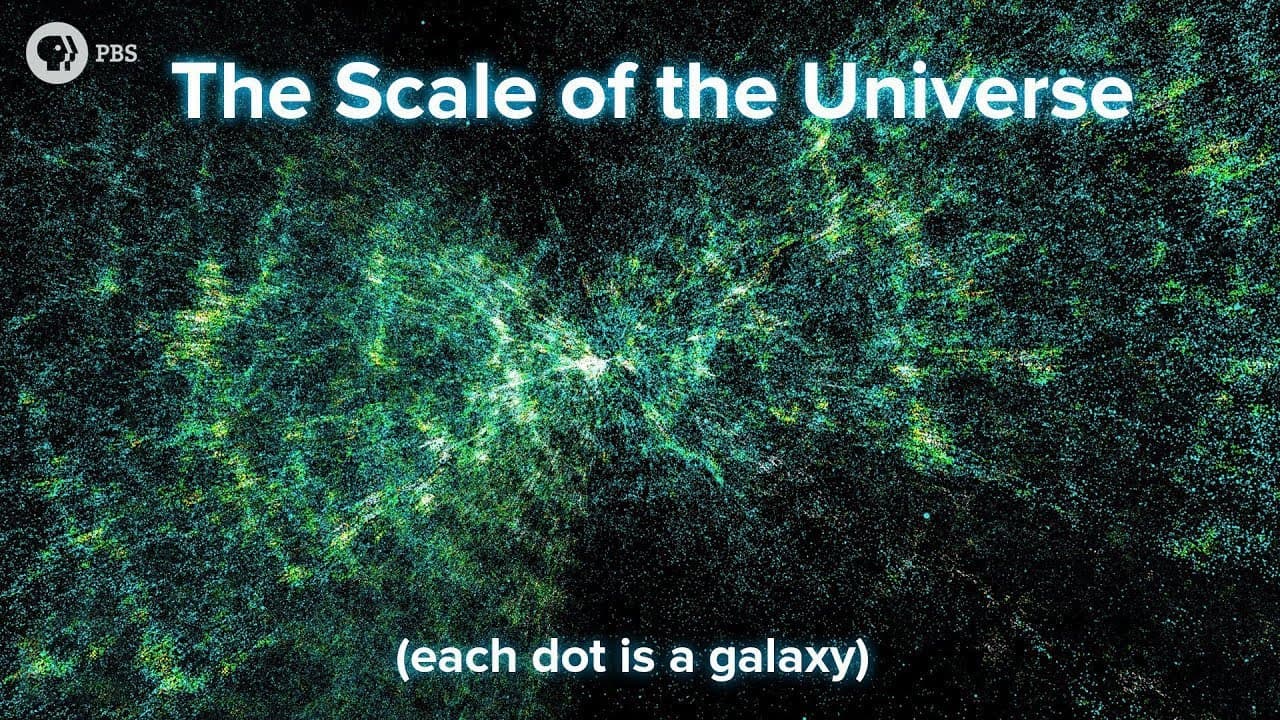
Exploring the vast scale of the universe beyond Earth.
Transcript
Thank you to Draper and its Hack the Moon initiative for supporting PBS Digital Studios. For much of human history, people believed that the planet Earth was the center of the universe. That's understandable. Earth is pretty big. We now know that it's a speck compared to the Universe. To get a sense of that scale, consider this grain of sand held a... Read More
Key Insights
- The observable universe contains more worlds than grains of sand on Earth, highlighting its vastness and complexity.
- Edwin Hubble's discovery in 1924 proved that the universe extends beyond the Milky Way, fundamentally changing our cosmic perspective.
- The Hooker Telescope at Mt. Wilson Observatory played a crucial role in Hubble's groundbreaking discoveries about the universe.
- Cepheid variables, discovered by Henrietta Leavitt, enabled astronomers to measure distances to stars and galaxies accurately.
- The Andromeda Galaxy, once thought to be a nebula, is 2 million light-years away, significantly larger than the Milky Way.
- Hubble's observations led to the understanding that the universe is expanding, supporting the Big Bang theory.
- Modern observatories and technology continue to expand our understanding of the universe's vastness and origins.
- The Digital Universe project allows for a virtual exploration of the universe, using data to map galaxies and cosmic structures.
Install to Summarize YouTube Videos and Get Transcripts
Explore YouTube Video Summarizer or Get YouTube Transcript Extractor
Questions & Answers
Q: What was Edwin Hubble's major discovery?
Edwin Hubble's major discovery was that the universe extends beyond the Milky Way. In 1924, he proved that what were thought to be nebulae within our galaxy were actually separate galaxies. This discovery fundamentally changed our understanding of the universe and paved the way for modern cosmology.
Q: How did Henrietta Leavitt contribute to astronomy?
Henrietta Leavitt discovered the relationship between the brightness and periodicity of Cepheid variable stars. This allowed astronomers to determine the actual brightness of these stars and, consequently, their distances from Earth. Her work provided a crucial tool for measuring cosmic distances and was instrumental in Hubble's discoveries.
Q: What role did the Hooker Telescope play in Hubble's work?
The Hooker Telescope at Mt. Wilson Observatory was instrumental in Edwin Hubble's work. It allowed him to observe Cepheid variables in the Andromeda Galaxy, leading to the discovery that Andromeda was a separate galaxy. This telescope provided the necessary observational power to make groundbreaking discoveries about the universe's scale.
Q: What is the significance of the Andromeda Galaxy in Hubble's discoveries?
The Andromeda Galaxy was significant in Hubble's discoveries as it was the first galaxy observed to be outside the Milky Way. Hubble's measurements of its distance, using Cepheid variables, confirmed that it was a separate galaxy, expanding our understanding of the universe's vastness and structure.
Q: How did Hubble's observations support the Big Bang theory?
Hubble's observations of galaxies moving away from the Milky Way provided evidence for the expanding universe. This observation supported the Big Bang theory, suggesting that the universe had a beginning and has been expanding ever since. His work laid the foundation for the modern understanding of cosmology.
Q: What is the Digital Universe project?
The Digital Universe project is a virtual exploration tool developed by the American Museum of Natural History. It uses OpenSpace software to create a 3D atlas of the universe, allowing users to explore cosmic structures and galaxy formations. This project enhances our understanding of the universe's scale and complexity.
Q: What advancements have been made in observing the universe since Hubble's time?
Since Hubble's time, advancements in technology have significantly enhanced our ability to observe the universe. Modern observatories like the Gemini Observatory and the Event Horizon Telescope, along with projects like LIGO, have provided deeper insights into cosmic phenomena, expanding our understanding of the universe's origins and structure.
Q: Why is the exploration of the universe important?
Exploration of the universe is important because it expands our understanding of the cosmos, offering insights into fundamental questions about our origins and existence. It drives technological advancements, inspires curiosity, and can lead to discoveries that impact various scientific fields, contributing to our knowledge of the universe and our place within it.
Summary & Key Takeaways
-
The universe is vast, containing countless galaxies and worlds beyond our imagination. Edwin Hubble's discoveries at the Mt. Wilson Observatory were pivotal in expanding our understanding of the universe beyond the Milky Way. His work laid the foundation for modern astronomy and the exploration of the universe's origins.
-
Henrietta Leavitt's discovery of Cepheid variables allowed astronomers to measure distances to stars and galaxies, aiding in Hubble's groundbreaking work. The Andromeda Galaxy, once thought to be a nebula, was revealed to be a separate galaxy, changing our cosmic perspective forever.
-
Modern technology like the Digital Universe project allows us to virtually explore the universe, using data to map galaxies and cosmic structures. This ongoing exploration continues to expand our understanding of the universe's vastness and origins, paving the way for future discoveries.
Read in Other Languages (beta)
Share This Summary 📚
Summarize YouTube Videos and Get Video Transcripts with 1-Click
Try YouTube Summary with ChatGPT & Claude or YouTube Transcript Generator
Explore More Summaries from PBS Space Time 📚



Summarize YouTube Videos and Get Video Transcripts with 1-Click
Try YouTube Summary with ChatGPT & Claude or YouTube Transcript Generator