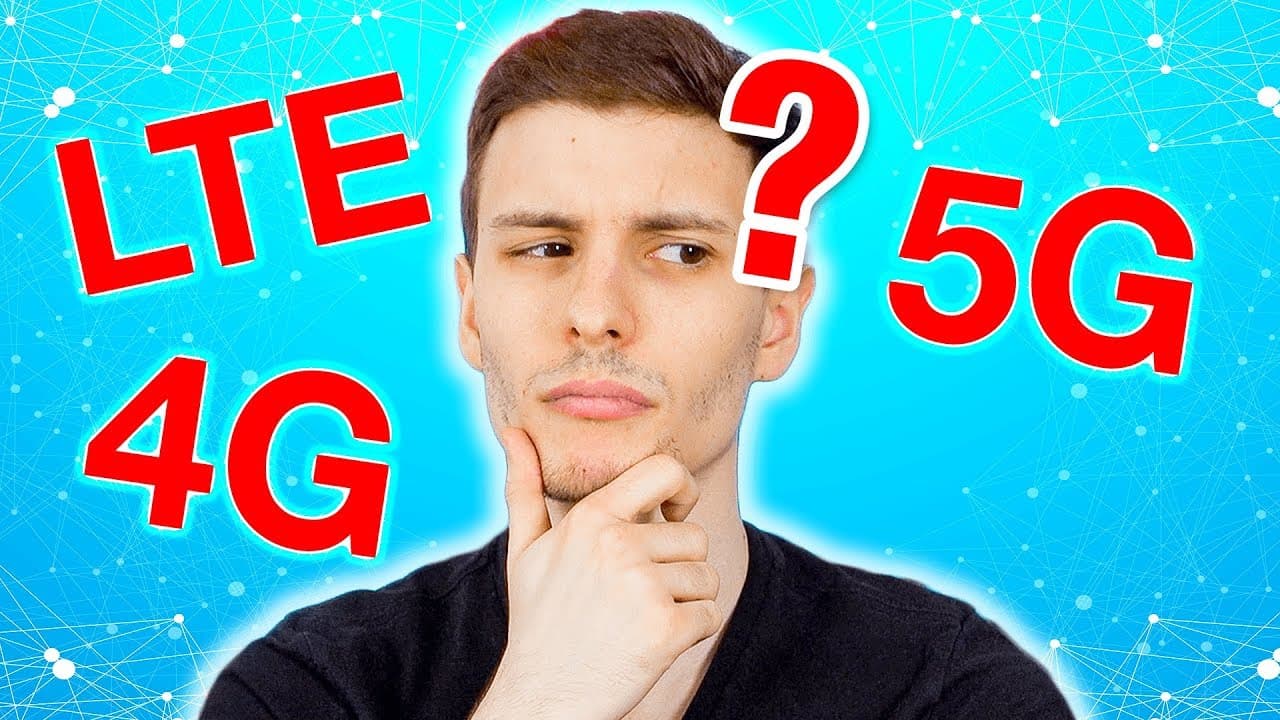
What Are the Differences Between 4G, LTE, and 5G?
TL;DR
4G, LTE, and 5G are generations of cellular technology, each with distinct specifications. 4G has a minimum speed of 100 Mbps, LTE is a stepping stone to 4G that isn’t quite there yet, while 5G boasts speeds up to 20 Gbps and significantly lower latency, enabling wireless home internet. The 'G' indicates the generation, with each new generation improving on speed and capabilities.
Transcript
there's been lots of talk about 5g coming but most people probably don't even know what that means and there's other terms as well that we've seen such as lte which just kind of is a term that came out of the blue one day and it's like what does that mean is it 4g is it better than 4g that's all the stuff that i'm going to be answering today in hop... Read More
Key Insights
- 📱 The "g" in 3G, 4G, and 5G refers to the generation of cellular network technology, and each generation has its own specifications and standards for speed, protocols, and frequencies.
- 🌐 3G initially had a slow speed of around 200 kilobits per second, but it has improved over time and can now reach speeds of up to 20 megabits per second or more.
- ⚡️ 4G, or 4th generation, replaced 3G and has a minimum speed requirement of 100 megabits per second. However, when it was first introduced, no company could reach this speed, leading to the creation of 4G LTE as an improvement towards the true 4G specification.
- 📶 4G LTE, or long-term evolution, is a term used to represent an improvement towards the 4G specification that companies could not initially meet. It is technically not 4G but is still better than 3G.
- 🆙 4G LTE Advanced is another improvement on the 4G LTE spec, with a minimum speed of 100 megabits per second. It can be considered true 4G but is not marketed as such to avoid confusion.
- 🔢 5G is the latest generation of cellular network technology, with an ideal maximum speed of 20 gigabits per second and a minimum requirement of one gigabit per second. It also offers lower latency and higher capacity for bandwidth and number of devices.
- 🏠 5G's low latency introduces a new use for the technology: home internet. Companies like Verizon are rolling out 5G as a wireless gigabit home internet service, eliminating the need for traditional wired connections.
- 📱 5G is currently being tested in select cities for home internet, and it is not yet available for mobile phones. It is expected to be fully rolled out in 2020, so current phones do not support 5G.
Install to Summarize YouTube Videos and Get Transcripts
Explore YouTube Video Summarizer or Get YouTube Transcript Extractor
Questions & Answers
Q: What is the difference between 3G and 4G cellular networks?
3G was the first generation, and while it started slow, it improved over time to reach speeds up to 20 Mbps. On the other hand, 4G had a minimum speed requirement of 100 Mbps and could potentially reach speeds up to 1 Gbps.
Q: Why is 4G LTE not considered true 4G?
While 4G LTE is an improvement over 3G speeds, it does not fully meet the original 4G specification. The term LTE was introduced to represent the progress toward the ideal 4G speeds.
Q: What is 5G and what are its benefits?
5G is the next generation of cellular network technology. It not only offers faster speeds (up to 20 Gbps) but also features lower latency, higher bandwidth capacity, and the potential for home internet services with lower lag.
Answer: The 5G specification includes a minimum speed requirement of 1 Gbps and latency as low as one millisecond, enabling new use cases like wireless home internet. However, widespread 5G availability is expected in 2020, and currently, no phones in the market support 5G.
Summary & Key Takeaways
-
3G was the first widely recognized cellular network technology, initially slow but later improved to reach speeds up to 20 Mbps.
-
4G replaced 3G and had a minimum speed requirement of 100 Mbps, with the specification of reaching speeds up to 1 Gbps down and 500 Mbps up.
-
4G LTE, or Long-Term Evolution, was created as an improvement toward the 4G specification, indicating that companies were working toward true 4G speeds.
Read in Other Languages (beta)
Share This Summary 📚
Summarize YouTube Videos and Get Video Transcripts with 1-Click
Try YouTube Summary with ChatGPT & Claude or YouTube Transcript Generator
Explore More Summaries from ThioJoe 📚





Summarize YouTube Videos and Get Video Transcripts with 1-Click
Try YouTube Summary with ChatGPT & Claude or YouTube Transcript Generator