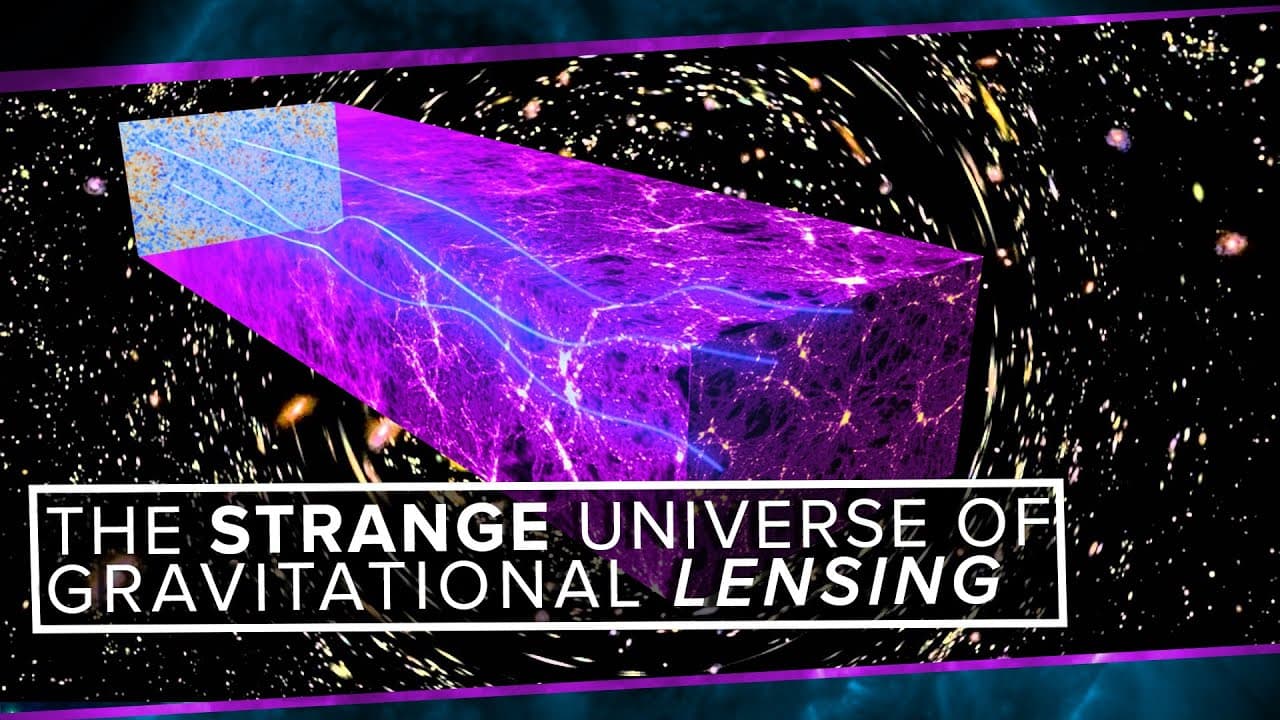
The Strange Universe of Gravitational Lensing
TL;DR
Gravitational lensing bends light, revealing universe secrets.
Transcript
[MUSIC PLAYING] The curvature of spacetime plays tricks on our eyes. Much of the deep universe is shifted and magnified by the warping effect of gravitational lensing. [THEME MUSIC] Our brains evolved in a Euclidean world, or pretty close to it. We have hardware to build internal models of our environment in which space is a simple 3D grid, static ... Read More
Key Insights
- Gravitational lensing is a phenomenon where light is bent by the gravitational field of massive objects, acting like a lens and causing distant objects to appear shifted and magnified.
- Einstein's general theory of relativity predicted gravitational lensing, and it was first confirmed by Sir Arthur Eddington during a solar eclipse in 1919.
- Gravitational lensing helps astronomers study the universe, allowing them to map the distribution of mass, including dark matter, in galaxies and galaxy clusters.
- Strong gravitational lensing creates visible distortions such as arcs and rings, while weak lensing subtly warps the shapes of galaxies, revealing the cosmic web's structure.
- The Einstein Cross is an example of gravitational lensing, where a distant quasar is seen through multiple paths due to a nearby galaxy's gravitational field.
- Gravitational lensing can measure cosmic distances and has been used to determine the Hubble Constant, confirming the universe's expansion rate.
- Microlensing, a form of gravitational lensing, allows astronomers to detect compact stellar bodies like black holes and neutron stars by observing brief flashes of increased brightness.
- The most extreme gravitational lensing occurs near black holes, where light can orbit the black hole, forming a photon sphere and creating a bright ring around it.
Install to Summarize YouTube Videos and Get Transcripts
Explore YouTube Video Summarizer or Get YouTube Transcript Extractor
Questions & Answers
Q: What is gravitational lensing?
Gravitational lensing is a phenomenon where the gravitational field of a massive object bends the path of light traveling nearby, much like a lens. This bending can cause distant objects to appear shifted, magnified, or distorted. It is a direct consequence of Einstein's general theory of relativity, which describes how mass curves spacetime.
Q: How was gravitational lensing first confirmed?
Gravitational lensing was first confirmed during a solar eclipse in 1919 by British astrophysicist Sir Arthur Eddington. He led an expedition to observe the positions of stars near the sun. The observed deflection of starlight matched Einstein's predictions, providing one of the first experimental confirmations of general relativity and significantly contributing to Einstein's fame.
Q: What are the applications of gravitational lensing in astronomy?
Gravitational lensing is a powerful tool in astronomy for studying the universe. It allows astronomers to map the distribution of mass, including dark matter, in galaxies and galaxy clusters. Lensing also helps measure cosmic distances, such as the Hubble Constant, and detect compact stellar bodies like black holes and neutron stars through microlensing, providing insights into the universe's structure.
Q: What is the Einstein Cross?
The Einstein Cross is a striking example of gravitational lensing, where a distant quasar appears as four distinct images around a foreground galaxy. This occurs due to the galaxy's gravitational field bending the quasar's light, creating multiple paths. Such configurations require a near-perfect alignment of the lensing galaxy and the quasar, making them rare but invaluable for studying gravitational lensing effects.
Q: What is microlensing, and how is it used?
Microlensing is a form of gravitational lensing where compact stellar objects, like black holes or neutron stars, pass in front of background stars, causing brief flashes of increased brightness. This technique allows astronomers to detect and count these otherwise invisible objects, providing valuable data on the population and distribution of compact stellar bodies within our galaxy and beyond.
Q: How does gravitational lensing help measure cosmic distances?
Gravitational lensing aids in measuring cosmic distances by observing the time delay between multiple images of a lensed object, such as a quasar. This time delay, caused by different light paths through the lensing galaxy's gravitational field, provides information on the path lengths. These measurements help determine the Hubble Constant, offering an independent method to confirm the universe's expansion rate.
Q: What is the photon sphere around a black hole?
The photon sphere is a region around a black hole where the gravitational field is so strong that light can orbit the black hole. This occurs at about 1.5 times the radius of the event horizon. Light paths are highly curved, and photons can either spiral inwards or outwards. The escaping light, combined with light from surrounding matter, forms a bright ring, showcasing extreme gravitational lensing.
Q: Why is gravitational lensing important in understanding the universe?
Gravitational lensing is crucial for understanding the universe because it reveals the distribution of mass, including dark matter, which cannot be observed directly. It provides a method to map cosmic structures, measure distances, and study the properties of distant objects. Lensing also offers insights into the behavior of light in curved spacetime, enhancing our understanding of general relativity and cosmic evolution.
Summary & Key Takeaways
-
Gravitational lensing, predicted by Einstein's relativity, bends light around massive objects, revealing cosmic structures and dark matter. Strong lensing creates visible distortions, while weak lensing subtly warps galaxies, mapping the universe's mass distribution.
-
The Einstein Cross illustrates gravitational lensing, showing a quasar viewed through multiple paths. Lensing measures cosmic distances, confirming the universe's expansion rate and revealing compact stellar bodies via microlensing.
-
Extreme gravitational lensing near black holes forms a photon sphere, where light orbits the black hole. This phenomenon helps astronomers study the universe's structure and measure cosmic distances, revealing hidden cosmic secrets.
Read in Other Languages (beta)
Share This Summary 📚
Summarize YouTube Videos and Get Video Transcripts with 1-Click
Try YouTube Summary with ChatGPT & Claude or YouTube Transcript Generator
Explore More Summaries from PBS Space Time 📚
Summarize YouTube Videos and Get Video Transcripts with 1-Click
Try YouTube Summary with ChatGPT & Claude or YouTube Transcript Generator