A Theoretical Framework for Describing Movement Variability
TL;DR
Movement variability is beneficial but needs clear definition and optimal application.
Transcript
hi everyone this is rob gray from asu in the perception action podcast back with another article review in this episode i want to talk about this really interesting new systematic review paper uh by get here uh jake cowan and colleagues looking at one of my favorite topics movement variability so this is a systematic review it's fully open access y... Read More
Key Insights
- Movement variability refers to normal variations in motor performance across task repetitions, beneficial for adapting to constraints.
- There is an optimal 'Goldilocks zone' of variability beneficial for performance and injury reduction, beyond which variability can be detrimental.
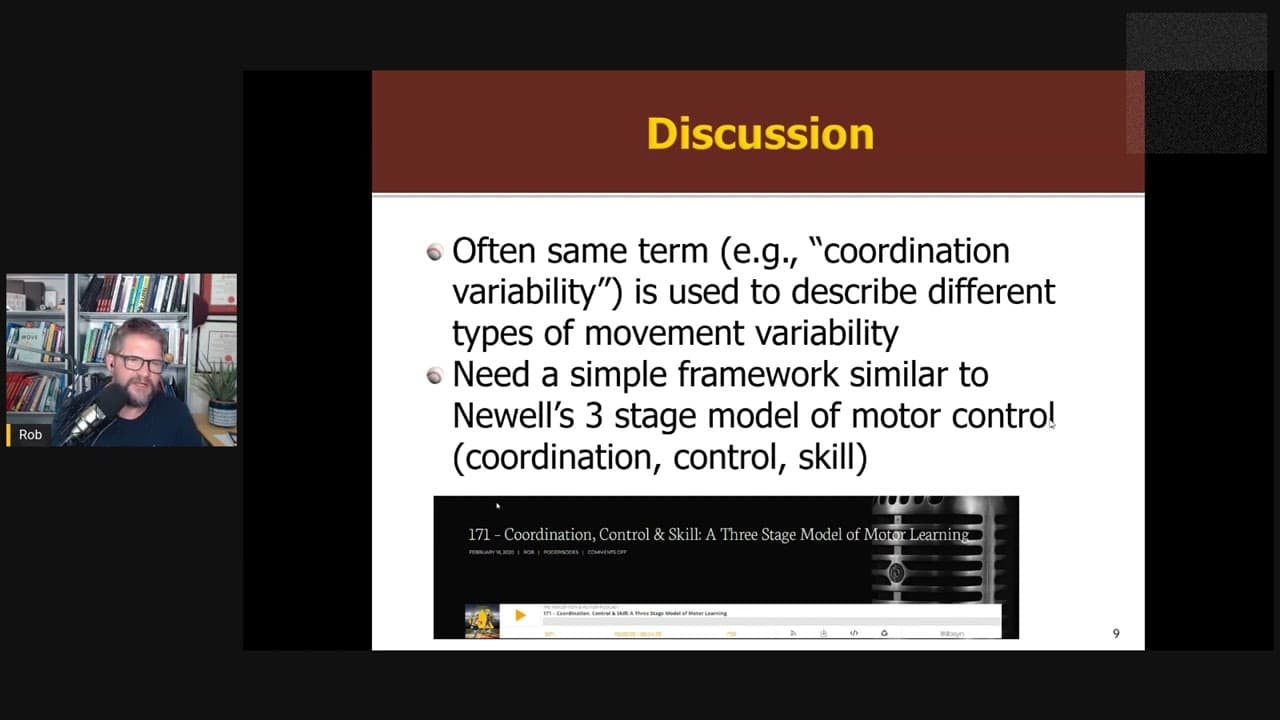
- The term 'movement variability' is often used broadly and inconsistently, necessitating a more precise framework for its study and application.
- A proposed framework divides movement variability into strategic, execution, and outcome variability, each with distinct roles in performance.
- Strategic variability involves using different approaches to achieve the same task, such as various basketball shots.
- Execution variability is the variation within the same strategy, like differences in release angle during a jump shot.
- Outcome variability relates to differences in movement results, providing feedback for movement calibration.
- The framework encourages more thoughtful practice design, incorporating strategic, execution, and outcome variability for better adaptability.
Install to Summarize YouTube Videos and Get Transcripts
Explore YouTube Video Summarizer or Get YouTube Transcript Extractor
Questions & Answers
Q: What is movement variability according to the paper?
Movement variability refers to the normal variations that occur in motor performance across multiple repetitions of a task. It is considered beneficial as it allows athletes to adapt to different constraints, enhancing performance and reducing the risk of injury. The paper emphasizes the need for a more precise understanding and categorization of movement variability.
Q: Why is movement variability considered beneficial?
Movement variability is beneficial because it allows athletes to adapt to varying constraints and conditions, leading to better performance and reduced injury risk. It supports the concept of 'repetition without repetition,' where athletes achieve the same outcome through different movements, enhancing their adaptability and skillfulness in dynamic sports environments.
Q: What are the three types of movement variability proposed in the framework?
The framework proposes three types of movement variability: strategic, execution, and outcome variability. Strategic variability involves different methods to achieve a task, execution variability refers to variations within a method, and outcome variability is the differences in results, providing feedback for further refinement. This categorization aims to enhance understanding and application in sports practice.
Q: How can the framework improve sports practice design?
The framework can improve sports practice design by encouraging more thoughtful incorporation of variability. By understanding and applying strategic, execution, and outcome variability, coaches can create training that enhances adaptability and performance. This involves varying conditions and instructions purposefully, rather than relying on simplistic repetition or random variability.
Q: What is the 'Goldilocks zone' of variability mentioned in the paper?
The 'Goldilocks zone' of variability refers to an optimal level of variability that is beneficial for performance and injury reduction. It suggests that while some variability is advantageous, too much or too little can be detrimental. The framework aims to identify and apply this optimal level in sports training to maximize benefits.
Q: How does strategic variability differ from execution variability?
Strategic variability involves using different strategies or methods to achieve the same task, such as various types of basketball shots. Execution variability, on the other hand, refers to variations within the same strategy, like differences in release angle during a jump shot. Both types are crucial for enhancing adaptability in sports.
Q: What role does outcome variability play in movement learning?
Outcome variability plays a crucial role in movement learning by providing feedback on the results of movements. This feedback helps athletes calibrate their movements and refine their strategies, improving their ability to achieve desired outcomes. It is an essential component of the proposed framework for understanding and applying movement variability.
Q: How does the paper propose to address the inconsistencies in the use of 'movement variability'?
The paper proposes addressing inconsistencies in the use of 'movement variability' by establishing a clear framework that categorizes it into strategic, execution, and outcome types. This framework aims to provide a more precise and consistent understanding, allowing for better research and application in sports practice. It encourages specificity in defining and measuring variability.
Summary & Key Takeaways
-
Movement variability is essential for adapting to different constraints and improving performance. The paper reviewed proposes a framework categorizing variability into strategic, execution, and outcome types. This allows for a more nuanced understanding and application in sports practice and coaching, moving beyond the simplistic notion of variability as merely beneficial.
-
Strategic variability involves using different methods to achieve the same goal, while execution variability pertains to variations within the same method. Outcome variability concerns the differences in results, which provide feedback for further refinement. The framework aims to clarify these distinctions to enhance training methods.
-
The paper highlights the need for a clearer definition of movement variability in sports research and practice. By categorizing variability, coaches and practitioners can better tailor training to improve adaptability and performance, ensuring variability is applied optimally to avoid negative effects.
Read in Other Languages (beta)
Share This Summary 📚
Summarize YouTube Videos and Get Video Transcripts with 1-Click
Try YouTube Summary with ChatGPT & Claude or YouTube Transcript Generator
Explore More Summaries from Rob Gray 📚
Summarize YouTube Videos and Get Video Transcripts with 1-Click
Try YouTube Summary with ChatGPT & Claude or YouTube Transcript Generator