What Is Bragg's Equation and How Is It Used in X-Ray Diffraction?
TL;DR
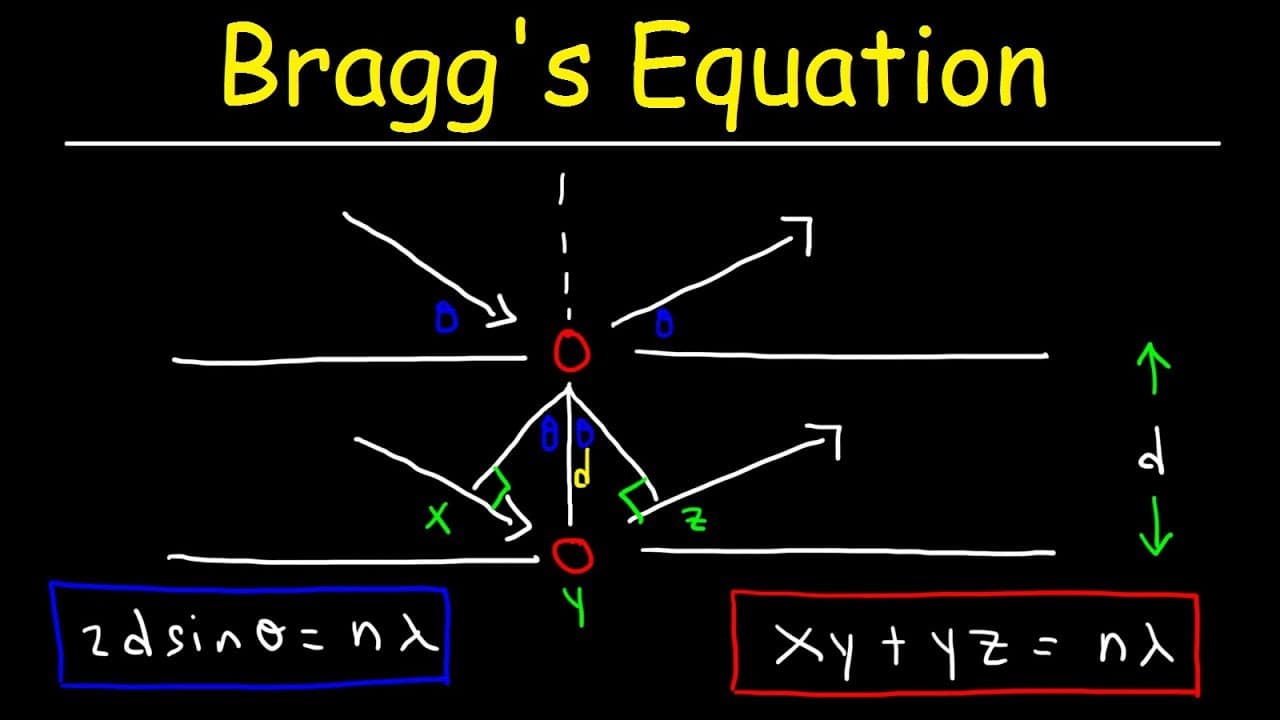
Bragg's equation, given by 2d sin(theta) = nλ, allows calculation of the distance between atomic layers in a crystal using X-ray diffraction. It relates the interplanar spacing (d), angle of reflection (theta), order of diffraction (n), and wavelength of the X-ray (λ). This equation is essential for solving various problems in crystallography.
Transcript
in this video we're going to talk about bragg's equation how we could derive it and how we can use it to solve some problems bragg's equation helps you to calculate the interspace and distance between layers of atoms it uses x-ray diffraction to calculate the distance so we're going to pass the first x-ray on this atom and then it's going to bounce... Read More
Key Insights
- 📤 Bragg's equation is derived by considering the distance traveled by x-rays when reflected off atoms in a crystal.
- ☺️ The equation is 2d sin(theta) = nλ, where d is the distance between layers of atoms, theta is the angle of reflection, n is the order of diffraction, and λ is the wavelength of the x-ray.
- 📤 Bragg's equation can be used to calculate the distance between layers of atoms or the wavelength of x-rays, depending on the given parameters.
- 😀 The order of diffraction, represented by n, determines which degree of reflection is being considered.
Install to Summarize YouTube Videos and Get Transcripts
Explore YouTube Video Summarizer or Get YouTube Transcript Extractor
Questions & Answers
Q: How does Bragg's equation help calculate the distance between layers of atoms?
Bragg's equation uses x-ray diffraction to determine the distance between layers of atoms in a crystal. By analyzing the angle of reflection and the wavelength of the x-ray, it allows us to calculate the distance using the equation 2d sin(theta) = nλ.
Q: What does the value of n represent in Bragg's equation?
The value of n in Bragg's equation represents the order of diffraction. It indicates which degree of reflection is being considered. For example, if n is 1, it refers to first-order diffraction.
Q: Can Bragg's equation be used to find the wavelength of x-rays?
Yes, Bragg's equation can also be used to find the wavelength of x-rays. By rearranging the equation to solve for λ, we can calculate the wavelength given the distance between layers of atoms, the angle of reflection, and the order of diffraction.
Q: How is the angle of reflection related to the angle of incidence in Bragg's equation?
In Bragg's equation, the angle of reflection is equal to the angle of incidence. This is because the lines representing the incident and reflected x-rays are parallel, forming congruent angles within the crystal.
Summary & Key Takeaways
-
Bragg's equation is derived by analyzing the distance traveled by x-rays when bouncing off atoms in a crystal.
-
The equation is 2d sin(theta) = nλ, where d is the distance between layers of atoms, theta is the angle of reflection, n is the order of diffraction, and λ is the wavelength of the x-ray.
-
The equation can be used to solve problems related to finding the distance between planes of atoms or the wavelength of x-rays given specific parameters.
Read in Other Languages (beta)
Share This Summary 📚
Summarize YouTube Videos and Get Video Transcripts with 1-Click
Try YouTube Summary with ChatGPT & Claude or YouTube Transcript Generator
Explore More Summaries from The Organic Chemistry Tutor 📚




Summarize YouTube Videos and Get Video Transcripts with 1-Click
Try YouTube Summary with ChatGPT & Claude or YouTube Transcript Generator