Speed and Delay Study - Traffic Engineering - Transportation Engineering - I
TL;DR
Speed and delay studies provide vital information on traffic density, location and causes of delay, and can be used for planning and remedial measures.
Transcript
hello students today we are going to study speed and delay study we know that spot speed study cannot give the density of traffic hence speed and delay studies are carried out over a long distance and hence it is possible to determine density of traffic this study gives information such as the amount location and causes of delay in traffic stream i... Read More
Key Insights
- 🦻 Speed and delay studies provide essential information about traffic density, delay, and can aid in planning and remedial measures.
- 😨 Different methods, such as the floating car method and license plate method, are used for speed and delay studies.
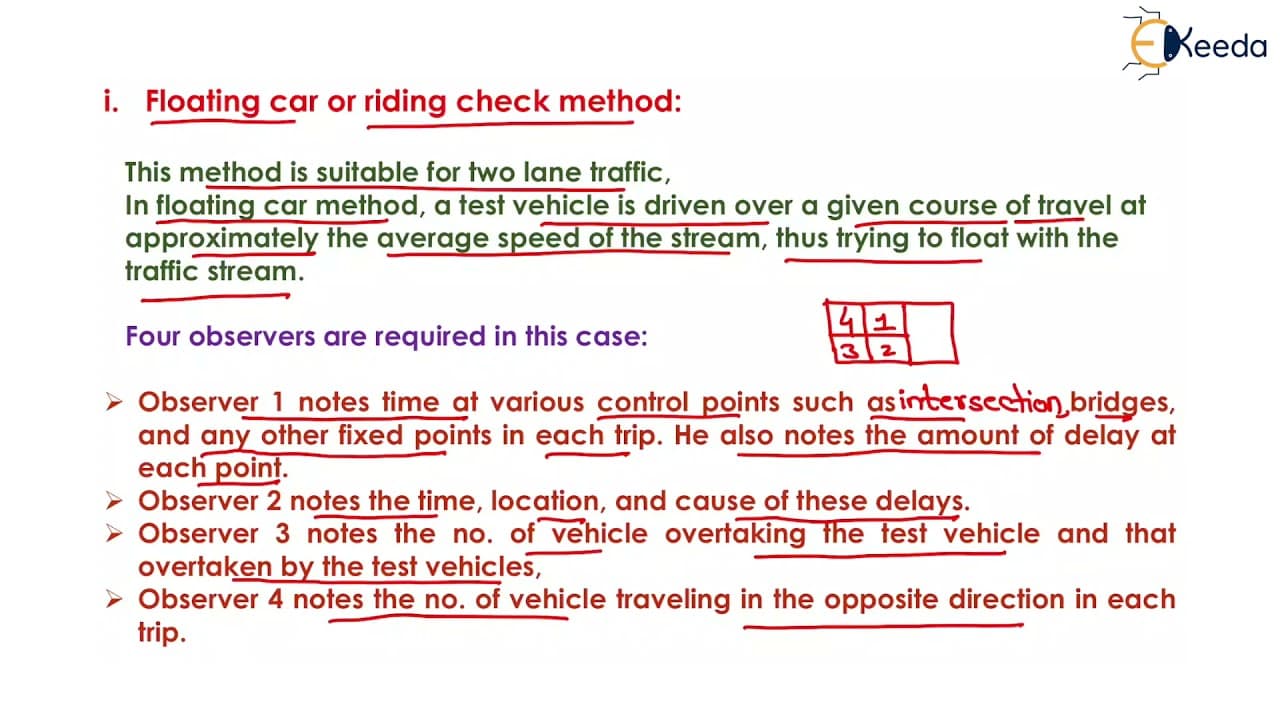
- 🚙 Observers in speed and delay studies note time, location, causes of delay, overtaking vehicles, and vehicles traveling in the opposite direction.
- ⏳ Traffic flow and average journey time can be calculated using data collected from speed and delay studies.
- 🐎 Speed and delay studies are crucial for evaluating traffic conditions and identifying potential areas for improvement.
- 🚙 The floating car method is suitable for two-lane traffic and involves driving a test vehicle at the average speed of the traffic stream.
- 🍽️ The license plate method involves tracking specific vehicles using their license plate numbers to gather data on speed and delay.
Install to Summarize YouTube Videos and Get Transcripts
Explore YouTube Video Summarizer or Get YouTube Transcript Extractor
Questions & Answers
Q: Why are speed and delay studies necessary for evaluating traffic conditions?
Speed and delay studies provide valuable insights into the density of traffic, the amount and causes of delay, and help in planning and implementing measures to tackle delays at specific locations.
Q: What are the different methods used to conduct speed and delay studies?
Some common methods include the floating car method, license plate method, interview technique, elevated observation, and photographic technique.
Q: How does the floating car method work?
The floating car method involves driving a test vehicle at the average speed of the traffic stream, with observers noting time, location, causes of delay, overtaking vehicles, and vehicles traveling in the opposite direction.
Q: How can traffic flow and average journey time be calculated using the data from speed and delay studies?
Traffic flow can be calculated using the formula: Traffic flow = (Average number of vehicles traveling in the direction of flow) / (Average journey time when test vehicle travels with the flow). Average journey time of flow can be calculated using the formula: Average journey time of flow = (Average journey time when test vehicle travels with the flow) - (Average number of vehicles overtaking the test vehicle).
Summary & Key Takeaways
-
Speed and delay studies are conducted over a long distance to determine traffic density and gather information on delay in traffic streams.
-
Various methods for speed and delay studies include the floating car method, license plate method, interview technique, elevated observation, and photographic technique.
-
The floating car method involves driving a test vehicle at the average speed of the traffic stream, with observers noting time, location, causes of delay, overtaking vehicles, and vehicles traveling in the opposite direction.
Read in Other Languages (beta)
Share This Summary 📚
Summarize YouTube Videos and Get Video Transcripts with 1-Click
Try YouTube Summary with ChatGPT & Claude or YouTube Transcript Generator
Explore More Summaries from Ekeeda 📚



Summarize YouTube Videos and Get Video Transcripts with 1-Click
Try YouTube Summary with ChatGPT & Claude or YouTube Transcript Generator