Why Are Arene Diazonium Salts More Stable Than Alkyl Diazonium Salts?
TL;DR
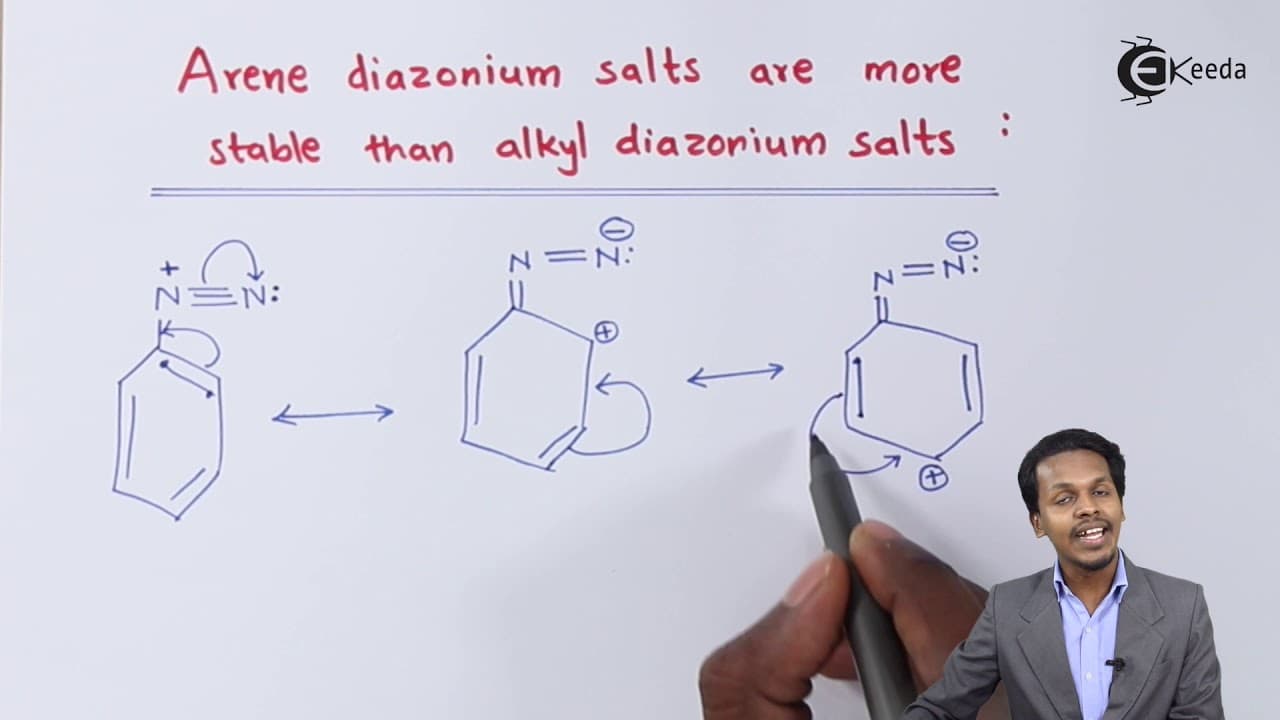
Arene diazonium salts are more stable than alkyl diazonium salts because their benzene ring allows resonance and delocalization of the pi electrons, spreading the positive charge across the ring. The nitrogen's lone pair makes it more negative, pulling electrons toward it and forming a series of resonance structures. Alkyl diazonium salts have no such resonance, so they break down into a carbocation and nitrogen gas. Read on for the step-by-step resonance mechanism.
Transcript
click the bell icon to get latest videos from equator reference in the previous lecture we have discussed about the reactions of benzene diazonium salts and now in this topic we are going to talk about that is why the arrange diazonium swans are very much stable then alkyl themselves so this is the topic that I am going to talk about so now let us ... Read More
Key Insights
- 😋 Arene diazonium salts have a benzene ring attached to a diazonium or iso group, leading to their stability.
- 👥 The lone pair of electrons on the nitrogen in the diazonium group causes the delocalization of electrons.
- 😋 Resonance and delocalization of electrons stabilize positive charges generated around the benzene ring in arene diazonium salts.
Install to Summarize YouTube Videos and Get Transcripts
Explore YouTube Video Summarizer or Get YouTube Transcript Extractor
Questions & Answers
Q: Why are arene diazonium salts more stable than alkyl diazonium salts?
Arene diazonium salts have a benzene ring attached to the diazonium group, which allows resonance and delocalization of pi electrons. This delocalization spreads the positive charge across the benzene ring, stabilizing the molecule. Alkyl diazonium salts have no ring to enable resonance, so they cannot delocalize the charge and are much less stable.
Q: How does the benzene ring stabilize an arene diazonium salt?
The nitrogen in the diazonium group carries a lone pair of electrons, making it more negative and pulling electrons toward it. To stabilize the resulting positive charge, electrons shift between the nitrogen and carbon bonds, moving the positive charge onto different carbon atoms of the ring. This produces multiple resonance structures that delocalize the charge and stabilize the whole molecule.
Q: What happens to the positive charge in an arene diazonium salt?
The positive charge does not stay on one atom. Through successive electron shifts, it moves around the benzene ring, appearing on different carbon atoms and on the nitrogen in the various resonance structures. Because the charge is delocalized rather than fixed in one place, the molecule becomes more stable.
Q: Why do alkyl diazonium salts lack stability?
Alkyl diazonium salts have no benzene ring, so there is no possibility of resonance or delocalization of pi electrons. Without a way to spread out the positive charge, the salt is very unstable. It breaks down into a carbocation while the nitrogen is released as a gas.
Q: What role does the nitrogen lone pair play in the diazonium group?
The nitrogen in the diazonium group has a lone pair of electrons that makes it more negative. This draws electrons toward the nitrogen and triggers the electron shifts that begin the resonance process. That movement of electrons is what starts the delocalization responsible for stabilizing the arene diazonium salt.
Q: What is an arene diazonium salt?
An arene diazonium salt is a compound in which a diazonium group is attached to a benzene ring (an arene). Because the diazonium group sits on an aromatic ring, its electrons can participate in resonance. This structure is the key difference that makes it more stable than an alkyl diazonium salt.
Q: How does resonance work in an arene diazonium salt?
Resonance begins when the nitrogen's lone pair pulls electrons and a double bond forms, placing a positive charge on a ring carbon. Pairs of electrons then jump successively to stabilize each positive charge, forming a new double bond each time and shifting the charge onward. After the electrons cycle through, the structure returns to its original form, showing the charge is delocalized across the molecule.
Summary & Key Takeaways
-
Arene diazonium salts, which have a benzene ring attached to a diazonium or iso group, exhibit resonance and delocalization of electrons.
-
The nitrogen in the diazonium group has a lone pair of electrons, making it more negative and causing the electrons to be pulled towards it.
-
The delocalization of electrons results in the generation of positive charges around the benzene ring, making arene diazonium salts more stable than alkyl diazonium salts.
Read in Other Languages (beta)
Share This Summary 📚
Summarize YouTube Videos and Get Video Transcripts with 1-Click
Try YouTube Summary with ChatGPT & Claude or YouTube Transcript Generator
Explore More Summaries from Ekeeda 📚






Summarize YouTube Videos and Get Video Transcripts with 1-Click
Try YouTube Summary with ChatGPT & Claude or YouTube Transcript Generator