Finite square well. Setting up the problem
TL;DR
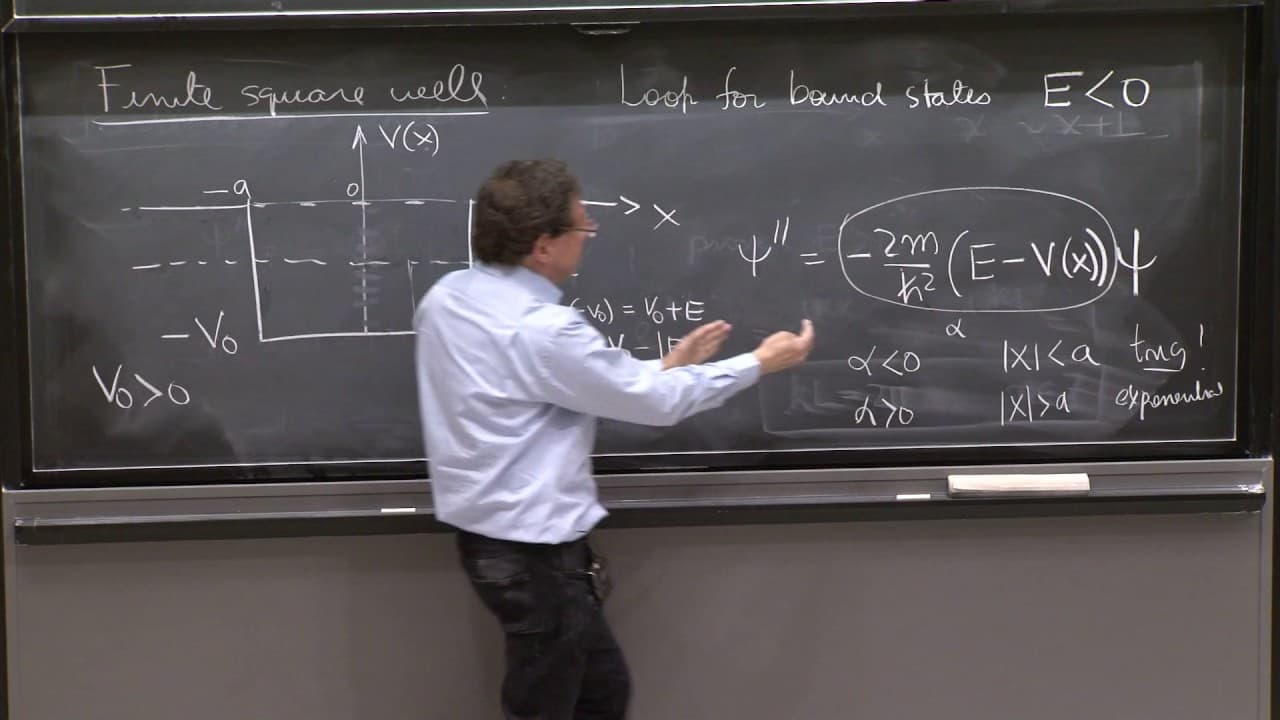
The lecture explains the concept of a finite square well potential and its solutions in quantum mechanics.
Transcript
BARTON ZWIEBACH: Finite square well. So this brings us also to a little common aside. So far, we could find every solution. Now we're going to write the equations for the finite square well, and we're not going to be able to find the solution. But we're going to understand the solution. So you're going to enjoy a little-- mathematicians usually say... Read More
Key Insights
- 👋 Understanding the solution of the wave function in the finite square well potential is more essential than finding it.
- ❎ The finite square well potential introduces the concept of bound states with negative energy.
- ❓ Trigonometric solutions are found within the well, while exponential solutions are found outside the well.
- 🥺 The potential symmetry leads to even and odd solutions of the wave function, corresponding to symmetric and antisymmetric states.
- #️⃣ Unit-free numbers, such as k, kappa, eta, and z0, play a crucial role in simplifying and characterizing the solutions.
- #️⃣ The number of bound states is determined by the dimensionless quantity z0, which depends on the potential parameters.
- 👋 The wave function must satisfy continuity conditions at the boundaries of the potential well.
Install to Summarize YouTube Videos and Get Transcripts
Explore YouTube Video Summarizer or Get YouTube Transcript Extractor
Questions & Answers
Q: What is the significance of finding bound states in the finite square well potential?
Bound states refer to particle states that are confined within the well, having negative energy. They have a higher probability of being found within the allowed region and are important in understanding quantum systems.
Q: How does the wave function behave at the boundaries of the finite square well potential?
At the boundary, the wave function must be continuous to satisfy the Schrodinger equation and boundary conditions. Matching the wave function inside and outside the well provides insights into the behavior of the particle within the potential.
Q: Can the potential in the finite square well be infinitely high?
No, if the potential is infinitely high, the wave function would not leak outside the well, and it would resemble the solutions for an infinite square well potential. The finiteness of the potential allows for leakage of the wave function.
Q: How is the number of bound states determined in the finite square well potential?
The number of bound states is controlled by the dimensionless quantity called z0, which depends on the potential depth and the width of the well. Larger z0 values correspond to more bound states, while smaller values result in fewer bound states.
Summary & Key Takeaways
-
The lecture introduces the finite square well potential, which consists of a potential well of limited width.
-
Bound states, which have negative energy, are sought after in this potential where the wave function is localized in the allowed region.
-
The Schrodinger equation is used to derive the solutions for the wave function inside and outside the well, depending on the potential energy.
-
Trigonometric solutions (cosine) are found within the well, while exponential solutions (Euler's formula) are found outside the well.
Read in Other Languages (beta)
Share This Summary 📚
Summarize YouTube Videos and Get Video Transcripts with 1-Click
Try YouTube Summary with ChatGPT & Claude or YouTube Transcript Generator
Explore More Summaries from MIT OpenCourseWare 📚



Summarize YouTube Videos and Get Video Transcripts with 1-Click
Try YouTube Summary with ChatGPT & Claude or YouTube Transcript Generator