Unit 10: Utility Analysis and Multidimensional Evaluation, Video 6: Dominated Solutions
TL;DR
Dominated solutions are inferior alternatives that can be screened out because another option performs at least as well on one benefit and better on another. The remaining choices lie on the dominant frontier, but evaluating them still requires examining risk, reward, downside, upside, capital expenditure, and benefit-cost measures, not expected value alone. Read on to see how value at risk, value in gain, and target curves support that comparison.
Transcript
[SQUEAKING] [RUSTLING] [CLICKING] RICHARD DE NEUFVILLE: What can we expect to achieve. So the evaluation has many dimensions. It is uncertainty. Best is not defined. What we can do first is to dominate, to screen out the dominate solutions. As we can go through a process and say, of the 1,000 different solutions or the 10 different solutions, eight... Read More
Key Insights
- 💻 Evaluating solutions involves identifying dominant options and screening out inferior alternatives.
- 🧑💼 Decision-making involves trade-offs between risk and reward for individuals and negotiation for groups.
- 🙃 Expected value is just one measure; downside risks, upside potential, and capital expenditure are important considerations.
- 🌸 Value at risk assesses the likelihood of significant losses and is crucial in decision-making, particularly in finance.
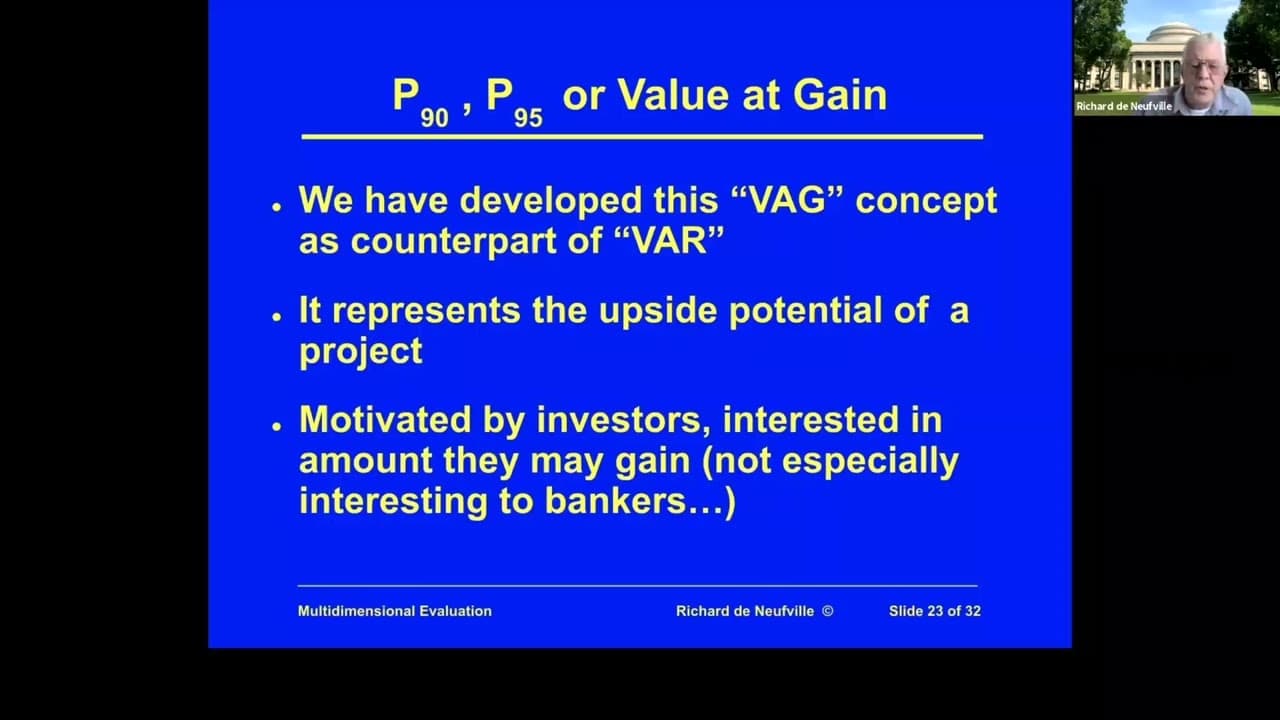
- 🉐 Balancing the equation with value in gain is essential to consider potential gains in decision-making.
- 🎯 Target curves help visualize the distribution of outcomes and determine value at risk and value in gain.
- 🧑🏭 Dominance of one design over another cannot be solely determined by target curves; contextual factors may influence their performance.
Install to Summarize YouTube Videos and Get Transcripts
Explore YouTube Video Summarizer or Get YouTube Transcript Extractor
Questions & Answers
Q: What are dominated solutions in multidimensional evaluation?
Dominated solutions are inferior alternatives for which better options exist on all relevant benefit axes. For example, another solution may offer the same value on one axis and a better value on the other, so the dominated alternative can be screened out.
Q: How do you identify dominant solutions?
Plot the alternatives across two benefit axes and eliminate points that are inferior to other available points. The remaining solutions lie on the frontier and form the dominant set for further evaluation.
Q: Why should dominated alternatives be screened out first?
Screening reduces the set of alternatives that require detailed consideration. From an initial group of 1,000 or 10 solutions, the process may reveal a dominant group of three, four, or five options.
Q: Why is expected value insufficient for evaluating solutions?
Expected value is only one way to describe a distribution of outcomes. Evaluation may also need to consider the worst outcome, downside risk, upside potential, capital expenditure, and a measure of benefit versus cost.
Q: How do risk and reward affect individual and group decisions?
Individuals must make some form of trade-off between risk and reward. Groups typically negotiate because what individuals or groups prefer may differ from what they ultimately receive.
Q: What is value at risk?
Value at risk reflects the lowest 5% or 10% of a distribution, the downside tail. Banks and others use it to examine how probable a large loss may be and whether a borrower might be unable to repay them.
Q: What is value in gain?
Value in gain is presented as a counterpart to value at risk that focuses on potential upside. Although it is not described as a well-established concept, it helps balance attention to losses with the gains that particularly interest investors.
Q: How do target curves support evaluation under uncertainty?
A target curve displays the distribution of outcomes from the worst case to the best case, using either a cumulative or frequency distribution. It allows evaluators to read value at risk and value in gain, but one curve being consistently to the right does not guarantee that its design performs better in every situation.
Summary & Key Takeaways
-
Evaluating solutions involves identifying dominant options and screening out inferior alternatives.
-
In decision-making, individuals have to make trade-offs between risk and reward, while groups negotiate for their preferences.
-
Expected value is just one measure; other dimensions like downside risk, upside potential, and capital expenditure are important considerations.
Read in Other Languages (beta)
Share This Summary 📚
Summarize YouTube Videos and Get Video Transcripts with 1-Click
Try YouTube Summary with ChatGPT & Claude or YouTube Transcript Generator
Explore More Summaries from MIT OpenCourseWare 📚


Summarize YouTube Videos and Get Video Transcripts with 1-Click
Try YouTube Summary with ChatGPT & Claude or YouTube Transcript Generator