Lecture 1.1: Nancy Kanwisher - Human Cognitive Neuroscience
TL;DR
Brain regions show functional specificity, supporting the existence of a specialized architecture for human intelligence.
Transcript
The following content is provided under a Creative Commons license. Your support will help MIT OpenCourseWare continue to offer high quality educational resources for free. To make a donation or view additional materials from hundreds of MIT courses, visit MIT OpenCourseWare at ocw.mit.edu. NANCY KANWISHER: So I'm going to talk today about a couple... Read More
Key Insights
- 😀 The human brain has specialized regions for different mental functions, such as face recognition, language processing, and perception of color, among others.
- ❓ These specialized regions show functional specificity, responding selectively to certain stimuli or tasks related to their specific function.
- 🧠 Functional MRI studies have provided evidence for the existence of functional specificity in the human brain.
- 🤙 In addition to specialized regions, there are also regions called multiple demand regions that are involved in multiple demanding tasks, suggesting a more general-purpose intelligence.
Install to Summarize YouTube Videos and Get Transcripts
Explore YouTube Video Summarizer or Get YouTube Transcript Extractor
Questions & Answers
Q: What is functional specificity?
Functional specificity refers to the ability of certain brain regions to be highly selective and specific in their function, such as face recognition or language processing.
Q: Are these specialized regions present in all individuals?
Yes, these specialized regions are present in essentially every normal person, although their exact location may vary slightly.
Q: How do functional MRI studies contribute to understanding functional specificity?
Functional MRI studies allow researchers to identify and study specific brain regions by using functional localizers and measuring the response in those regions to different stimuli or tasks.
Q: Is functional specificity related to innate abilities or learned experiences?
Functional specificity can be influenced by both innate abilities and learned experiences. For example, regions involved in language processing may be influenced by language exposure and experience.
Q: Are these specialized regions necessary for their specific function?
These specialized regions are believed to be necessary for their specific function, as evidenced by patient studies that show a decline in cognitive abilities related to that function when the region is damaged.
Summary & Key Takeaways
-
The human brain has specific regions that are highly specialized and involved in different mental functions.
-
These regions have been found to be selectively activated by certain stimuli or tasks, such as face recognition or language processing.
-
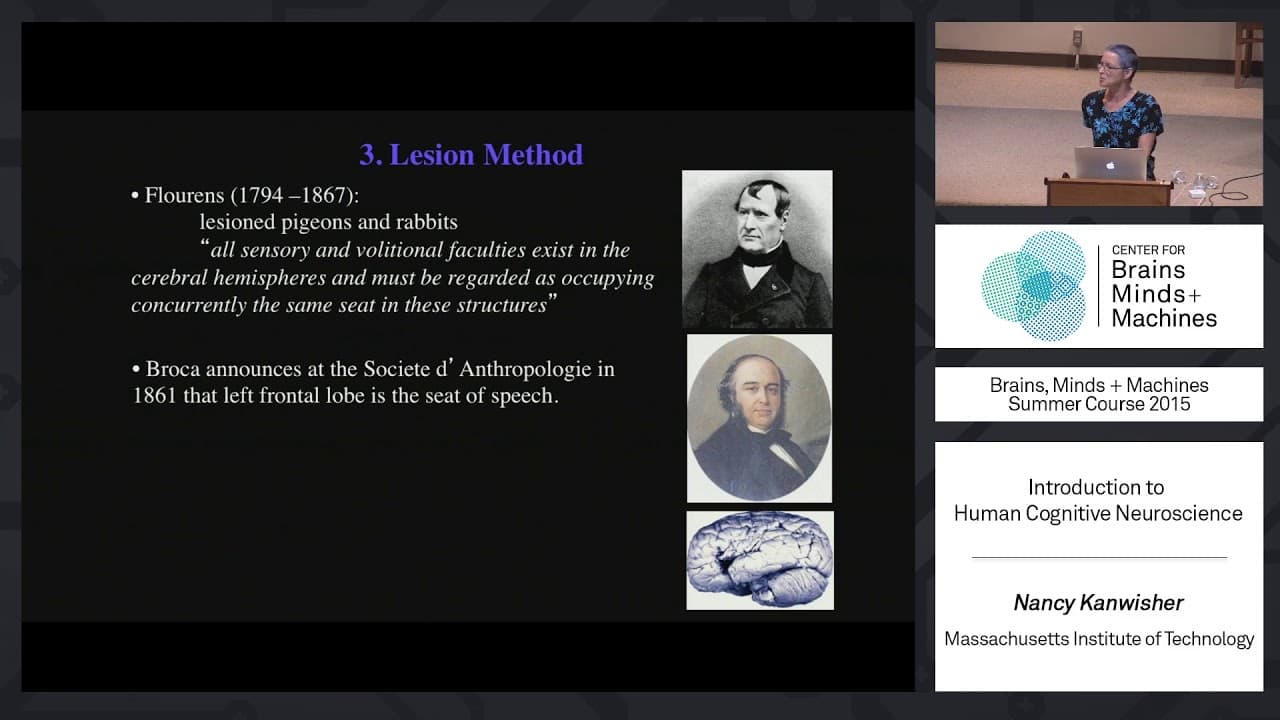
Patients with brain damage in these specific regions show a decline in cognitive abilities related to that function.
-
There are also regions of the brain that are involved in multiple demanding tasks, suggesting a more general-purpose intelligence.
Read in Other Languages (beta)
Share This Summary 📚
Summarize YouTube Videos and Get Video Transcripts with 1-Click
Try YouTube Summary with ChatGPT & Claude or YouTube Transcript Generator
Explore More Summaries from MIT OpenCourseWare 📚



Summarize YouTube Videos and Get Video Transcripts with 1-Click
Try YouTube Summary with ChatGPT & Claude or YouTube Transcript Generator