Lecture 09
TL;DR
Explores efficient market theory, anomalies, and behavioral finance.
Transcript
thank you in this lesson we'll discuss the theory of efficient markets and behavioral Finance in the previous discussions the purpose of holding the firm's capital investment decision constant is to separate the decision from the financing decision strictly speaking this assumes that investment and financing decisions are independen... Read More
Key Insights
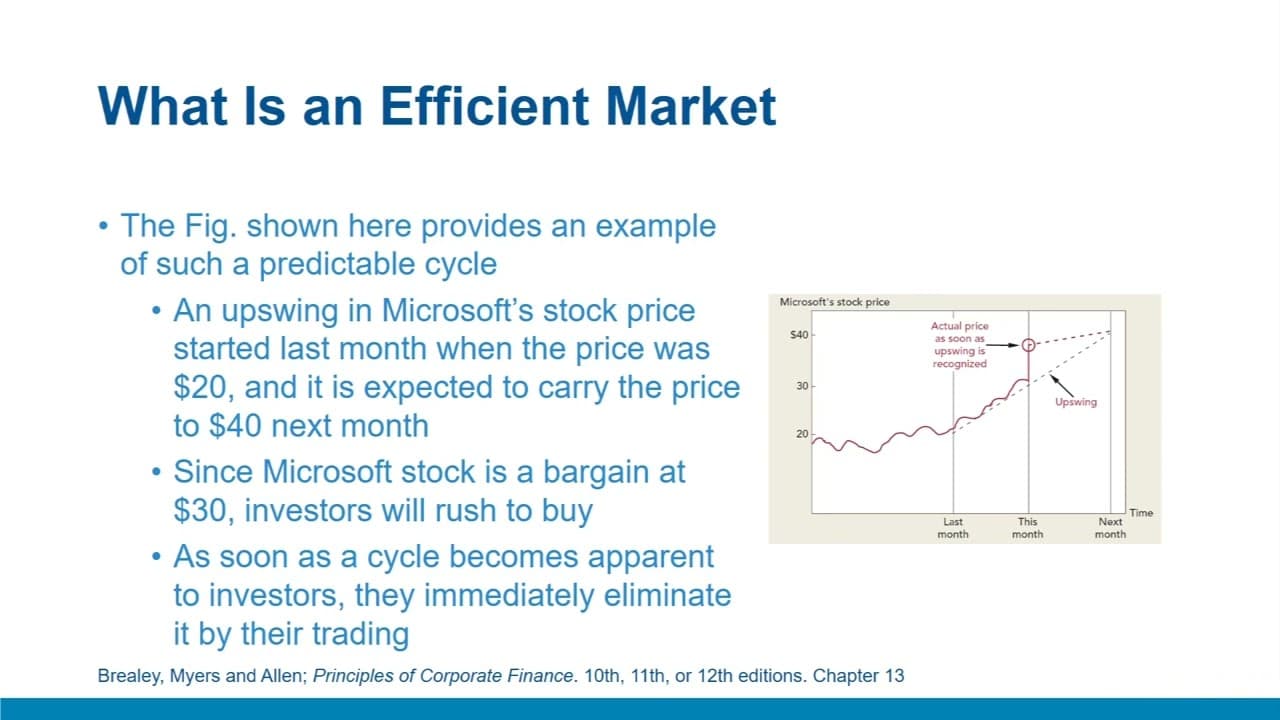
- Efficient Market Hypothesis (EMH) suggests that capital markets are competitive, eliminating profit opportunities and ensuring securities are fairly priced.
- EMH comes in three forms: weak, semi-strong, and strong, each reflecting different levels of information integration in prices.
- Behavioral finance challenges EMH by highlighting psychological biases like overconfidence and loss aversion that affect investor decisions.
- Market anomalies, such as the small firm effect and January effect, suggest deviations from EMH, though many disappear once identified.
- Arbitrage opportunities are rare and risky, limiting the ability of rational investors to correct market inefficiencies.
- Investment decisions are perceived as simpler than financing due to fewer competitors and unique firm assets like patents.
- Bubbles occur when asset prices deviate significantly from fundamental values, often driven by investor psychology and speculative trading.
- Market efficiency implies that stock prices reflect all available information, making it difficult to consistently achieve superior returns.
Install to Summarize YouTube Videos and Get Transcripts
Explore YouTube Video Summarizer or Get YouTube Transcript Extractor
Questions & Answers
Q: What is the Efficient Market Hypothesis?
The Efficient Market Hypothesis (EMH) suggests that capital markets are highly competitive, leading to securities being fairly priced. It posits that profit opportunities are eliminated due to fierce competition among investors. EMH is categorized into three forms: weak, semi-strong, and strong, each reflecting different levels of information integration in prices.
Q: How does behavioral finance challenge the Efficient Market Hypothesis?
Behavioral finance challenges the Efficient Market Hypothesis by highlighting psychological biases that affect investor decisions. These include overconfidence, loss aversion, and reliance on recent events when predicting future outcomes. Such biases can lead to market anomalies, suggesting deviations from the assumptions of market efficiency posited by EMH.
Q: What are market anomalies, and how do they relate to EMH?
Market anomalies are patterns or occurrences in financial markets that seem to contradict the Efficient Market Hypothesis. Examples include the small firm effect and the January effect. These anomalies suggest that markets are not always perfectly efficient. However, many anomalies disappear once they are identified by investors, as opportunities are quickly exploited.
Q: Why are arbitrage opportunities rare in efficient markets?
Arbitrage opportunities are rare in efficient markets because these markets are highly competitive, and any price discrepancies are quickly corrected by investors. Arbitrage involves exploiting these discrepancies to earn risk-free profits, but in practice, such opportunities are risky and difficult to execute due to trading costs and market constraints.
Q: How do bubbles form in financial markets?
Bubbles form in financial markets when asset prices deviate significantly from their fundamental values. This often occurs due to speculative trading and investor psychology, where rising prices generate increased optimism and demand. Bubbles can be self-sustaining for a period but eventually burst, leading to significant losses for investors.
Q: What role do psychological biases play in investment decisions?
Psychological biases play a significant role in investment decisions by influencing how investors perceive risk and assess probabilities. Biases such as overconfidence, loss aversion, and reliance on recent events can lead to irrational decision-making, affecting market prices and contributing to anomalies and deviations from the predictions of the Efficient Market Hypothesis.
Q: What are the practical implications of market efficiency for investors?
The practical implications of market efficiency for investors include the understanding that it is difficult to consistently achieve superior returns, as prices reflect all available information. Investors should be cautious of relying on past price patterns or attempting to time the market. Instead, they might consider diversifying their portfolios to manage risk effectively.
Q: How does the Efficient Market Hypothesis categorize market efficiency?
The Efficient Market Hypothesis categorizes market efficiency into three forms: weak, semi-strong, and strong. Weak form efficiency suggests that prices reflect all historical information; semi-strong form efficiency indicates that prices incorporate all publicly available information; and strong form efficiency posits that prices reflect all information, both public and private, making it impossible to consistently achieve superior returns.
Summary & Key Takeaways
-
The video discusses the Efficient Market Hypothesis (EMH), which posits that capital markets are highly competitive, leading to fairly priced securities and eliminating profit opportunities. EMH is categorized into three forms: weak, semi-strong, and strong, each reflecting different levels of information integration in prices.
-
Behavioral finance challenges the assumptions of EMH by highlighting psychological biases like overconfidence and loss aversion that can affect investor decisions, leading to market anomalies. These anomalies, such as the small firm effect and January effect, suggest deviations from EMH, though many disappear once identified by investors.
-
The video also explores the concept of market bubbles, where asset prices deviate significantly from their fundamental values, often driven by investor psychology and speculative trading. Despite these anomalies, the video emphasizes that market efficiency implies stock prices reflect all available information, making it difficult to consistently achieve superior returns.
Read in Other Languages (beta)
Share This Summary 📚
Summarize YouTube Videos and Get Video Transcripts with 1-Click
Try YouTube Summary with ChatGPT & Claude or YouTube Transcript Generator
Explore More Summaries from IIT KANPUR-NPTEL 📚






Summarize YouTube Videos and Get Video Transcripts with 1-Click
Try YouTube Summary with ChatGPT & Claude or YouTube Transcript Generator