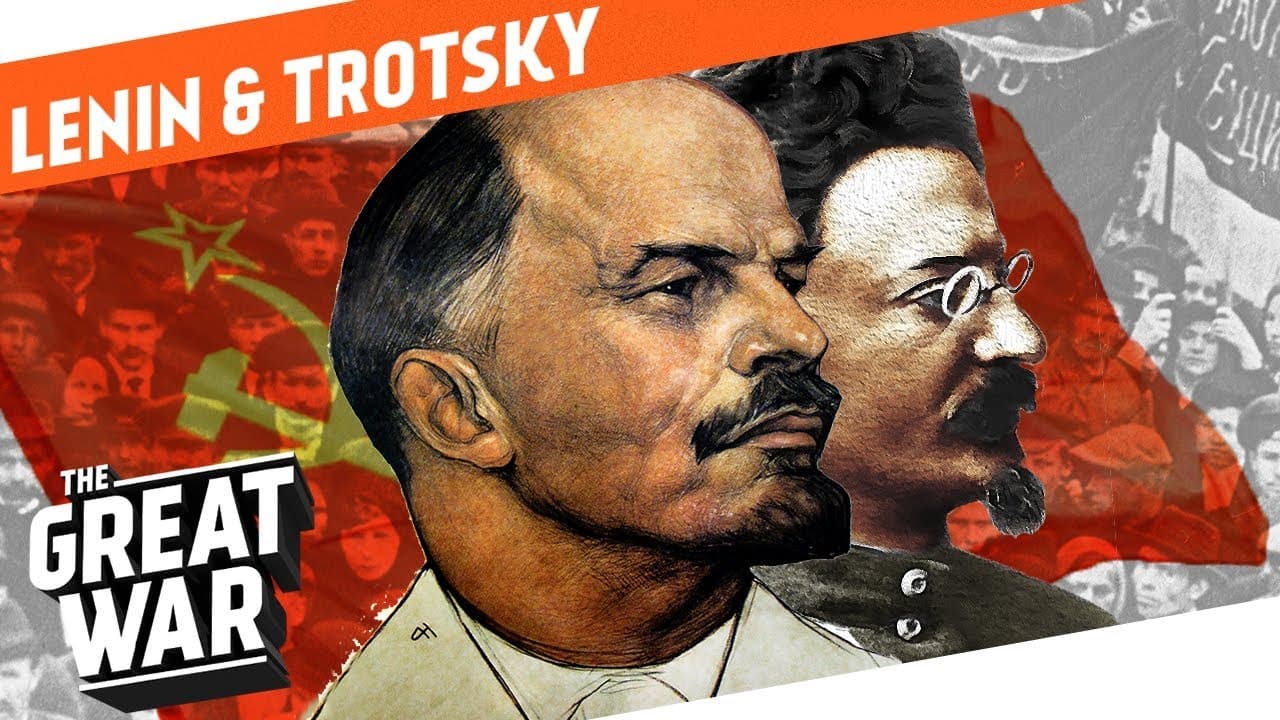
How Did Lenin and Trotsky Rise to Power?
TL;DR
Lenin and Trotsky's rise to power was marked by strategic alliances and revolutionary fervor. Lenin's leadership and Trotsky's organizational skills were crucial in the Bolsheviks' success during the Russian Revolution. Despite internal disagreements, their collaboration led to significant political shifts, culminating in the Treaty of Brest-Litovsk, which secured peace with Germany but at a high territorial cost.
Transcript
We’ve talked about Lenin, Trotsky, and the situation in Russia during and after both revolutions quite a bit in our regular episodes, and will continue to do so, but who were these guys? And how did they end up in their positions of power? Let’s have a look. I’m Indy Neidell; welcome to a Great War special episode about Lenin, Trotsky, and the Bols... Read More
Key Insights
- Leon Trotsky was born in Ukraine in 1879 and initially ambivalent to politics until influenced by the People’s Will party.
- Lenin was born Vladimir Ilyich Ulyanov in 1870 and was deeply influenced by Marxist theories, leading to his revolutionary activities.
- Trotsky joined Lenin in London in 1902, contributing to the Marxist newspaper Iskra.
- The Russian Marxists split into Bolsheviks and Mensheviks in 1903, with Trotsky initially siding with the Mensheviks.
- The Bolsheviks, under Lenin and Trotsky, eventually seized power during the October Revolution of 1917.
- Lenin's leadership was pivotal in the Bolsheviks' success, although Trotsky played a crucial role in organizing the Petrograd takeover.
- Germany funded Lenin and the Bolsheviks, aligning with their interests to dissolve the Russian army.
- The Treaty of Brest-Litovsk resulted in significant territorial losses for Russia but was deemed necessary by Lenin to consolidate Bolshevik power.
Install to Summarize YouTube Videos and Get Transcripts
Explore YouTube Video Summarizer or Get YouTube Transcript Extractor
Questions & Answers
Q: How did Lenin and Trotsky first meet?
Lenin and Trotsky first met in London in 1902 when Trotsky fled his Siberian exile and sought out Lenin. Trotsky, impressed by Lenin's revolutionary fervor, joined the editorial board of Iskra, a Marxist newspaper Lenin was involved with. This meeting marked the beginning of their collaboration in the revolutionary movement.
Q: What were the key differences between the Bolsheviks and Mensheviks?
The Bolsheviks, led by Lenin, advocated for a centralized, disciplined party that could lead a proletarian revolution. In contrast, the Mensheviks believed in a more democratic approach, emphasizing mass membership and gradual reform. This ideological split occurred during the Russian Social Democratic Labor Party's Second Congress in 1903.
Q: What role did Trotsky play in the October Revolution?
Trotsky played a pivotal role in the October Revolution as he organized the Petrograd Soviet and led the Military Revolutionary Committee. His strategic planning and execution of the takeover of key government sites in Petrograd were crucial to the Bolsheviks' successful seizure of power in October 1917.
Q: Why was the Treaty of Brest-Litovsk significant?
The Treaty of Brest-Litovsk was significant because it ended Russia's involvement in World War I, allowing the Bolsheviks to focus on consolidating power domestically. Although it resulted in substantial territorial losses for Russia, Lenin viewed it as a necessary compromise to maintain the nascent Bolshevik regime and prevent further military conflict.
Q: How did Germany influence the Bolshevik Revolution?
Germany played a strategic role by funding Lenin and the Bolsheviks, seeing them as a means to destabilize Russia and secure peace on the Eastern Front. This financial support helped the Bolsheviks gain momentum, ultimately leading to their successful revolution and the signing of the Treaty of Brest-Litovsk, which was favorable to German interests.
Q: What were Lenin's views on peace negotiations during World War I?
Lenin's views on peace negotiations were pragmatic; he prioritized consolidating Bolshevik control over maintaining territorial integrity. He advocated for the Treaty of Brest-Litovsk, despite its harsh terms, to secure a temporary peace with Germany. Lenin believed this would buy time to strengthen the Bolshevik regime and prepare for future conflicts.
Q: What challenges did the Bolsheviks face after the October Revolution?
After the October Revolution, the Bolsheviks faced numerous challenges, including widespread famine, economic instability, and the onset of civil war. Internally, they dealt with ideological splits within the socialist movement and external threats from the Allied intervention. Lenin's leadership focused on overcoming these obstacles to maintain Bolshevik authority.
Q: How did internal disagreements affect Bolshevik strategies?
Internal disagreements, particularly between Lenin and Trotsky, influenced Bolshevik strategies by creating tension over the direction of the revolution. While Lenin favored immediate peace with Germany, Trotsky and others were initially resistant. These conflicts shaped the Bolsheviks' approach to governance, balancing ideological purity with pragmatic decisions to secure their power.
Summary & Key Takeaways
-
Lenin and Trotsky's collaboration was instrumental in the Bolshevik rise to power. Lenin's strategic vision and Trotsky's organizational prowess enabled revolutionary success and the establishment of Bolshevik dominance. Despite internal party conflicts, their actions led to the pivotal Treaty of Brest-Litovsk, which, while costly, secured peace with Germany.
-
Trotsky's early political awakening was influenced by radical organizations, leading to his eventual alignment with Lenin. Their partnership in London solidified their Marxist ideologies, setting the stage for the Bolshevik Revolution. Lenin's leadership style was autocratic, but Trotsky's support was crucial during critical moments.
-
The Bolsheviks' path to power involved strategic maneuvering amid a tumultuous political landscape. Lenin's insistence on a singular revolutionary course, combined with Trotsky's tactical execution, facilitated the October Revolution. The subsequent Treaty of Brest-Litovsk, though controversial, was a strategic move to maintain Bolshevik control.
Read in Other Languages (beta)
Share This Summary 📚
Summarize YouTube Videos and Get Video Transcripts with 1-Click
Try YouTube Summary with ChatGPT & Claude or YouTube Transcript Generator
Explore More Summaries from The Great War 📚
Summarize YouTube Videos and Get Video Transcripts with 1-Click
Try YouTube Summary with ChatGPT & Claude or YouTube Transcript Generator