What Are Protons and How Do They Determine Elements?
TL;DR
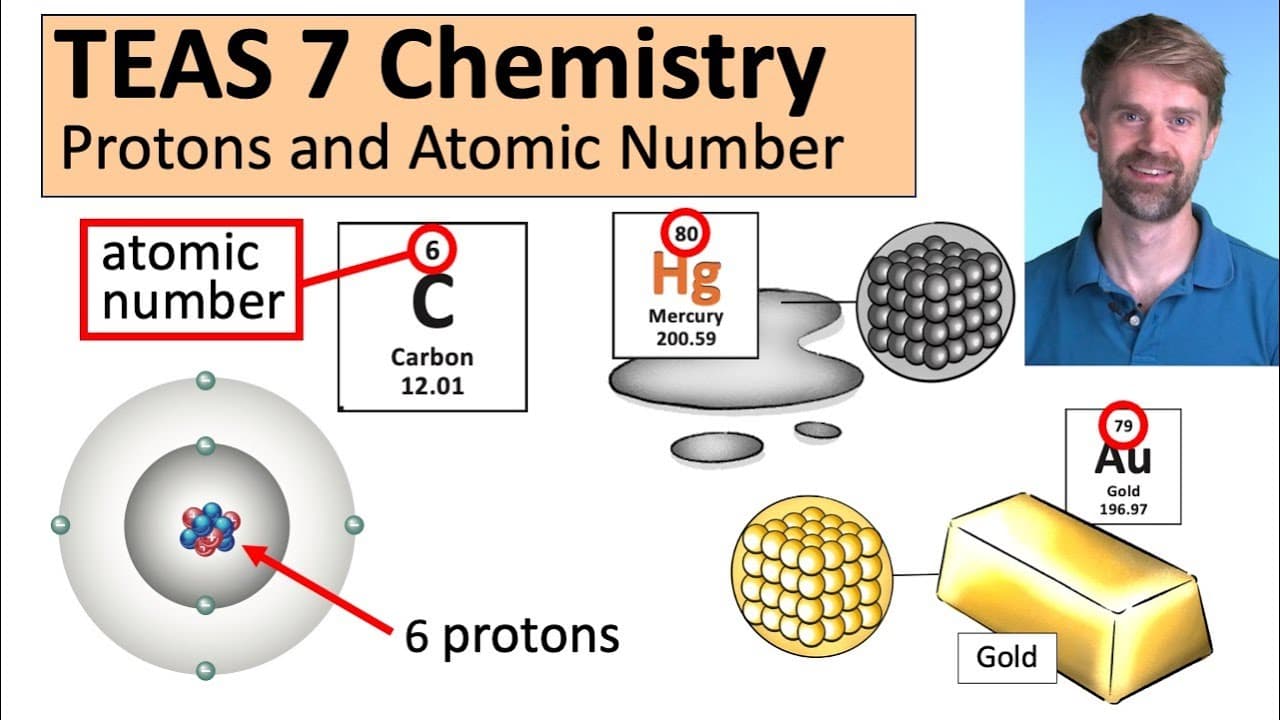
Protons are crucial because the number of protons in an atom's nucleus defines its element. For example, an atom with 29 protons is copper, while one with 6 protons is carbon. You can find this information in the periodic table, which organizes elements by atomic number, telling you how many protons each element contains.
Transcript
in this short lesson we're going to talk about protons and atomic number which are two things that are super important for understanding atoms this video is part of my short course on everything that you need to know for the chemistry section of the te's exam you can find a link to the full course in the description below this video okay so let's s... Read More
Key Insights
- 🫀 Atoms are composed of subatomic particles: protons, neutrons, and electrons.
- 🫀 The number of protons in an atom determines its element.
- 🫀 The periodic table organizes all known elements and provides important information about each element, including the atomic number.
- 😂 The TEAS exam may provide a periodic table square or section for specific questions.
- 🚰 Memorizing the entire periodic table is not necessary for the TEAS exam.
- #️⃣ The atomic number of an element is equal to the number of protons in its nucleus.
- #️⃣ The periodic table can be used to determine the atomic number and therefore the number of protons for any element.
Install to Summarize YouTube Videos and Get Transcripts
Explore YouTube Video Summarizer or Get YouTube Transcript Extractor
Questions & Answers
Q: What are the subatomic particles that make up an atom?
An atom is made up of protons and neutrons in its nucleus, while electrons are found outside in energy levels or shells.
Q: How does the number of protons in an atom determine its element?
Each element has a specific number of protons in its nucleus, and this number is known as the atomic number. For example, carbon has an atomic number of six, meaning it has six protons.
Q: How can we determine the number of protons in an element without a periodic table?
The atomic number of an element is the number of protons it has. By looking at the atomic number, we can determine the number of protons in that element.
Q: Do we need to memorize the whole periodic table for the TEAS exam?
No, the TEAS exam does not provide a periodic table for the entire test. However, for specific questions, the exam may provide a periodic table square or section if necessary.
Summary & Key Takeaways
-
Atoms are the building blocks of everything and are made up of subatomic particles called protons, neutrons, and electrons.
-
The number of protons in an atom determines its element, and this can be found on the periodic table.
-
The periodic table organizes all known elements and provides information such as atomic number, symbol, and atomic mass.
Read in Other Languages (beta)
Share This Summary 📚
Summarize YouTube Videos and Get Video Transcripts with 1-Click
Try YouTube Summary with ChatGPT & Claude or YouTube Transcript Generator
Explore More Summaries from Tyler DeWitt 📚
Summarize YouTube Videos and Get Video Transcripts with 1-Click
Try YouTube Summary with ChatGPT & Claude or YouTube Transcript Generator