Super Common Mistake: Diatomic Elements
TL;DR
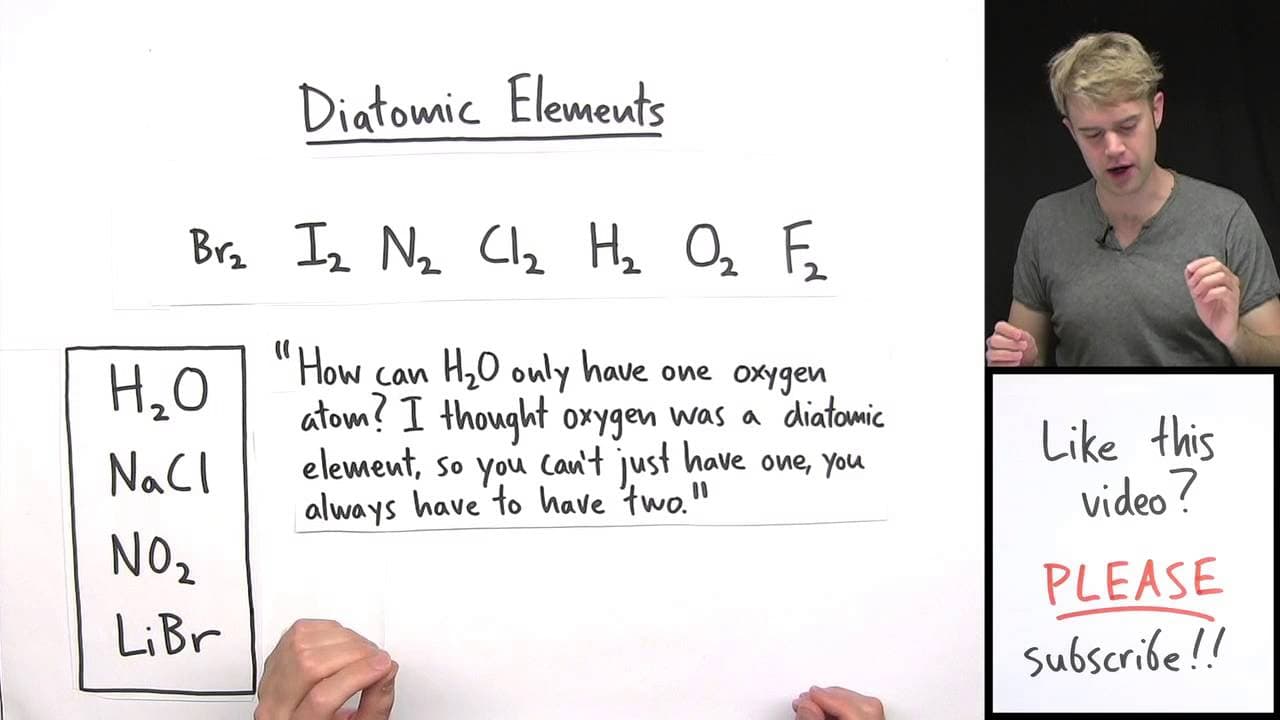
Diatomic elements always exist as pairs, but in chemical compounds, they don't need to pair up if they are connected to other elements.
Transcript
let me talk about a big question that a lot of people have with the diatomic elements these are the diatomic elements here there's seven of them and they're bromine iodine nitrogen chlorine hydrogen oxygen and Florine now the diatomic elements are special because you never find just one atom of a datomic element on its own you always find them in p... Read More
Key Insights
- 🫀 Diatomic elements, such as bromine, iodine, nitrogen, chlorine, hydrogen, oxygen, and fluorine, always exist as paired atoms.
- 🪡 Diatomic elements only need to pair up when they are not connected to any other elements.
- 🫀 In chemical compounds, diatomic elements may appear as single atoms if they are connected to other elements.
- ❓ The confusion arises when diatomic elements are encountered in chemical formulas, but they are not paired because they are connected to other elements.
- 🫢 Nitrogen gas and liquid bromine are examples of diatomic elements that exist as paired atoms because they contain only nitrogen or bromine, respectively.
- 👻 The presence of other elements in a compound allows diatomic elements to exist as single atoms in chemical formulas.
- 🫢 The diatomic elements should be paired up when they are not connected to any other elements, such as in nitrogen gas or liquid bromine.
Install to Summarize YouTube Videos and Get Transcripts
Explore YouTube Video Summarizer or Get YouTube Transcript Extractor
Questions & Answers
Q: Why do diatomic elements have to pair up?
Diatomic elements need to pair up because when they exist on their own, they form molecules with two atoms of the same element. This pairing is a characteristic of diatomic elements.
Q: Why does H2O have only one oxygen atom if oxygen is diatomic?
In the compound H2O, the oxygen atom is not on its own but is connected to two hydrogen atoms. It is not necessary for oxygen to pair up when it is connected to other elements.
Q: Shouldn't the formula for lithium bromide be LiBr2 if bromine is diatomic?
The formula for lithium bromide is correctly written as LiBr because bromine in this compound is connected to lithium. When diatomic elements are connected to other elements, they don't need to pair up.
Q: Do nitrogen and bromine have to pair up in all compounds?
Nitrogen and bromine only need to pair up when they exist on their own. If they are connected to other elements in a compound, they can exist as single atoms.
Summary & Key Takeaways
-
Diatomic elements include bromine, iodine, nitrogen, chlorine, hydrogen, oxygen, and fluorine, and they always exist as pairs.
-
In chemical compounds, such as H2O, only one oxygen atom is present because it is connected to two hydrogen atoms.
-
Diatomic elements only need to pair up if they are on their own and not connected to any other elements.
Read in Other Languages (beta)
Share This Summary 📚
Summarize YouTube Videos and Get Video Transcripts with 1-Click
Try YouTube Summary with ChatGPT & Claude or YouTube Transcript Generator
Explore More Summaries from Tyler DeWitt 📚




Summarize YouTube Videos and Get Video Transcripts with 1-Click
Try YouTube Summary with ChatGPT & Claude or YouTube Transcript Generator