Classifying Types of Chemical Reactions Practice Problems
TL;DR
Learn to classify chemical reactions using five major types and example equations.
Transcript
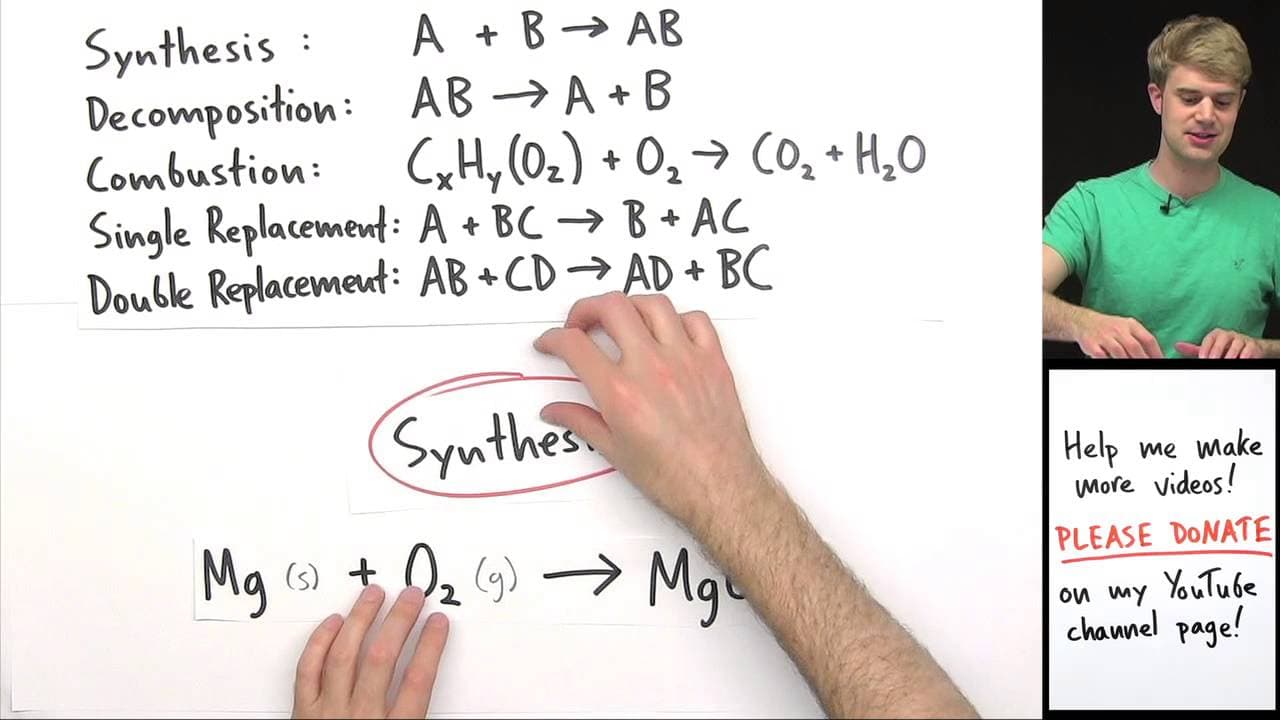
here we're going to practice classifying chemical reactions we're going to look at a whole bunch of them and we're going to figure out what type they are now if this stuff here looks unfamiliar to you and you need some background check out my introductory video on this topic and then come back and we'll do these problems so here are the five major ... Read More
Key Insights
- 🔂 There are five major types of chemical reactions: single replacement, combustion, decomposition, synthesis, and double replacement.
- ⚾ Each type of reaction has distinctive characteristics and can be identified based on the rearrangement of elements.
- ❓ Example equations are provided to practice classifying reactions.
- ❓ Understanding and memorizing the example equations is crucial for successful classification of chemical reactions.
- 💦 Combustion reactions involve the combination of carbon and hydrogen compounds with oxygen, producing carbon dioxide and water.
- 🍳 Decomposition reactions break down compounds into simpler components.
- 💁 Synthesis reactions involve the combination of simple elements or compounds to form a more complex substance.
Install to Summarize YouTube Videos and Get Transcripts
Explore YouTube Video Summarizer or Get YouTube Transcript Extractor
Questions & Answers
Q: What are the five major types of chemical reactions?
The five major types of chemical reactions are single replacement, combustion, decomposition, synthesis, and double replacement.
Q: How can we identify a single replacement reaction?
A single replacement reaction occurs when one element replaces another element in a compound. In the given example of magnesium and aluminum chloride, magnesium replaces aluminum.
Q: What happens in a combustion reaction?
A combustion reaction involves the combination of a carbon and hydrogen compound with oxygen to produce water and carbon dioxide. An example provided is the combustion of octane.
Q: How does a double replacement reaction occur?
In a double replacement reaction, two pairs of different elements switch places. For instance, silver nitrate and sodium chloride yield silver chloride and sodium nitrate.
Q: What is the key characteristic of a decomposition reaction?
A decomposition reaction involves a compound breaking down into simpler components. The example given is magnesium chloride decomposing into magnesium and chlorine gas.
Summary & Key Takeaways
-
There are five major types of chemical reactions: single replacement, combustion, decomposition, synthesis, and double replacement.
-
Each type of reaction is characterized by specific elements and their rearrangement.
-
Example equations are provided to support understanding and practice in classifying reactions.
Read in Other Languages (beta)
Share This Summary 📚
Summarize YouTube Videos and Get Video Transcripts with 1-Click
Try YouTube Summary with ChatGPT & Claude or YouTube Transcript Generator
Explore More Summaries from Tyler DeWitt 📚

Summarize YouTube Videos and Get Video Transcripts with 1-Click
Try YouTube Summary with ChatGPT & Claude or YouTube Transcript Generator