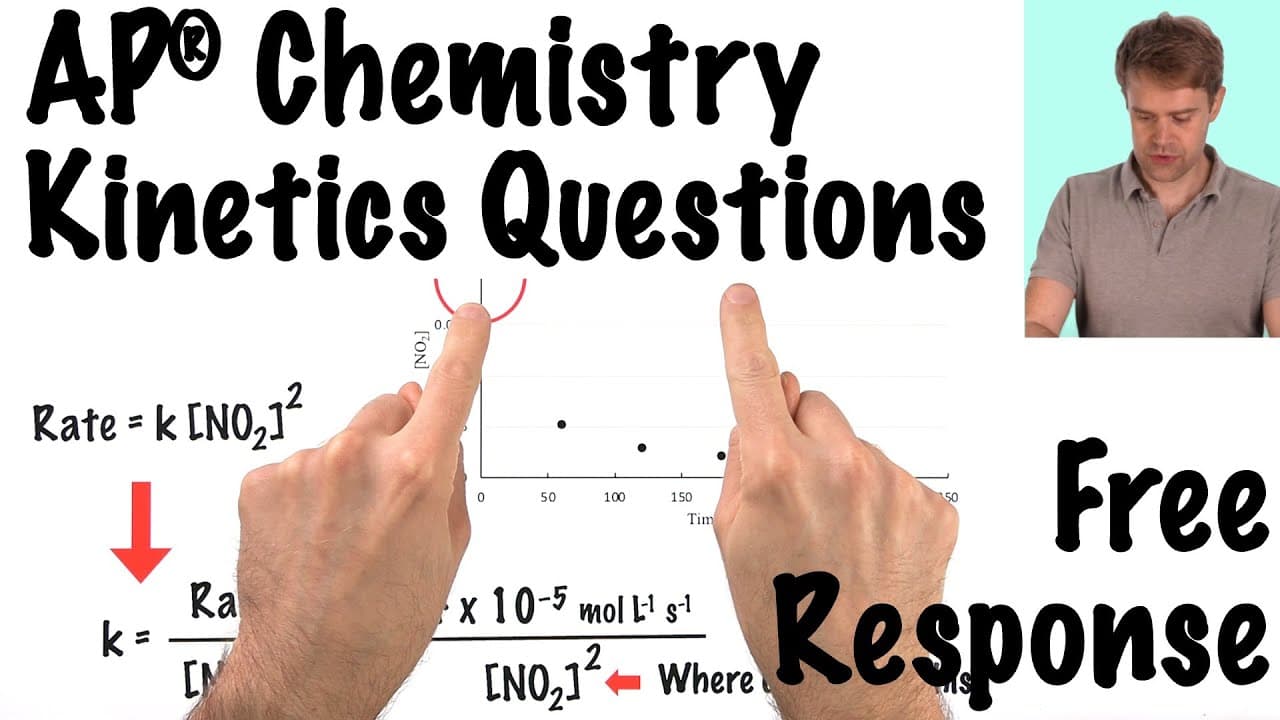
AP® Chemistry Kinetics Questions Free Response
TL;DR
This analysis breaks down various kinetics problems that commonly appear on the AP chemistry exam, including interpreting graphs, determining reaction orders, writing rate laws, analyzing reaction mechanisms, and sketching potential energy diagrams.
Transcript
Here we're going to work through a kinetics problem that's very similar to one you'd see on the free response section of the AP chemistry exam. This question is part of an AP chem mini test you can download on my website right here to help you study for the AP chem exam. Okay, let's get started. Part A shows three graphs and asks you to ... Read More
Key Insights
- 🪈 Kinetics questions on the AP chemistry exam often involve interpreting graphs to determine reaction orders.
- 🪈 Rate laws can be written based on the orders of each reactant, and the concentration terms may vary depending on the order.
- ☠️ Calculating the rate constant involves using the rate law equation and initial rate of reaction.
- ☠️ Reaction mechanisms must include all reactants in the rate law and have a rate-determining step consistent with the overall reaction order.
Install to Summarize YouTube Videos and Get Transcripts
Explore YouTube Video Summarizer or Get YouTube Transcript Extractor
Questions & Answers
Q: How can graphs be used to determine the reaction order in kinetics problems?
By analyzing the linearity of different graphs (time vs. concentration, time vs. natural log of concentration, time vs. inverse of concentration), one can identify the reaction order. A linear fit of the graph of time vs. inverse concentration indicates a second-order reaction.
Q: What does it mean for a reactant to have a zero order in a rate law equation?
A zero order reactant has no effect on the rate of the reaction. This means that the concentration of the reactant does not play a role in determining the rate constant or the overall rate of reaction.
Q: How can the rate constant be calculated using the rate law and initial rate of reaction?
The rate constant (k) can be calculated by rearranging the rate law equation and substituting the initial rate of reaction and the initial concentration of the reactant. Solving for k requires squaring the concentration term if the reaction order is 2.
Q: How can the consistency of a reaction mechanism with a rate law be determined?
The reaction mechanism should include all reactants featured in the rate law and match the reaction order of each reactant. The molecularity of the rate-determining step should also be consistent with the overall reaction order.
Summary & Key Takeaways
-
Part A of the analysis explains how to interpret three graphs to determine the reaction order, focusing on the graph of time versus the inverse of the reactant's concentration.
-
Part B instructs on how to write a rate law assuming zero order with respect to one reactant.
-
Part C provides a step-by-step guide to calculate the rate constant using the rate law and initial rate of reaction.
-
Part D discusses the consistency of a proposed two-step reaction mechanism with the rate law determined in part B.
-
Part E explains how to sketch a potential energy diagram for a spontaneous reaction.
Read in Other Languages (beta)
Share This Summary 📚
Summarize YouTube Videos and Get Video Transcripts with 1-Click
Try YouTube Summary with ChatGPT & Claude or YouTube Transcript Generator
Explore More Summaries from Tyler DeWitt 📚

Summarize YouTube Videos and Get Video Transcripts with 1-Click
Try YouTube Summary with ChatGPT & Claude or YouTube Transcript Generator