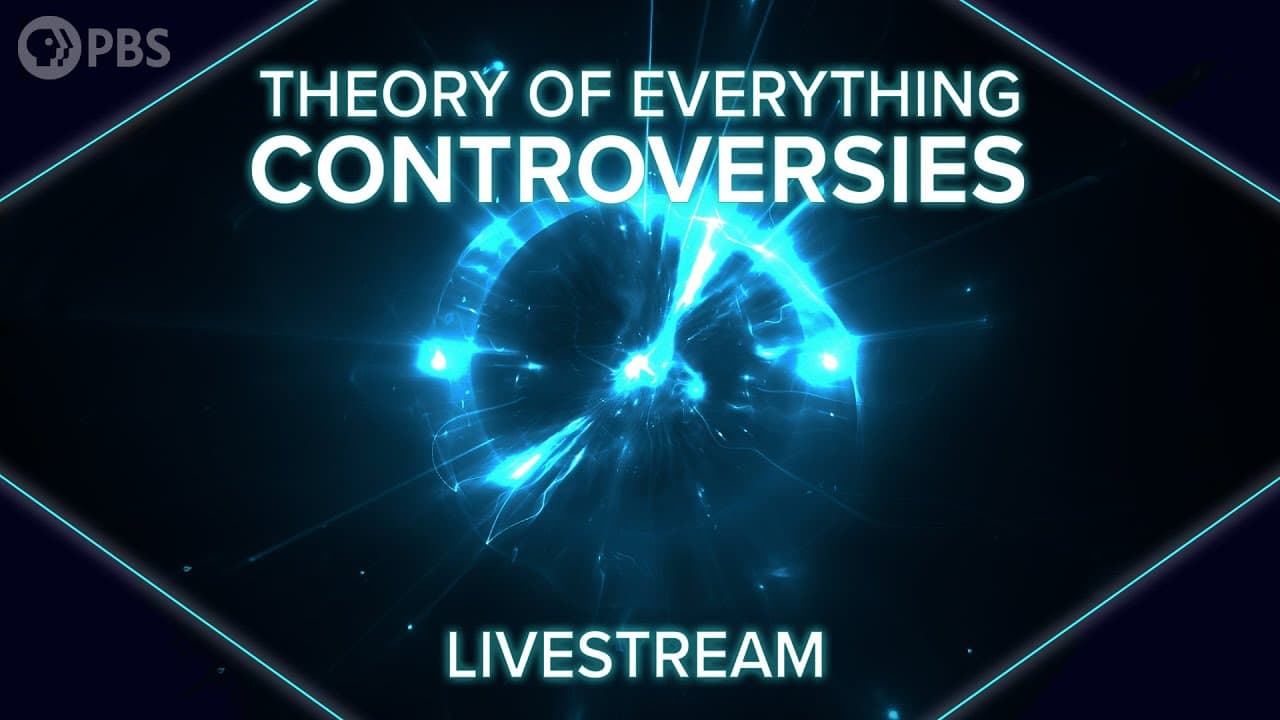
Theory of Everything Controversies: Livestream
TL;DR
Exploration of theories of everything and their scientific implications.
Transcript
hello everyone so this is the second in our very unusual two-part series here on space time our great quest to understand the universe to find the mechanics of base reality and to understand why our universe exists at all seem to be at an impasse for the past century after the great revolutions of relativity and quantum mechanics so together with p... Read More
Key Insights
- Theories of Everything (TOEs) have not yet produced experimental evidence that solves fundamental challenges in physics, leading to controversies and questioning their necessity.
- The discussion highlights the lack of progress in TOEs and the emergence of competing theories from researchers outside the traditional academic community.
- Eric Weinstein argues that the current models have failed to deliver on their promises, and there is a need for more diverse approaches.
- Sabine Hossenfelder emphasizes the importance of addressing the inconsistency between quantum theory and gravity, while questioning the pursuit of beauty in physics.
- Lee Smolin suggests that the evolution of laws and the concept of locality are central to resolving quantum gravity and foundational quantum mechanics issues.
- The conversation critiques the reliance on beauty and symmetry in theoretical physics, suggesting it may have led to stagnation in the field.
- The debate touches on the economic aspects of funding large-scale physics experiments and the need for a more pragmatic approach.
- The panelists discuss the importance of fostering new ideas and encouraging a broader range of theories and methodologies in physics research.
Install to Summarize YouTube Videos and Get Transcripts
Explore YouTube Video Summarizer or Get YouTube Transcript Extractor
Questions & Answers
Q: What are the main controversies surrounding Theories of Everything?
The main controversies involve the lack of experimental evidence produced by existing TOEs, questioning their necessity, and the cost/benefit of investing in large-scale experiments like particle accelerators. There is also debate over the emergence of competing TOEs from outside the traditional academic community.
Q: What is Sabine Hossenfelder's stance on the pursuit of beauty in physics?
Sabine Hossenfelder criticizes the emphasis on beauty in developing theories of everything, arguing that it has led to stagnation in physics. She believes that focusing on resolving the inconsistency between quantum theory and gravity is more scientifically productive.
Q: How does Lee Smolin propose to address issues in quantum gravity?
Lee Smolin suggests that understanding the evolution of laws and the concept of locality is crucial to resolving issues in quantum gravity and foundational quantum mechanics. He believes that space might be an emergent structure, and locality is dynamically determined.
Q: What role does Eric Weinstein see for alternative approaches in physics?
Eric Weinstein advocates for more diverse approaches in physics, criticizing the current models for failing to deliver on their promises. He believes that the political economy of physics has hindered research potential and encourages exploring new ideas and methodologies.
Q: What economic considerations are discussed regarding large-scale physics experiments?
The discussion highlights the economic challenges of funding large-scale physics experiments, like particle accelerators. Sabine Hossenfelder argues for a more pragmatic approach, suggesting that there are better investments with higher expected returns than a new collider.
Q: How do the panelists view the scientific method in relation to TOEs?
The panelists debate the scientific method's role in pursuing TOEs, with some questioning the reliance on falsifiability and the traditional scientific method. They discuss the need for innovative approaches and the potential limitations of adhering strictly to established scientific protocols.
Q: What is the significance of beauty and symmetry in theoretical physics?
Beauty and symmetry have traditionally guided theoretical physics, but the panelists critique this approach, suggesting it may have contributed to the field's stagnation. They argue for a more evidence-based approach and caution against using beauty as a primary criterion for developing theories.
Q: What advice do the panelists offer to young physicists?
The panelists encourage young physicists to explore new ideas, question established norms, and focus on resolving fundamental inconsistencies in physics. They emphasize the importance of fostering diversity in approaches and methodologies to advance the field.
Summary & Key Takeaways
-
The discussion explores the controversies surrounding Theories of Everything (TOEs) and their lack of experimental evidence, questioning their necessity and the cost/benefit of large-scale experiments. Eric Weinstein and Sabine Hossenfelder offer contrasting views on the role of beauty in physics and the need for diverse approaches.
-
Lee Smolin suggests focusing on the evolution of laws and the concept of locality as key to resolving quantum gravity issues. The conversation critiques the reliance on beauty and symmetry in theoretical physics, suggesting it may have led to stagnation in the field.
-
The panelists discuss the economic aspects of funding large-scale physics experiments and the need for a more pragmatic approach. They emphasize the importance of fostering new ideas and encouraging a broader range of theories and methodologies in physics research.
Read in Other Languages (beta)
Share This Summary 📚
Summarize YouTube Videos and Get Video Transcripts with 1-Click
Try YouTube Summary with ChatGPT & Claude or YouTube Transcript Generator
Explore More Summaries from PBS Space Time 📚



Summarize YouTube Videos and Get Video Transcripts with 1-Click
Try YouTube Summary with ChatGPT & Claude or YouTube Transcript Generator