Justification for polar arc length formula
TL;DR
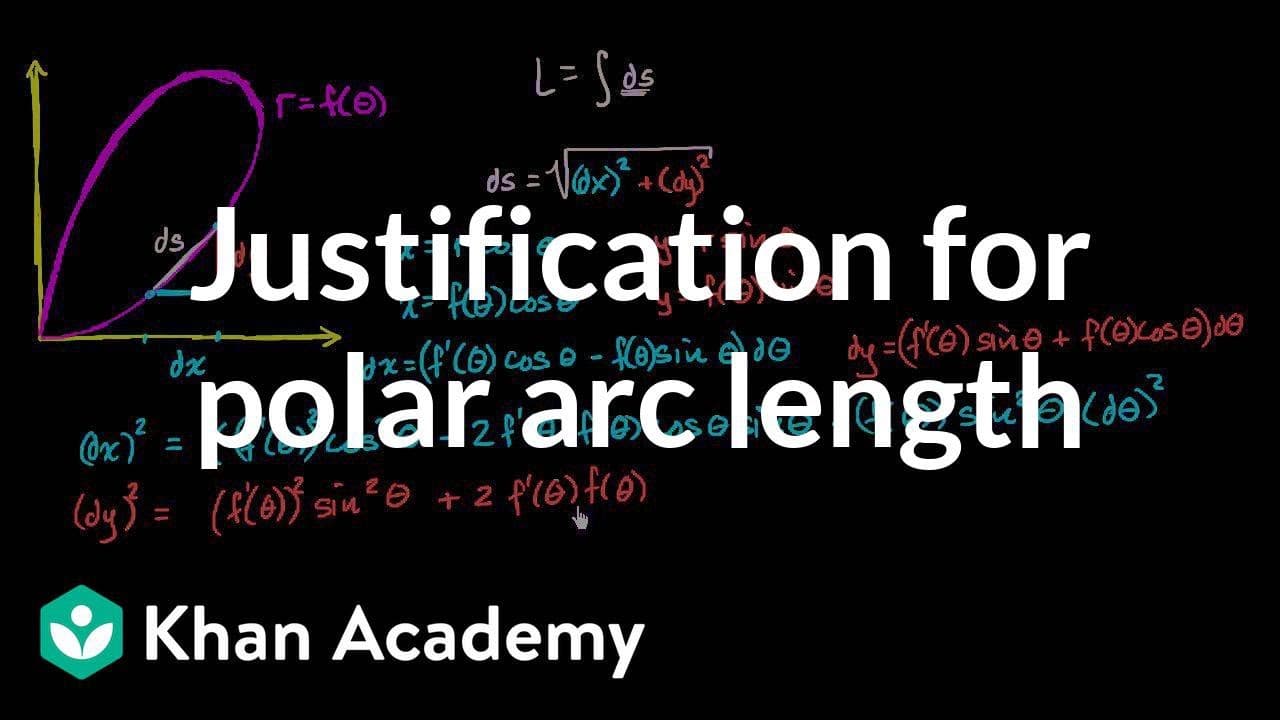
This video explains how to find the arc length of a curve defined in polar coordinates by using the formula: arc length = ∫√(r² + (dr/dθ)²)dθ.
Transcript
- [Voiceover] What I want to do with this video is come up with the formula for the arc length of a curve that's defined in polar coordinates. So, if this curve right over here is r is equal to F of theta, how do we figure out the length of this curve between two thetas, say between theta is equal to, well let's say, in this case, it looks like bet... Read More
Key Insights
- 🫠 The formula for arc length in polar coordinates is ∫√(r² + (dr/dθ)²)dθ.
- 🐻❄️ It is derived by relating polar coordinates to rectangular coordinates and applying the Pythagorean Theorem.
- ❓ The formula can be simplified using trigonometric identities to F'(θ)² + F(θ)².
- 🫡 To find the actual length of a curve, the formula is integrated with respect to θ from the starting to the ending value.
Install to Summarize YouTube Videos and Get Transcripts
Explore YouTube Video Summarizer or Get YouTube Transcript Extractor
Questions & Answers
Q: How is arc length defined in polar coordinates?
Arc length in polar coordinates refers to the length of a curve defined by a polar function between two given values of θ. It is denoted by ∫√(r² + (dr/dθ)²)dθ, where r represents the polar function and dr/dθ is its derivative.
Q: How is the formula for arc length derived from rectangular coordinates?
The formula for arc length in polar coordinates is derived by relating it to rectangular coordinates. By converting polar coordinates (r,θ) to rectangular coordinates (x,y), the formula becomes: arc length = ∫√(dx² + dy²)dθ. This is obtained by considering small changes in x (dx) and y (dy) and applying the Pythagorean Theorem.
Q: How can the formula for arc length be simplified using trigonometric identities?
The formula for arc length in polar coordinates, √(dx² + dy²), can be simplified using trigonometric identities. By expressing x and y in terms of r and θ (x = rcosθ, y = rsinθ), the formula becomes √((dr/dθ)² + r²). This can be further simplified to F'(θ)² + F(θ)², where F(θ) represents the function r in terms of θ.
Q: How can the formula for arc length be used to find the actual length of a curve?
To find the length of a curve defined by a polar function between two given values of θ, the formula for arc length (∫√(r² + (dr/dθ)²)dθ) is integrated with respect to θ. The process involves evaluating the integral from the starting value of θ (α) to the ending value of θ (β).
Summary & Key Takeaways
-
The video introduces the concept of finding the arc length of a curve defined in polar coordinates.
-
The formula for arc length in polar coordinates is derived by relating it to rectangular coordinates using the Pythagorean Theorem.
-
By converting polar coordinates to rectangular coordinates, the formula becomes: arc length = ∫√(dx² + dy²)dθ.
-
The formula is then simplified using the trigonometric identities and can be integrated to find the arc length.
Read in Other Languages (beta)
Share This Summary 📚
Summarize YouTube Videos and Get Video Transcripts with 1-Click
Try YouTube Summary with ChatGPT & Claude or YouTube Transcript Generator
Explore More Summaries from Khan Academy 📚




Summarize YouTube Videos and Get Video Transcripts with 1-Click
Try YouTube Summary with ChatGPT & Claude or YouTube Transcript Generator