Random number list to run experiment | Probability | AP Statistics | Khan Academy
TL;DR
On average, it takes approximately 11.67 boxes to collect all six prizes in a cereal box lottery.
Transcript
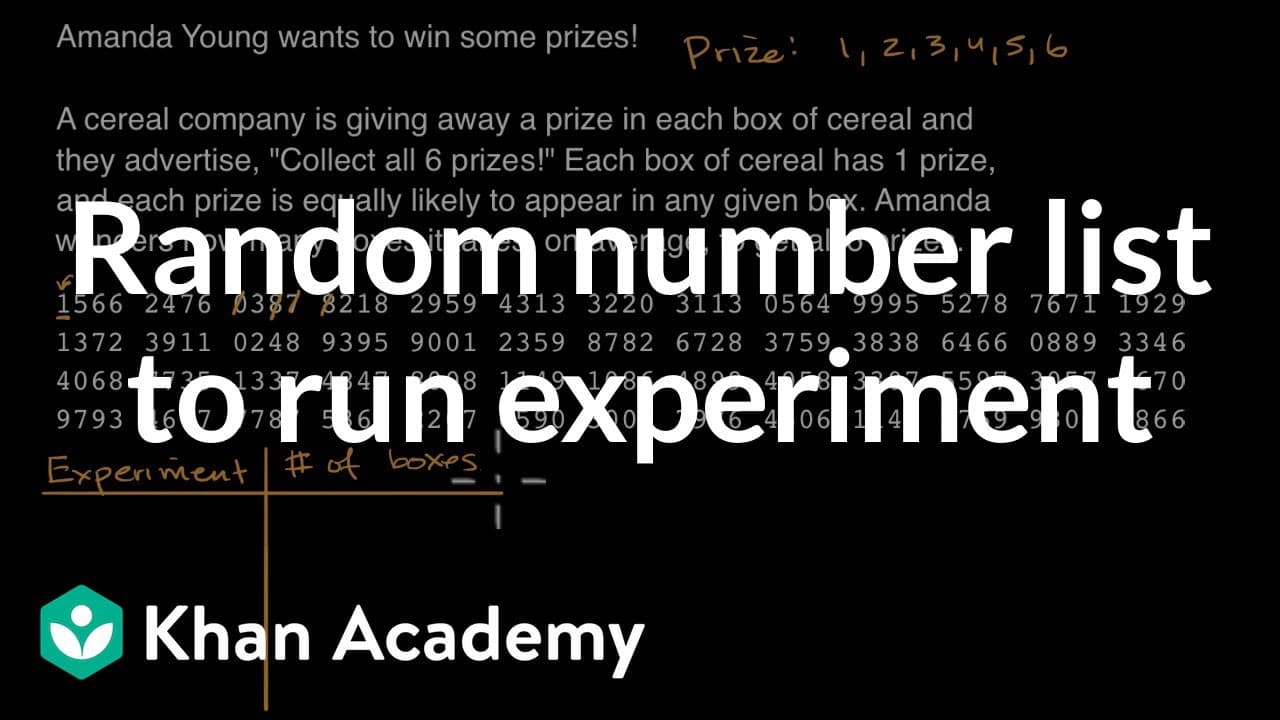
- [Instructor] So we're told that Amanda Young wants to win some prizes. A cereal company is giving away a prize in each box of cereal, and they advertise, "Collect all six prizes." Each box of cereal has one prize, and each prize is a equally likely to appear in any given box. Amanda wonders how many boxes it takes on average to get all six prizes... Read More
Key Insights
- 🍱 Amanda wants to determine the average number of boxes needed to get all six prizes in a cereal box lottery.
- 🏃 She can approach this question mathematically or by running simulations with random numbers.
- 🏃 By running three experiments, Amanda found that the average number of boxes needed is approximately 11.67.
- ❓ Conducting more experiments would yield a more accurate estimation of the true theoretical average.
- 🙈 Amanda ignores numbers outside the range of 1-6 when simulating box collections.
- #️⃣ Each experiment requires starting from the first valid number and counting the number of boxes needed to collect all prizes.
Install to Summarize YouTube Videos and Get Transcripts
Explore YouTube Video Summarizer or Get YouTube Transcript Extractor
Questions & Answers
Q: How can Amanda calculate the expected number of boxes she would need to collect on average to win all six prizes?
Amanda can either determine the mathematical expected value or run simulations with random numbers to find the average number of boxes needed.
Q: How does Amanda simulate collecting boxes to estimate the average number of boxes needed?
Amanda assigns a number to each prize and generates a random string of numbers. She starts from the left and treats each number as a prize. She ignores numbers outside the range of 1-6.
Q: How many boxes did Amanda need in the first experiment to collect all six prizes?
Amanda needed 8 boxes in the first experiment to collect all six prizes.
Q: Why does Amanda need to conduct multiple experiments to estimate the average?
Conducting multiple experiments allows for a more accurate estimation of the average number of boxes needed. The more experiments conducted, the closer the average will be to the true theoretical average.
Summary & Key Takeaways
-
Amanda wants to know the average number of boxes she needs to collect to win all six prizes in a cereal box lottery.
-
She can approach this question mathematically or by simulating multiple trials with random numbers.
-
By running three experiments, she found that the average number of boxes needed to collect all prizes is approximately 11.67.
Read in Other Languages (beta)
Share This Summary 📚
Summarize YouTube Videos and Get Video Transcripts with 1-Click
Try YouTube Summary with ChatGPT & Claude or YouTube Transcript Generator
Explore More Summaries from Khan Academy 📚



Summarize YouTube Videos and Get Video Transcripts with 1-Click
Try YouTube Summary with ChatGPT & Claude or YouTube Transcript Generator