Are Many Worlds & Pilot Wave THE SAME Theory?
TL;DR
Explores if Many Worlds and Pilot Wave are the same theory.
Transcript
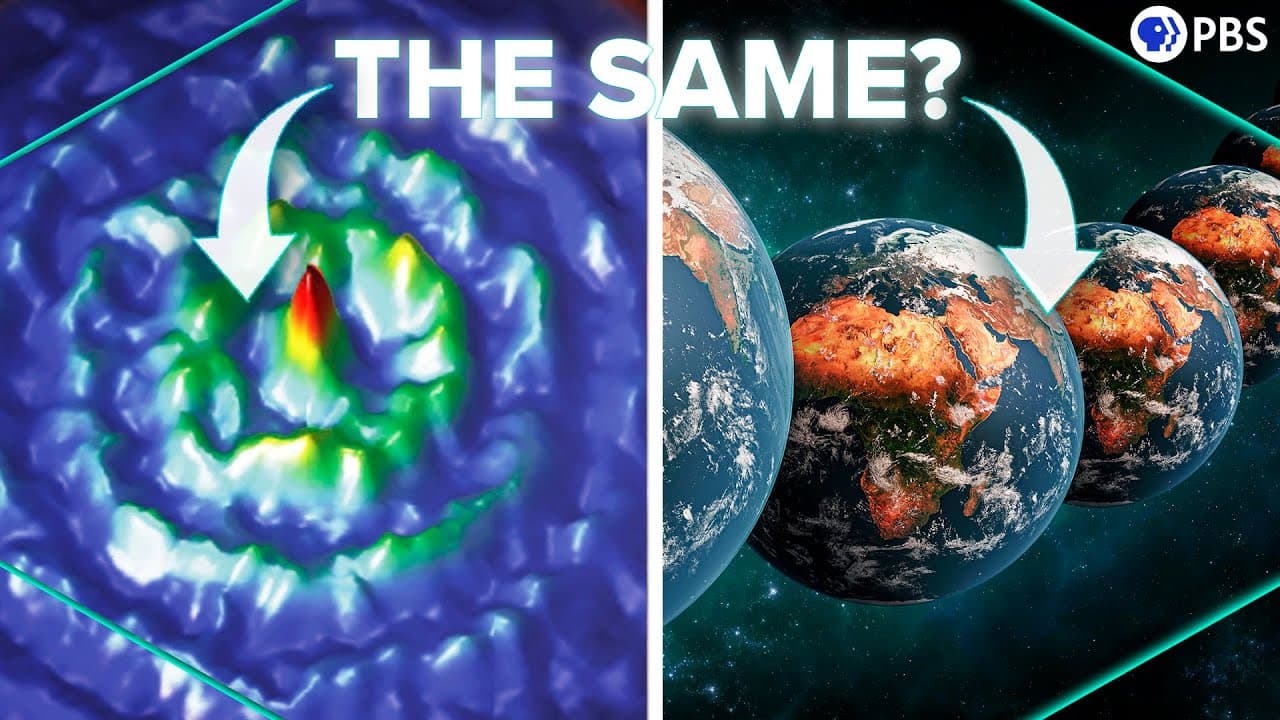
It’s hard to interpret the strange results of quantum mechanics, though many have tried. Interpretations range from the outlandish—like the multiple universes of Many Worlds, to the almost mundane, like the very mechanical Pilot Wave Theory. But perhaps we’re converging on the answer, because some are arguing that these two interpretations are rea... Read More
Key Insights
- Quantum mechanics presents a challenge to deterministic classical physics, introducing randomness through wavefunctions and measurements.
- The Copenhagen interpretation suggests wavefunction collapse is random, while Pilot Wave Theory and Many Worlds offer deterministic alternatives.
- Pilot Wave Theory posits corpuscles guided by wavefunctions, introducing hidden variables to explain apparent randomness.
- Many Worlds Interpretation suggests all possible outcomes exist in parallel realities, removing the need for wavefunction collapse.
- Pilot Wave Theory and Many Worlds share similarities, with corpuscles in Pilot Wave acting as markers for 'real' outcomes.
- Both interpretations struggle with explaining the Born rule, which predicts probabilities of quantum outcomes.
- Pilot Wave Theory faces challenges with non-locality and compatibility with relativity, unlike Many Worlds.
- Occam's razor suggests Many Worlds might be simpler, as it doesn't require additional parameters like corpuscles.
Install to Summarize YouTube Videos and Get Transcripts
Explore YouTube Video Summarizer or Get YouTube Transcript Extractor
Questions & Answers
Q: What is the main challenge quantum mechanics presents to classical physics?
Quantum mechanics challenges classical physics by introducing randomness and non-determinism. Classical physics is deterministic, meaning that the future state of a system can be precisely predicted from its current state. However, quantum mechanics, with its wavefunctions and probabilistic nature, suggests that certain outcomes cannot be precisely predicted, as demonstrated by the double slit experiment.
Q: How does the Copenhagen interpretation explain quantum randomness?
The Copenhagen interpretation explains quantum randomness through the concept of wavefunction collapse. According to this interpretation, the wavefunction evolves deterministically under the Schrodinger equation, but when a measurement is made, the wavefunction collapses to a single outcome in a random manner. This randomness is seen as an inherent feature of quantum mechanics, making it fundamentally non-deterministic.
Q: What distinguishes Pilot Wave Theory from the Many Worlds Interpretation?
Pilot Wave Theory and the Many Worlds Interpretation differ mainly in the existence of corpuscles. In Pilot Wave Theory, corpuscles are particles guided by wavefunctions, marking the 'real' outcomes among many possibilities. Many Worlds, however, eliminates corpuscles, suggesting that all possible outcomes exist as parallel realities, with no single outcome being more real than the others. This distinction leads to different implications for determinism and the nature of reality.
Q: How do Pilot Wave Theory and Many Worlds Interpretation approach the Born rule?
Both Pilot Wave Theory and Many Worlds Interpretation struggle with explaining the Born rule, which predicts the probabilities of quantum outcomes. In Pilot Wave Theory, the distribution of corpuscles must initially follow the Born rule, but the theory doesn't explain how this distribution arises. Many Worlds uses the density of timelines to derive probabilities, suggesting that the number of alternate realities corresponding to a measurement determines its likelihood, aligning with the Born rule.
Q: What challenges does Pilot Wave Theory face regarding non-locality and relativity?
Pilot Wave Theory faces significant challenges with non-locality and relativity. The guiding equation in Pilot Wave Theory requires instantaneous interactions between corpuscles across large distances, violating the principle of locality. This non-locality makes it difficult to reconcile Pilot Wave Theory with the principles of special relativity, which prohibits faster-than-light interactions. Many Worlds, lacking corpuscles, does not face these issues and can be more easily aligned with relativity.
Q: Why might Occam's razor favor the Many Worlds Interpretation?
Occam's razor, which favors simpler explanations without unnecessary assumptions, might favor the Many Worlds Interpretation because it doesn't require additional parameters like corpuscles. Many Worlds posits that the wavefunction itself is the fundamental reality, eliminating the need for hidden variables or wavefunction collapse. This simplicity contrasts with Pilot Wave Theory, which introduces corpuscles and a guiding equation to explain quantum phenomena.
Q: In what way are Pilot Wave Theory and Many Worlds Interpretation similar?
Pilot Wave Theory and Many Worlds Interpretation are similar in that they both reject wavefunction collapse and maintain determinism in quantum mechanics. Both interpretations suggest that the wavefunction evolves according to the Schrodinger equation without collapsing. In Pilot Wave Theory, corpuscles mark the real outcomes, while Many Worlds considers all outcomes equally real, with the wavefunction representing the entirety of reality.
Q: How does the double slit experiment illustrate the differences between quantum interpretations?
The double slit experiment illustrates the differences between quantum interpretations by showing how they explain the behavior of particles and wavefunctions. In Copenhagen, the wavefunction collapses randomly upon measurement. Pilot Wave Theory suggests corpuscles are guided by wavefunctions, determining outcomes through hidden variables. Many Worlds posits all outcomes occur in parallel, with each possible path taken by the wavefunction representing a different reality, avoiding collapse entirely.
Summary & Key Takeaways
-
Quantum mechanics challenges classical determinism, introducing wavefunctions and randomness through measurements, as seen in the double slit experiment. Interpretations like Copenhagen, Pilot Wave, and Many Worlds offer diverse explanations, with Copenhagen suggesting randomness and wavefunction collapse, while Pilot Wave and Many Worlds provide deterministic alternatives.
-
Pilot Wave Theory involves corpuscles guided by wavefunctions, explaining randomness through hidden variables. Many Worlds posits parallel realities for all outcomes, eliminating the need for wavefunction collapse. Both interpretations share similarities, with corpuscles marking 'real' outcomes in Pilot Wave, while Many Worlds considers all outcomes equally real.
-
The Born rule, predicting quantum probabilities, remains a challenge for all interpretations. Pilot Wave Theory struggles with non-locality and relativity, unlike Many Worlds. Occam's razor may favor Many Worlds for its simplicity, avoiding additional parameters like corpuscles, while still explaining quantum phenomena.
Read in Other Languages (beta)
Share This Summary 📚
Summarize YouTube Videos and Get Video Transcripts with 1-Click
Try YouTube Summary with ChatGPT & Claude or YouTube Transcript Generator
Explore More Summaries from PBS Space Time 📚
Summarize YouTube Videos and Get Video Transcripts with 1-Click
Try YouTube Summary with ChatGPT & Claude or YouTube Transcript Generator